
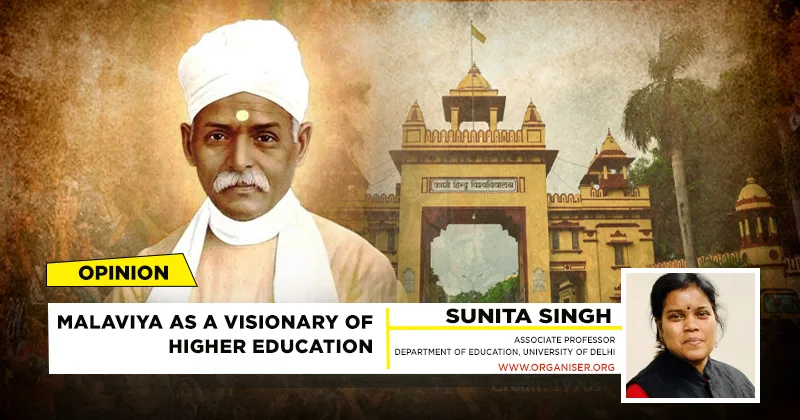
Malaviya Ji was a well-known leader who held a high position in Indian politics and public life. He is widely perceived as a man of profound religious convictions due to his adherence to Sanatan Dharma; however, he was, in fact, a progressive idealist who not only envisioned the revitalisation of the Ancient Vedic heritage but also integrated modern science and technology into higher education to foster progress and economic strength in India. He emerges as a visionary of higher education due to his scientific mindset and socio-economic and political thoughts.
Although he was neither a scientist who formulated laws or theories nor an economic expert he adeptly and logically identified the detrimental impact of British colonial dominance on India’s scientific and technical education and economic policies and presented his critical views in his speech on Note of Dissent in 1918 he specified that India had become an agrarian nation from an industrial and agricultural country due to the rule of the British Government.
At the time of Famine commission in 1878 Malaviya said, “At the root of the poverty of Indian people and the risk to which they exposed in seasons of the scarcity lies the unfortunate circumstance that agriculture forms almost the sole occupation of the mass of the people ,and that no remedy for the present evils can be complete which does not include introduction of a diversity of the occupations is only the mean through which the surplus population may be drawn from agriculture pursuit and led to earn the means of subsistence in manufactures and employments.” He cited numerous sources to demonstrate that India had trade relations with Babylon in 3000 BC, and that Indian Mulmul had a specialised market in Egypt and Greece more than two thousand years ago, whereas the cotton textile industry began in Britain only in the 17th century. India was even superior in technique and quality in Iron and Steel manufacturing and forging, and the world-famous Damascus swords were made by Indian steel.
As a member of the Indian Industrial Commission, he endorsed the words of Sir Fredrick Nicholson: “I beg to record my strong opinion that in the matter of Indian Industries, we are bound to consider Indian interest firstly, secondly and thirdly I mean be ‘firstly’ that the local raw products should be utilized by ‘secondly’, that industries should be introduced and by ‘thirdly’ that profit of such industries should remain in the country”.Although he was not a financial expert like Naoroji, Wacha, Gokhale etc. but he could determine the huge loss continued by India owing to British economic policy. He realized that “finance is not mere arithmetic; finance is a great policy.
Without sound finance, no sound government is possible; without sound government, no sound finance is possible (Parmanand, 1967, Note of Dissent in 1918) Malaviya had advocated for the involvement of Indian youth in the Indian public services because he believed that if Indians received greater education, they would be able to compete in the Indian civil services and own their positions and authority. Subsequently, they would assist in rectifying unsuitable British regulations. On the birth anniversary of Pt. It is essential to recognise how Malaviya’s vision inspired Indians to cultivate a scientific spirit and to examine Mahamana Malaviya’s vision on higher education and national patriotism, particularly in the context of the celebration of Azadi Ka Amrit Mahotsav in the country. Malviya ji’s vision is embodied in the National Education Policy (2020) through the integration of multidisciplinary approaches in higher education, alongside the establishment of MERU universities.
These initiatives are prominently manifested within the BHU campus, in alignment with Para 11.1 of NEP (2020), which discussed “India has a long tradition of holistic and multidisciplinary learning in the ‘liberal arts’, from universities, such as Takshashila and Nalanda to the extensive literature of India combining subjects across fields. In consonant rhyme to the NEP paragraph, if the speech of Mahamna of the 12th convocation of Banaras Hindu University is analysed, then a very similar essence was observed, where he expressed, “It was in October 1917 that the University started its work. In the twelve years that have elapsed, much progress has been recorded. The ideal of the University was an institution which should revive the best traditions of the ancient gurukuls of India – like those of Takshashila and Nalanda, where Hindu sages taught and fed ten thousand students at a time-and which should combine with them the best traditions of the modern Universities of the West, where the highest instruction is imparted in Arts, Science and Technology.”
In locating epistemic inquiry, it is important, as an educator, to explore what the basic expectations of Malaviya ji are for higher education. How did the idea of the first residential university, where religion, science, technology, industrial, commercial, and agricultural all kinds of knowledge manifested, including the visualisation of future contemporary needs? Locating objectives of BHU it is visualized that from Higher Education he had expected is to make accountable HEIs in any situations from global to local perspective as he urged, “And the creator and Benefactor of the World, the universal soul moving in all, brought together his children of the East and the West, and induced their minds to that unanimity which meaneth good and right understanding and directed them to raise this Home of Universal Learning in the Capital Town of the Lord of Universe” (Printed in Copper Plate, 1916, BHU,1).
In 1907, in his financial statement, at Allahabad legislative Council, he said, “Such a system should provide necessary instructions for all the different classes of persons who may desire to be engaged in productive industry, namely, as mechanical engineers, workmen, foremen, overseers, managers or masters. I would confine my remarks now to manufacturers and handicrafts and I submit that there should be at least one institution in these provinces for giving instruction in the former, and one school in every district for giving instruction in the latter.”
Despite following only a metaphysical view, he believed in a flexible and realistic education, which arose due to his socio-political experiences. While conferring the degree to Raman on 11 February 1932, Malaviya exhorted, “By your achievement in the field of science, you have already won the worldwide distinction and have raised the glory of the motherland. I pray to God that you may continue to do your work for a long number of years, and with higher and higher distinction in the world of science for the benefit of mankind and for the glory of the motherland”. While providing Honorary D.Sc. degree to J. C. Bose and P. C. Ray proclaimed, “I am establishing a University, which will combine ancient wisdom with the knowledge of the physical sciences and technology”.
Narlikar (1976) wrote that, while searching for talent in India, he had heard that I was pursuing research as an Isaac Newton student at the University of Cambridge under Sir Arthur Eddington. While on a visit to the UK for a round table conference, he visited him in Cambridge in 1931 and invited him to join Banaras Hindu University. Narlikar (1976) also described how he was welcomed and respected by Malaviya first time in 1932 in Banaras Hindu University Campus in the New physics lecture theatre and at 7.30 in evening when he walked in the campus in moonlight, the hostels, the college building and beyond it love of Malaviya and holy Ganga was sufficient to set his mind to reside in India although he had the return ticket of passage to Landon. The Banaras Hindu University kulgeet was composed by S. S. Bhatnagar (in the summer in 1924 at Gangotri, first time sung at the science congress session in Banaras Hindu University in 1925), one of the most renowned scientists, who was a professor in Chemistry for three years during 1921–1924.
Malaviya ji is an eclectic, moderate and progressive man who has followed Satyameva Jayate (Mundaka Upanishad) and the essence of Vasudhaiva Kutumbakam. He said in his speech that a teaching university would only partially fulfil its function if it were unable to develop the heart power of its learners with the same solicitude as it develops cognitive power. It is no wonder that the Banaras Hindu University graduates played a pivotal role in shaping modern India and will reach the goal of Viksit Bharat 2047.