India is a founder member of UNESCO, one of UN’s most important Specialized Agencies. The Preamble of its Constitution adopted in London on September 16, 1945, after the devastation of World War II simply states:
“Since wars begin in the minds of men, it is in the minds of men that the defences of peace must be constructed.”
It continues: “That the wide diffusion of culture and the education of humanity for justice and liberty and peace are indispensable to the dignity of man and constitute a sacred duty which all the Nations must fulfil in a spirit of mutual assistance and concern.”
UNESCO is the only UN Specialised Agency committed to diffusion of soft power through education, culture, science and information. Its aims and objectives coincide with the guiding principles enshrined in our own Constitution. As a founder Member, having ratified the Constitution on November 4, 1946, when still under colonial rule, India has played a leadership role in supporting the implementation of the priorities of UNESCO.
As a pluralistic, democratic, multi-ethnic and multi-cultural State, the world’s largest democracy, we have been and will continue to be a bridge between differing ideologies, cultures and civilizations. We believe in soft power as a fundamental tool of our diplomacy and intrinsic to our national interests.
Among India’s most significant global contribution has been the exercise of its soft power drawing on its ancient culture and civilisation. Vasudhaiva Kutumbakam was among the first precursors of Global Citizenship as it is understood today. It is the basis of UNESCO’s dialogue between cultures and civilisations.
Today, India’s soft power as represented through her vibrant cultural and civilisational heritage and through her Diaspora spread worldwide, serves as a powerful reminder that those values of tolerance, inclusiveness and cross fertilisation of cultures which are an intrinsic part of our civilisation, are more relevant than ever before in the uncertain international scenario of today.
At the UNESCO General Conference in Mexico in 1982, culture was defined as comprising “the whole complex of distinctive spiritual, material, intellectual and emotional features that characterises a society or a social group. It includes not only the arts and letters but also the modes of life, the fundamental rights of human beings, value systems, traditions and beliefs.”
Intangible Cultural Heritage includes traditions or living expressions inherited from our ancestors and passed on to our descendents, such as oral traditions, performing arts, religious and cultural festivals and traditional crafts. UNESCO, through the World Heritage Committee on one hand and the Committee for Safeguarding Intangible Cultural Heritage on the other, is India’s partner in promoting an international, inter-cultural dialogue and promoting in the long run international peace and security.
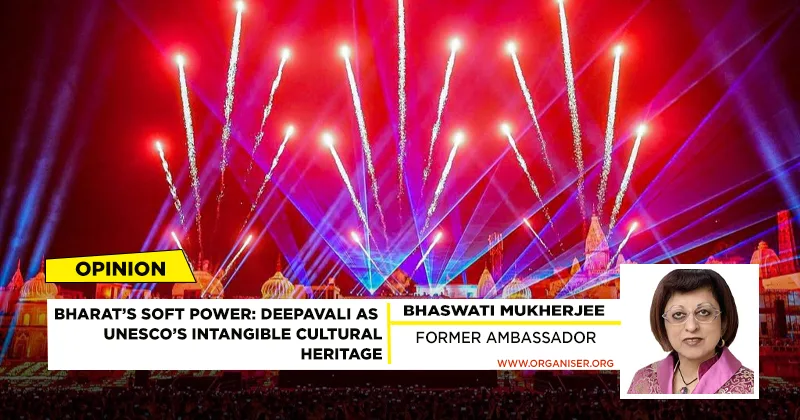
Bharat’s soft power and her contribution to global heritage are recognized globally. The inclusion of Deepavali on UNESCO’s Representative List of Intangible Cultural List of Humanity on 10th December 25, at the 20th session of the UNESCO Intergovernmental Committee for the Safeguarding of the Intangible Cultural Heritage, being hosted by India at Red Fort in New Delhi, was greeted with joy within India and by her Diaspora.
Deepavali was the 16th element from India to be included in the List, which includes, among others, Kumbha Mela, Durga Puja, Garba dance, Yoga and Ramlila. The inscription was celebrated by an impressive cultural panorama at the Red Fort that evening while a grand Diwali like celebration was organized at ‘Dilli Haat’.
Describing the new inscription, UNESCO’s website stated: “Deepavali, also known as Diwali, is a joyous occasion that symbolizes the victory of light over darkness and good over evil”.
The inscription acknowledged that Deepavali is “a living heritage that strengthens social bonds, and reinforces values of generosity and well-being”.
Writing on X, PM Modi noted: “Deepavali is the soul of our civilization. It personifies illumination and righteousness”.
India was a founder member of the Committee which flows from the 2003 Convention, which India played a key role in the negotiations and was one of the first to ratify, enabling it to enter into force. India had sent the Deepavali nomination dossier for examination by UNESCO in 2023for the 2024-2025 cycle. For the next year’s cycle, India has sent the nomination dossier of Bihar’s Chhath Puja.
To be included in the list the ICH should be ‘inclusive, representative and community based’. The nodal agency for ICH in the Ministry of Culture is the Sangeet Natak Academy. The nomination dossier was meticulously and rigorously prepared, with engagement from diverse communities, groups and individuals evaluated by an expert regional committee considering the pan India and global outreach of the festival.
India under PM Modi has travelled a long way in ensuring that the nomination dossiers are professionally prepared to the last detail and that the delegation presenting it to the Committee can respond to the many searching questions posed by members of the Committee. As the then Ambassador/PR to UNESCO, I recall the difficulties faced by our delegation on the Majuli Island nomination in 2009. It still remains on the tentative list. In contrast, since 2014, there is a transformation in our approach, leading to so many successful nominations.
To conclude, Diwali, also known as Deepavali, is symbolic of India’s syncretic culture. Syncretism is the core of India’s cultural and civilizational values. Today, Diwali is celebrated globally as a cultural and social festival, be it within the White House or in 10 Downing Street. It symbolizes in the triumphant return of Lord Ram, with his wife Sita and brother Lakshmana to Ayodhya after 14 years of exile, of the victory of the positive forces of good over evil.
There can be no better definition of India’s syncretic culture than as explained by Vivekananda who associated Hinduism with spiritualism and the very soil of India with religious diversity. Vivekananda’s approach to Hinduism was an inclusive one. Referring to India as ‘Punyabhumi’ (the land of the blessed), Vivekananda recognized that India’s multi-ethnic, multi-racist and multicultural links were its strength.
The distinguishing mark of India’s cultural and civilizational heritage which goes back millennia is that it consists of an extraordinary array of living heritage. Culture and religion get intertwined in a complex and beautiful mosaic of music, dance, theatre, storytelling, festivals and rituals.
On a personal note, I am convinced that in an emerging global disorder, where the forces of fundamentalism, racism and extremism are raising their ugly heads, India’s culture carries a multidimensional message of love, tolerance and understanding. This composite culture demonstrates that unlike other great cultures which exist no more, India’s culture reflects the evolution of her own history. India through history seamlessly absorbed other cultures including of her invaders but never lost her own. India’s culture and civilisation is her gift to the world. It is a composite culture spread worldwide. Deepavali is one of the best examples of our global cultural legacy.
Inscribed on the gate of ‘Shantiniketan’ is a quotation from Gurudev Rabindranath Tagore:
“India represents the wealth of mind which is for all.
We acknowledge India’s obligation to offer to others the hospitality of her best culture,
And India’s right to accept from others their best.”