Describing the phrase “Hindu Rate of Growth” as a fallout of a colonial mindset, honourable Prime Minister Narendra Modi argued that it was wrong to link Bharat’s slow economic growth of the past to the faith or identity of its people.
Speaking at the 23rd Hindustan Times Leadership Summit on December 6, 2025, PM Modi said the phrase victimised an “entire civilisation,” labelling it unproductive and poor — deliberately defaming the term ‘Hindu’ when the actual cause of low growth rate was flawed economic policies. He emphasised the need to discard this notion which symbolised the ‘slave mentality’ with a stereotyped mindset and colonial hangover. He pointed out that at the time the term was coined, Bharat’s growth rate was around 2 to 3 per cent. He asked — in view of Bharat’s current economic trajectory — whether anyone now calls Bharat’s growth as “Hindu Rate of Growth.” By implying a sharp contrast, he underscored that the phrase has become obsolete. Thus, it is imperative to check the ideological roots of such a narrative and testify its validity.
Genesis of Hindu Rate of Growth
The phrase “Hindu Rate of Growth” was coined in 1978 by Indian economist Professor Raj Krishna, who taught at the Delhi School of Economics. The term emerged during a period when Bharat’s GDP growth had averaged about 3–3.5 per cent for nearly two decades after Independence from 1950s to 1970s. Prof. Raj Krishna, who was a free-market-leaning economist, introduced the phrase during debates on Bharat’s chronic low growth. He used the term informally to highlight Bharat’s persistent stagnation under central planning and heavy state control.
Originally, the term had no cultural or religious connotation Prof. Krishna used the term “Hindu Rate of Growth” somewhat metaphorically to imply a rate of growth that Bharat seemed stuck with, almost as if it were “destined” or unchanging and a critique of the Indian state’s socialist economic model, not of Hindu society. He argued that unless Bharat adopted freer markets, growth would remain permanently slow.
Misinterpretation by Marxist Scholars
By the 1980s Marxist & Left-leaning academia transformed the term and many of such Left-leaning and Marxist scholars began using the phrase ideologically. They interpreted it as evidence that Hindu civilisation was inherently non-dynamic or anti-growth. The term became a tool to mock Bharat’s economic capacity, rather than critique policy failure. This cultural twist had little empirical basis, but it became a routine word in academic and journalistic circles at that time. Hence, the term originated in economic critique and slowly became a
cultural judgement.
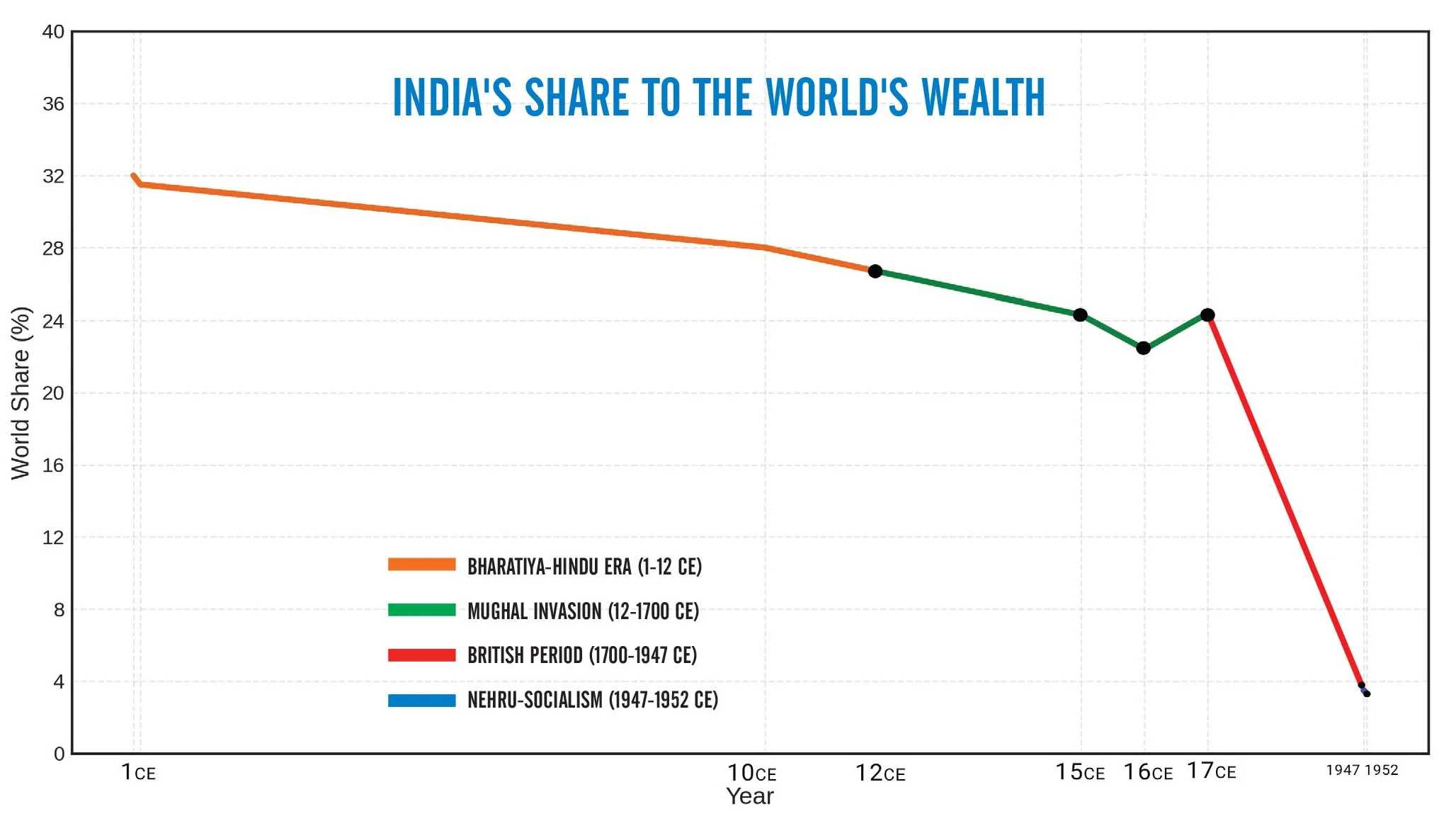
The structural context behind this term was characterised by License-Permit-Quota Raj, High state intervention, Closed economy model, Weak private investment and Low productivity. These flawed policy practices were responsible for the economic stagnation and low growth, not the religion or civilisation.
It is highly important to look back at the genesis of this narrative today as the term was misinterpreted and led to a false narrative that Bharat’s civilisational ethos hindered growth. It also diverted public attention from the real bottleneck which was state-led socialist planning. Bharat’s post-1991 and post-2014 economic acceleration clearly disproves this ideological narrative. The rhetorical questions positioned by PM Modi condemned the phrase and challenged decades of fake narrative by giving a call to abandon “slave-mentality” signal a push for reclaiming national pride, self-confidence and a new growth-centric identity for the country. By denouncing the term, he encourages replacing depreciatory stereotypes with a narrative of self-reliance, growth, and civilisational pride. By calling it a colonial-era mindset, he implies that this kind of labelling was part of a broader historical attempt to undermine Indian people’s self-confidence. The “Hindu Rate” tag was a misattribution, rooted in ideological prejudice.
Implicitly contrasting the old “Hindu Rate” with today’s rapid growth, PM Modi signals that India’s economic ambitions are no longer constrained — and that it deserves respect.
A Term Born in Ideology, Not the Facts
For the Marxist scholars, the slow growth of the 1950s–70s was “proof” that India’s Hindu ethos was somehow fatalistic, inward-looking, or incapable of modern economic dynamism. The narrative fit neatly into a colonial–Marxist framework: Hindu civilisation = anti-growth; socialism = salvation.
Bharat’s prosperity was not exploitation
Unlike Europe, whose wealth grew through slavery, colonialism, and extraction, Bharat’s economic prosperity evolved through decentralised production, artisan networks, and a culture of sharing and community ownership. Before colonial rule, Bharat commanded roughly 23–24 per cent of the world GDP in the early 17th century. This was not achieved through exploitation but through value creation, textiles, steel, agriculture, shipbuilding, spices etc. Trade guilds ensured workers’ rights long before labour laws existed. Villages operated through mutual aid, not extractive landlords. Bharatiya society prioritised prosperity with dharma, not profit at any cost. Colonial records themselves admit that before British rule, India was a land of widespread artisanal literacy, agricultural innovation and a Golder Sparrow.
Capitalism’s ‘Shuddh Labh’ vs Hindu ‘Shubh Labh’
Western capitalism is built on the idea of maximum extraction of profit unrestrained by moral duty. This is reflected in the concept of Shuddh Labh, where only the numeric outcome matters. In contrast, Bharatiya civilisation always emphasised Shubh Labh, profit that is auspicious, ethical, socially harmonious, and rooted in dharma. The traditional Hindu business day starts with Lakshmi Puja, reinforcing that wealth must be pure, earned rightfully, and used responsibly. Markets in ancient Bharat enforced fair pricing, consumer protection, and worker welfare. This cultural philosophy ensured Bharat was prosperous yet socially stable. Today, Bharat’s growing emphasis on ethical consumption, CSR, green energy, and social entrepreneurship revives this ancient ethos.
However, the economic data never supported any of such arguments. Nothing in India’s ancient philosophical, mathematical, technological, or mercantile traditions remotely suggests hostility to prosperity. The stagnation of the pre-1991 period was not a civilisational failure—it was a policy failure. So, what has really caused slow growth in India was never Hindu Civilisation but Nehruvian Socialism. The bitter truth is that India’s sluggish pre-liberalisation growth was the direct result of a rigid state-controlled economic model and State monopolisation that crowded out private investments. Nehruvian socialist model, policy choices that were imported from Soviet planning manuals and defended for decades by Marxist economists. The “Hindu Rate of Growth” label conveniently shifted blame from policymakers to civilisation itself.
Marxist Narrative vs. Economic Reality
The Marxist retelling of India’s growth history rests on two false premises:
1. Hindu society is anti-modern and anti-growth.
2. State socialism was necessary to industrialise India.
Post-1991 history has demolished both assumptions. Liberalisation released India’s entrepreneurial energies long suppressed by socialist controls. Suddenly, the same society that was allegedly incapable of growth began producing one of the world’s fastest-growing major economies. Post-2014, the transformation has been unambiguous. Economic reforms aimed at formalisation, infrastructure expansion, digitalisation, and global competitiveness have given India a renewed economic trajectory. Growth at 8.2% today is not an anomaly—it is rather evidence of what India can achieve when allowed to function without ideological restrictions.
COVID-19: Profit-driven West vs Bharat’s free
vaccination model
The COVID pandemic exposed the stark contrast between Western profit-driven healthcare and Bharat’s dharmic public-welfare model. Pfizer, Moderna, and other Western pharma giants operated on commercial terms, seeking high margins, demanding legal indemnity, and negotiating contracts. In several Western nations, vaccines were priced high, and made billion-dollar profits. In contrast, Bharat launched the world’s largest free vaccination programme, administering over 200 crore+ doses without charging citizens. CoWIN became a global model. Bharat’s vaccines (Covishield and Covaxin) were affordable, effective, and equitably distributed even across globe. Instead of profiteering from a pandemic, Bharat became the Vaccine Guru, supplying doses to over 90 countries under Vaccine Maitri.
Loot that built Britain
Before British rule, Bharat was one of the world’s richest civilisations. According to Angus Maddison, Bharat held 24.4 per cent of the world GDP in 1700, almost equal to Europe’s share. After nearly two centuries of British loot that built Britain and broke Bharat, India’s share collapsed to just 3 per cent by the time the British left in 1947. Economist Utsa Patnaik estimates that between 1765 and 1938, the British drained £45 trillion from Bharat pushing in into poverty.
An economy that was told for decades it was doomed by its culture is now among the world’s most dynamic. The numbers have spoken; the Marxist narrative has collapsed.
Recent Growth Story
The recent growth story in India shows a very promising future.
● For the second quarter of FY 2025-26 (July–September 2025), India’s real GDP growth has increased up to about 8.2 per cent (year-on-year).
● The first quarter (April–June 2025) saw growth of 7.8 per cent, signalling a strong start to the fiscal year
● On a half-year basis (April–September 2025), India’s real GDP growth is about 8.0 per cent versus 6.1 per cent in H1 of FY 2024-25
● The average GDP growth rate in India is around 8 per cent in the last 5 years, marking India the 3rd largest economy in the world
These numbers reflect robust expansion across key sectors — manufacturing, construction, services, investment, and domestic consumption. The driving forces of such impressive economic growth are:
1. Vigorous performance in manufacturing, construction, services, and real-estate/financial sectors.
2. Strong private consumption demand, supported by easing inflation and improving household incomes.
3. Increased investments (both public and private) — indicating confidence in long-term growth.
4. Structural reforms and policies facilitating business, infrastructure, and economic activity.
5. Substantial investments, both public and private, to improve the access to education and health that ensures social equity.
These growth rates are far away from the “slow growth decades” often associated with earlier eras when the phrase Hindu Rate of Growth was introduced. The current trajectory suggests that India — with young demographics, population dividend, rising consumption, expanding industrial and service sectors, and structural reforms — is moving onto a much higher growth path.
So, it is colonialism and not the Hindu civilisation that caused impoverishment in inequalities in the past.
To blame Hindu civilisation for India’s past poverty is to ignore a thousand years of historical distortions. To name a few:
● Colonial extraction drained wealth, dismantled industries, and disrupted indigenous markets
● Traditional knowledge systems and guilds were undermined or destroyed
● Railways, taxation, and land policies were designed for extraction and exploitation and not for development
Debunking the Myth
The “Hindu Rate of Growth” was never an analytical term—it was a cultural accusation. A myth crafted by ideological commentators who mistook policy paralysis for civilisational weakness.
The real story is this:
● India grew slowly because socialism stifled markets, not because Hinduism stifled ambition.
● India grows rapidly today because it has begun reclaiming a culture of innovation, risk-taking, and entrepreneurship long embedded in its civilisational DNA.
● Modern Bharat is disproving, both empirically and intellectually, the outdated colonial-Marxist propaganda that equated Hinduism with economic backwardness.
From Myth to Modernity
The time has come to retire the “Hindu Rate of Growth” label permanently. Bharat’s trajectory—especially in the last decade—shows a civilisation capable not merely of catching up but of leading. The myth served an ideological purpose for its time, but the facts of a resurgent, innovative Bharat have made it redundant. India did not fail because of its civilisation. Rather the economy stagnated because its civilisation was never allowed to shape its economics. Today, as Bharat moves from Marx to markets—not by discarding its cultural
roots but by drawing strength from them—the myth finally stands exposed and discredited.