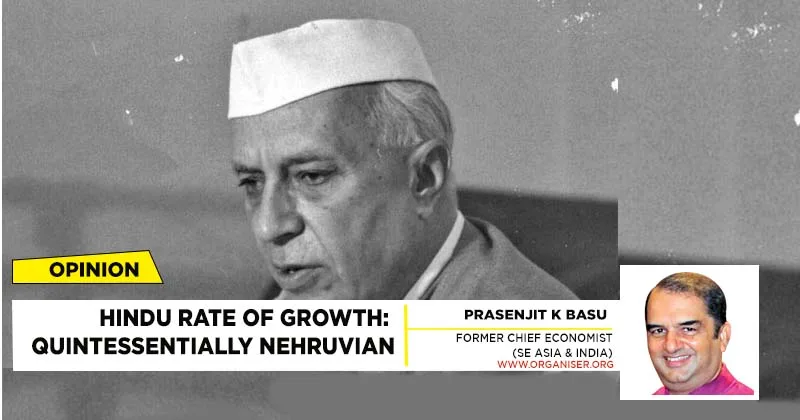
There was nothing ‘Hindu’ about the sluggish growth of the Indian economy between 1947 and 1990. Had he been candid, Prof Krishna would have honestly termed it a ‘Nehruvian Rate of Growth’, for it was Nehru’s policies that caused the average Indian (already among the poorest individuals on earth) to become even poorer than the average world citizen.
Until 1951, Nehru’s socialist ideas did not enjoy majority support within the Congress party. This was evident not only in May 1946 (when 12 of the 15 provincial Congress committees nominated Patel to be the Congress candidate for Prime Minister, only to be overruled by Gandhi), but even more emphatically in 1950. Nehru (and the Left wing of Congress) supported JB Kripalani for the presidency of the Congress at that year’s Nagpur session, but he was handily defeated by the relatively less-known Purushottam Das Tandon, who was supported by Sardar Patel and the Congress Right.
Similarly, Nehru wanted Rajaji to become India’s first President in January 1950, but Patel’s support for Rajendra Prasad proved decisive. Nehru opposed both Prasad and Tandon on the grounds that they were ‘too involved in Hindu causes, and not secular enough. But once Patel died (December 1950) and Prasad was out of politics, Nehru pressed for Tandon to step aside in 1951 in the run-up to the first General Elections. Thereafter, socialist policies came to predominate.
Sharing Colonial Mindset
Economist Rakesh Mohan demonstrated that India’s panoply of industrial controls originated in the defence of India war powers of 1939. Hence, ‘it was much more for control and less for development. This was also consistent with the colonial bureaucratic mindset more designed to control rather than foster development: a system that we inherited and have not changed to this date.’ The 1956 Industrial Policy Resolution cemented these, complementing the controls on foreign exchange, imports, exports and capital issues that were already in place, with additional controls (licensing) for new investments, expansion and altering product mix, creating the labyrinthine system that strangled enterprise and eventually ossified incumbents by banning imports if any domestic producer existed. The Indian economy grew at an average pace of 3.7 per cent annually between 1950 and 1980, implying annual per capita income growth of 1.5 per cent. This was considerably faster than the 0.7 per cent annual growth of real GDP in the 1900–50 period (which meant a decline in per capita income over that period). But between 1950 and 1980, India was expanding slightly slower than the average pace of global GDP growth. Since India’s population was growing slightly faster than the world’s population during that period, India’s per capita income was growing 1 per cent less annually than the world’s average growth rate over those three decades.
For one of the poorest countries on earth at the start of this period (following colonial rule), this was simply abysmal — the average Indian’s income was declining relative to the average human’s income until 1980. India remained among the 10 poorest nations on earth in 1980.
In the first decade (1950–60), real GDP expanded 4 per cent annually despite suffering a balance of payments crisis in FY1957/58. That crisis was largely a consequence of the fiscal profligacy necessary to fund the state-led industrialisation central to the Second Five Year Plan (1956), causing the current account deficit to widen to 3.4 per cent of GDP. Morarji Desai effectively addressed this crisis by liberalising norms for Foreign Direct Investment (FDI) at a time when this was distinctly unfashionable in the developing world. But instead of rupee devaluation, foreign exchange began to be rationed, implicitly tightening import controls.
More broadly, Finance Minister Desai established the principle of avoiding deficit financing, or outlays exceeding the limits of foreseeable resources. At a celebrated meeting of the National Development Council in 1960 to discuss the Third Plan, Nehru forcefully pushed to mobilise more resources than originally budgeted for. Desai refused to yield, saying the arguments for expanding the Plan were not realistic, and he refused to be party to ‘speculative’ actions worthy only of the Share Brokers’ Association.
War Despite Nehru’s Soft Corner for China
The wars with China (1962) and Pakistan (1965 especially) sapped the economy’s strength. Despite the abject debacle of 1962, marking a complete repudiation of his Hindi–Chini Bhai Bhai policy, Nehru’s position in the Cabinet was protected by the resignation of other key Ministers, notably Finance Minister Desai in August 1963. This was especially ironic as Desai had been one of the notably strong performers in the Cabinet.
Nehru had attempted to graft a Soviet style planning approach onto a colonial era bureaucracy, with mediocre results. Import-substituting industrialisation (ISI) was the policy recommended by the World Bank in the 1950s, in the hope of stimulating demand for capital goods from the west, while the newly emerging economies would focus on replacing imports of consumer goods with domestic production.
Nehru adopted an extreme version of this ISI strategy by banning virtually all imports of consumer goods, while also attempting (after 1956) to develop heavy and chemical industries via public enterprises that Nehru termed the ‘temples of modern India’ that would capture ‘the commanding heights of the economy’.
The extreme protection meant that India produced shoddy consumer products in the absence of competition, which was restricted via a panoply of licenses/controls for the amount and mix of products that each company was allowed to produce. Intermediate goods and parts still needed to be imported for most products, so the ‘foreign exchange constraint’ was often a binding one on an economy that was characterised by scarcity.
While Taiwan adopted an explicitly export promoting policy by 1958, and Korea after 1961, India retained its export pessimism, justifying it by the ‘fallacy of composition’ (if every developing economy tried to export, they would flood the market, cause export prices to fall and hurt each other even more). India’s policy makers made the cardinal mistake of believing that India was a large economy and should thus focus on domestic demand, although India’s economy was only the size of Holland even in 1990. Had India chosen an export-promoting policy in 1950 or 1960, most of its exports would have had a negligible share of world markets, and would thus have been ‘price-takers’ rather than causing export prices to fall. The possible exceptions were tea and jute in 1950; these were still dominated by British companies so India had no particular reason to promote them. India could have used the Sterling Balances built up during WWII to take ownership of these companies, and then mounted a serious attempt at controlling the global market for those exports. In textiles and garments, India had a significant global market-share in the early 1950s, with that market-share having grown rapidly during the Second World War and less in the Korean War. But the overvaluation of the rupee because of the import-substitution strategy severely weakened India’s textile sector, and caused it to lose competitiveness, especially to Japan and Taiwan in the second half of the 1950s, and to Korea, Hong Kong and Singapore in the 1960s.
Nehru’s Flawed Vision
Nehru, on the other hand, was seeking to do everything at once. Starting with dismally low literacy rates and negligible rates of enrolment in tertiary education, Nehru attempted land reforms (which failed in much of the country) and agricultural extension programmes to boost agricultural output. He also sought to import-substitute both consumer and capital goods production, while ignoring how he was going to overcome the foreign exchange constraint that would limit the ability to import essential intermediate goods and raw materials that India did not produce.
Japan had done all this, but sequentially – land reforms to boost agricultural productivity, alongside universal mass education, then inducing former daimyo and landlords (who had been compensated with bonds for the loss of their agrarian land) to invest in the new industries (which were labour-intensive at first, with state-owned heavy industry only gradually introduced in the third decade after the Meiji Restoration, as a complement to private industry which always retained primacy).
By attempting to do it all at once (and with a strong bias toward government rather than private ownership), Nehru achieved poor results everywhere. Agriculture suffered both from an overvalued exchange rate (that made imports cheap and exports uncompetitive) and poor response to land reform, and Nehru’s redistributive approach achieved neither equity nor productivity; consumer goods remained inefficient because of excessive protection; and heavy industry’s ability to expand was constrained by the dearth of imported capital goods and technology.
The baleful consequence was that, from having the eighth largest manufacturing sector among all market economies in 1955, India’s rank slumped to 15th by 1976, and India’s share in world exports fell from 2.4 per cent in 1948 to 0.4 per cent in 1979.
There was nothing ‘Hindu’ about this failure; it was quintessentially Nehruvian!