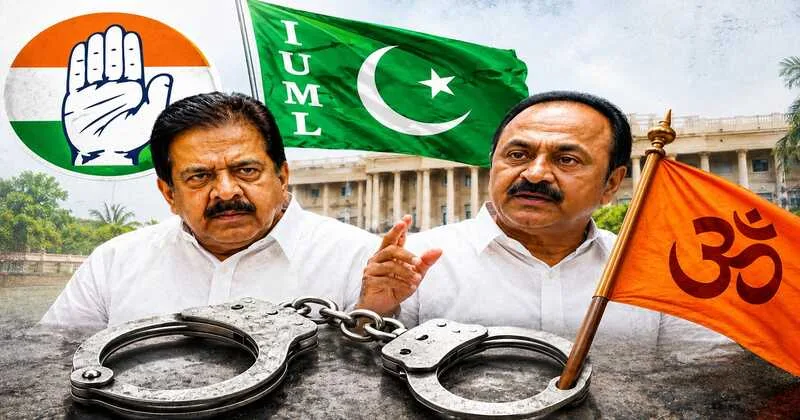
New Delhi: An unprecedented wave of unabashed minority appeasement has taken complete hold of Keralam’s political and administrative machinery. Driven by a desperate scramble for Chief Ministership, power, and electoral survival, top Congress heavyweights are engaging in competitive capitulation to the Indian Union Muslim League (IUML), Jamaat-e-Islami, and radical outfits such as the Social Democratic Party of India (SDPI), the political offshoot of the banned Popular Front of India (PFI).
In their relentless bid to secure Muslim support and solidify their alliance, the political establishment has weaponized state power, turning Hindu leaders and nationalist figures into soft targets. Grassroots activists, elected representatives, commentators, and educators who raise their voices for the nation and community rights are being systematically victimized, prosecuted, and hunted down to appease radical bases.
Targeted state action and victimization of nationalist figures
This campaign of state victimization rapidly expanded to nationalist intellectuals and commentators who speak out for the country and raise critical questions regarding national interest. In the most recent crackdown on August 9, veteran political commentator T. G. Mohandas was subjected to a sudden late-night police operation by the Thiruvananthapuram Cyber Police, who took him into custody from his Kochi residence over digital broadcasts following a complaint filed by a leader of the Social Democratic Party of India (SDPI), the political offshoot of the banned Islamic terrorist organization Popular Front of India (PFI). Charged under severe sections of the Bharatiya Nyaya Sanhita, the IT Act, and the Keralam Police Act, his electronic equipment was confiscated in a dramatic display of force.
While judicial intervention ultimately granted him bail due to severe procedural lapses by the police, the message sent by the administration was clear that Hindu leaders who raise their voice for the nation will be treated as soft targets to appease radical political bases.
Kochi : RSS ideologue TG Mohandas is arrested by Keralam police. He has been charged for passing "derogatory remarks" against Jantar Mantar protesting students..
Those who passed derogatory remarks against the PM and his mother got support from Pappu ji, but those who gave them… pic.twitter.com/jUE2axnAFM
— Mr Sinha (@Mrsinha) August 10, 2026
The institutional hostility reached a fresh boiling point on August 10 in Kasaragod district, where the state’s education administration was weaponized against educators who acknowledge national icons. Guru Prasad, a teacher at AUPS Pallathadka in the Kumbla sub-district, was summarily suspended by the General Education Department, headed by Minister for General Education N. Samsudheen, a prominent Muslim League leader, after preparing a questionnaire for a sub-district level ‘Freedom Quiz’ held on August 6, 2026.
The source of the state’s fury was a tie-breaker question asking which freedom fighter suffered the most imprisonment under British rule, with the key identifying V. D. Savarkar. Following intense pressure from minority political outfits and coalition leverage exerted through Minister Samsudheen’s own party, the IUML, the administration immediately launched disciplinary proceedings on August 9, 2026.
This swift, punitive measure against a teacher for referencing a prominent national figure highlights how state machinery under the current portfolio arrangement is actively deployed to penalize anyone presenting historical facts that clash with the ideological demands of the UDF’s favored minority blocs.
Selective law enforcement and institutional crackdown
The systematic campaign of targeting nationalist figures hit another critical juncture in July 2026 when police registered a case against Hindu Aikya Vedi state president R. V. Babu. The action was taken by the Thrikkakara police in Kochi based on a formal complaint filed by Ashraf Vazhakkala, a central committee member of the People’s Democratic Party (PDP), an organization founded by Abdul Nasser Madani, the prime mastermind behind the 2008 Bengaluru serial bomb blasts.
R. V. Babu had raised sharp questions regarding state governance after Home Minister Ramesh Chennithala engaged Muslim religious leader and Samastha president Jifri Muthukoya Thangal to launch the police department’s anti-narcotic campaign, ‘Operation Toofan’, in June 2026.
Pointing out the stark paradox in the government’s approach, R. V. Babu publicly questioned why the Home Minister was seeking the assistance of community and Samastha leaders when a significant portion of those caught smuggling and distributing narcotics in Keralam belonged to their own community.
He asserted that rather than political posturing, these community leaders should take internal responsibility to address the issue. However, to placate fundamentalist vote banks and protect the coalition’s appeasement narrative, the state police swiftly booked R. V. Babu under severe sections of the Bharatiya Nyaya Sanhita and the Keralam Police Act for promoting enmity between communities and outraging religious feelings.
This immediate state machinery reaction, acting on a complaint from an outfit tied to Madani’s radical network, underscores how nationalist leaders highlighting law-and-order realities are routinely criminalized to satisfy the political demands of fringe extremist factions.
#WATCH | Kasaragod, Keralam | BJP workers staged a protest at an event attended by the State Education Minister at Bela Kadambala GWLP School in Kasaragod over the suspension of a school teacher in connection with a question on Savarkar in a 'Freedom Quiz' conducted at the… pic.twitter.com/Tz4r4L5fq6
— ANI (@ANI) August 10, 2026
A prime example of this selective state crackdown traces back to June 2026 with the high-profile arrest of R. Sugathan, a Bharatiya Janata Party (BJP) municipal councillor in the Thiruvananthapuram Corporation. Authorities imposed the draconian Kerala Anti-Social Activities (Prevention) Act (KAAPA) on Sugathan, placing him under preventive detention in central prison. Even after obtaining legal relief in underlying cases, his KAAPA detention was strictly enforced, forcing the elected representative to take his official oath of office from inside Viyyur Central Prison under High Court orders.
The administrative hostility surrounding his case deepened further in August 2026 when Dr. Chithra P. Arunima, an Under Secretary in the Local Self Government Department, headed by Minister for Local Self Government K. M. Shaji, a senior Muslim League leader, was summarily suspended by the state government. The KAS officer faced immediate suspension after processing a file outlining standard procedure for an elected representative to apply for Council leave to prevent the loss of his post, highlighting how administrative mechanisms under IUML-held ministries are aggressively policed to block any procedural relief for detained nationalist representatives.
Factional warfare for power and capitulation to minority blocs
This aggressive policy of minority appeasement is fueled directly by an intense, three-way internal war for chief ministerial dominance involving Chief Minister V. D. Satheesan, Home Minister Ramesh Chennithala, and AICC General Secretary K. C. Venugopal. Sitting at the apex of Keralam’s governance is Chief Minister V. D. Satheesan, who heads a 20-member United Democratic Front (UDF) Cabinet. However, Satheesan’s authority remains fragile, heavily dependent on the conditional patronage of the Muslim League.
During high-level leadership negotiations, the Muslim League asserted its dominance by threatening to support the government only from the outside unless its political terms were met. This coercion forced the Congress high command, influenced by Lok Sabha MP K. C. Venugopal, to yield completely, securing Satheesan’s position while exposing deep organizational fractures.
Despite V. D. Satheesan occupying the Chief Minister’s office, Home Minister Ramesh Chennithala, who controls key portfolios including Home, Vigilance, Prisons, and Coir, operates with complete administrative independence. Leveraging his history as a former KPCC President and Leader of the Opposition, Chennithala routinely sidesteps chief ministerial oversight, creating a distinct parallel power center within the 20-member ministry.
To outmaneuver both Satheesan and Venugopal in the ultimate battle for political leverage, Chennithala has actively trying to cultivate ties with the Muslim League, Jamaat-e-Islami, and SDPI networks. This fierce intra-party friction has sparked an unbridled race of competitive appeasement, where rival Congress leaders trade administrative integrity and equal governance to secure minority backing.
Institutional collusion and administrative paralysis
The surrender of governance to coalition blackmail has created widespread institutional paralysis across Keralam. By granting IUML ministers like General Education Minister N. Samsudheen and LSGD Minister K. Muhammad Shaji unbridled authority over key administrative domains, the Congress leadership has allowed minority vote banks to dictatate state policy.
Civil servants, educators, and local administration officers are routinely subjected to intimidation or disciplinary action if their official duties clash with the preferences of these influential coalition partners.
#WATCH | Thiruvananthapuram | The tussle over the Chief Minister’s post in Kerala intensifies as supporters of senior leaders V. D. Satheesan and K. C. Venugopal have put up posters demanding that their leader be made the Chief Minister of the state.
AICC observers Mukul Wasnik… pic.twitter.com/sBD659d8b5
— ANI (@ANI) May 8, 2026
This institutional framework ensures that state apparatuses function not as neutral enforcers of law and administrative procedure, but as enforcement tools for political patronage. While radical outfits operate with functional immunity under the political protection of coalition arrangements, government officers who follow statutory guidelines to facilitate standard governance face immediate suspension and public vilification.
The escalating cost of appeasement on Keralam’s social fabric
The desperate struggle between Chief Minister V. D. Satheesan and Home Minister Ramesh Chennithala to secure the endorsement of the Muslim League, Jamaat-e-Islami, and the SDPI has entrenched an unbalanced, deeply biased system of governance in Keralam.
By placing the survival of the 20-member Cabinet and the pursuit of ultimate chief ministerial power above equal justice, Congress leaders have allowed minority vote banks to hold an effective veto over state security policies, educational curricula, and law enforcement choices.
While radical elements and fringe outfits operate with impunity under political cover, Hindu leaders, grassroots workers, nationalist educators, and voices who stand up for the country face immediate state repression, arbitrary detentions, suspensions, and cyber prosecutions. This unabashed policy of appeasement threatens to permanently fracture the social fabric of Keralam.
As Congress stalwarts continue their battle for power and alliance backing, the systematic targeting of nationalist Hindu figures is used as currency to buy minority support, leaving dedicated leaders victimized in a high-stakes, polarized war for administrative control.