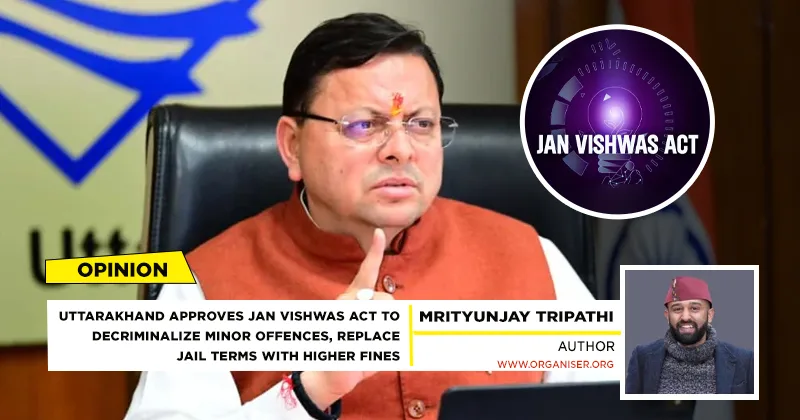
The Uttarakhand state cabinet has accepted the enactment of the Uttarakhand Jan Vishwas (Amendment of Provisions) Ordinance, 2025, in a landmark decision that indicates that India is overall moving towards trust-based governance and ease of do business. This legislative act would be a radical change in the approach to the regulation infractions and the focus would no longer be on the punishment-based approach, but rather on the penalty-based one with the focus on compliance as opposed to a risk of imprisonment.
This decision was made on Wednesday, December 11, 2025, in an all-inclusive cabinet meeting that discussed several departmental issues and the development priorities of the state. The program is in line with the overall effort by the government to generate a conducive business environment and at the same time also tackle some of the long-term challenges of jail congestion and overburdening of the judicial system. Uttarakhand becomes the latest state to implement the Jan Vishwas framework at the state level, following successful central government enactment of the Jan Vishwas (Amendment of Provisions) Act, 2023, which decriminalized 183 provisions in 42 central laws, by decriminalizing minor regulatory violations and substituting imprisonment arrangements with commensurate monetary fines.
Understanding the Jan Vishwas Act: Philosophy and Background
The Jan Vishwas Act is not just a mere administrative change, but it is a philosophical change in how the government regulates and complies. The main principle, which is that good governance is premised on trust between the government and the people instead of the fear of criminal prosecution, is captured in the term, Jan Vishwas, which means trust in the government. This practice recognizes a key fact of contemporary regulation regimes: small scale technical infractions, procedural failures, and unintentional non-conformity are bound to occur in the complicated regulatory context, and the adoption of criminal sanctions against the latter frequently generates unwarranted obstacles to economic life and personal growth.
On January 1st, 2023, the central government presented the first Jan Vishwas Act that decriminalized 183 provisions of 42 central acts administered by 19 different ministries and departments. The effectiveness of such an initiative led to the implementation of similar models by states. The Jan Vishwas (Amendment of Provisions) Bill, 2025, broadened the area to further by suggesting that over 36 other minor offences should be decriminalized and a structured approach to enforcement should be implemented that starts with warnings instead of criminal prosecution. The philosophical basis of Jan Vishwas is based on various principles:
To begin with, it acknowledges that fear of incarceration on petty offences serves as a great inhibitor to the growth of business and confidence in people. Second, it recognizes that a good number of regulatory provisions are either obsolete or they do not match the offenses they aim to mitigate. Third, it realizes that the judiciary system has excessively many minor cases that can be addressed by administrative means or civil punishment without the need to go to court. Lastly, it focuses on proportionality, that is, acquiring the fact that the severity and nature of punishment will be in line with the severity of the crime.
Uttarakhand’s Implementation: Scale and Scope
The Jan Vishwas Ordinance passed by the Uttarakhand cabinet is an important move towards modernizing regulation on a state-level. The government according to the announcement has carried out a thorough scrutiny and came up with 52 varied acts of the multiple state departments as a candidate to be decriminalized. But since the state understands there should be a gradual application phase, it has opted to amalgamate seven acts at the first phase, and continue to gradually introduce other acts to the confines of the law as the implementation process goes on and lessons learned on the first implementation.
This is a tactful administrative discretion. The state government has not tried to decriminalize all the 52 acts at the same time which might pose implementation difficulties and uncertainties in the regulatory environment but instead followed a gradual process. This will enable close tracking of compliance trends, appraisal of the efficiency of punishment systems, and optimization of workflows prior to their extension to other laws. The gradual nature of the implementation also gives the businesses and regulatory authorities time to adapt to the new structure and know how monetary fines are going to substitute criminal charges.
The decriminalization sought in the ordinance passed by the cabinet will be accomplished in a variety of ways: by substituting criminal sanctions on minor, technical, regulatory, and procedural offenses with financial fines; treating small technical or procedural infractions by civil fines and administrative disposition instead of criminal charges; eliminating outdated or redundant legal provisions that no longer have useful purposes; and where possible, reformatting and enhancing penalties to maintain them within reasonable proportions and still preserve their deterrent effect.
The Mechanism: From Imprisonment to Penalties
It takes more than just the elimination of imprisonment clauses in legislation to turn the system of criminal to a civil penalty. The Uttarakhand ordinance has a few advanced mechanisms that are integrated to guarantee that the system is functional and has compliance reinforcements.
Rationalization of Penalty and Proportionality: With the new system where criminal provisions are replaced with monetary penalties, state has ensured that the monetary penalties are scaled to the seriousness of offense. Instead of lessening the punishment, the state in most instances has in fact escalated the punishment in order to preserve the deterrent effect. This is based on the knowledge that even though imprisonment may no longer be applied in case of minor violation, financial implications must still play a significant role in deterring the non-compliance.
Automatic Escalation Mechanism: As the inflation reduces the value of set penalties in the long run, the cabinet has passed an automatic three-year 10% increment on all fines and penalties. This is done so that the structures of penalties can be effective deterrents despite varying economic circumstances and that they do not need a high rate of changes in legislation. The same was included in the central government, Jan Vishwas Act, 2023, which suggested a 10 percent increment at the end of each three-year period to keep it deterring.
Introduction of Adjudicating Officers and Authorities: The ordinance structure has the measures on the development of specialized adjudicating officers, who will evaluate the breaches granted and the need to impose suitable penalties to them. Also, there has been the development of appellate bodies where individuals can appeal against the ruling of the officers adjudicating them. These two layered systems help to guarantee procedural fairness and ensures that disputes do not enter into the formal court system and saves judicial burden.
Tiered Enforcement Approach: Later versions of Jan Vishwas such as the 2025 central Bill have brought in a tiered system of enforcement. In some types of minor offence, the initial instance of violation leads to a warning in the form of an improvement notice instead of penalizing it. Later violations are then followed with fines of escalating magnitude. This strategy has the benefit of a decent time frame during which to rectify unintentional violations, and yet carry with it significant penalties in the case of non-adherence.
Jail Overcrowding: An Acute Requirement.
The main reason why the decriminalization initiative was undertaken is the fact that the Indian correctional system is facing a serious problem of jail overcrowding. According to the announcement of cabinet by the principal secretary R. Meenakshi Sundaram, in many instances of petty crimes a jail term and fine will be provided. The sentence on minor offences will be harsher and jail term will be done away with except in cases of major crimes.
This assertion would summarize one of the most important insights into policy the Indian prison system is full of those who committed minor infractions, often regulatory or technical in nature, that are not very likely to promote the safety of the population and should take up a lot of correctional capacity. A great number of them are first-time criminals whose imprisonment can never be rehabilitative or substantial deterrent. With incarceration substituted with hefty fines on these infractions, the state can at once avoid the overcrowding of prisons as well as redistribute the scarce means of correction to serious criminal offenses where incapacitation and punishment can be clearly used to achieve definite public policy goals.
The secondary advantage of this solution is improved compliance. People and companies will keep regulatory compliance due to the fear of the financial fines more than they shall keep it due to the threat of serving a jail term due to the technical violations. Additionally, the ordinance enables less adversarial regulatory enforcement by eliminating the risk of jail time over minor offenses, which may stimulate the voluntary reporting of infractions and lowering their likelihood of remediation instead of hiding and avoiding them.
Complementary Cabinet Decisions: A Comprehensive Reform Agenda
Although the cabinet meeting was marked by the approval of the Jan Vishwas Ordinance which is the headline decision of the meeting, 19 proposals regarding different sectors and other developmental priorities were also approved by the Uttarakhand cabinet. All of these complementary decisions are a complete package of reforms that will lead to increased investor confidence, sustainable development, and governance efficiency.
Electricity Sector Compensation Improvements: The cabinet is appreciating the necessity to obtain land cooperation in order to develop important infrastructures, so it made important improvements to the compensation of installing electricity towers and transmission line easements. Tower base compensation varied to 200 percent of land value as compared to 85 percent of circle rate which was a great enhancement to landowner compensation. In the transmission lines traversing on land, compensation was raised to 30 percent in the rural regions, 45 percent in semi-urban regions and 60 percent in urban areas compared to the previous uniform rate of 15 percent. All these increases are a policy choice, which is taken by the Union government in 2024, as a way of encouraging landowner collaboration in the development of important infrastructure.
Urban Development and Land Pooling: To promote the development of townships in an organized and planned manner, the cabinet passed town planning scheme and land pooling scheme that would be implemented as in the case of Gujarat and Amaravati. This plan enables the landowners to combine their land to have unified development of towns and in exchange they obtain the developed commercial or residential land; this way avoids the unstructured and unplanned development that has marred past development activities in Uttarakhand. This is a great move towards a major governance issue, since the past attempts of land banking as a development project had led to unplanned sprawl when the land was returned back to the original owners.
Green Building Incentives: The cabinet in a step to encourage sustainable building construction, passed more floor area ratio (FAR) incentives on green-certified buildings. Platinum grade buildings are awarded an extra 5% FAR, gold grade buildings are awarded 3 percent and silver grade buildings are awarded 2 percent. This incentive package motivates developers to design buildings in sustainable designs that minimize the environmental impact of new buildings to the environment and enable the developers to create more rentable or usable space.
Flexibility of Commercial Zones: The cabinet dampened down the limits of ground coverage in commercial locations and setback laws were to be applied uniformly across all zones. Also, the state has allowed construction of eco-resorts as well as normal resorts without land use changes and land use conditions on map approvals where commercial opportunities in the hospitality industry are increased. The buildings with multi-storeys soon have the ability to have no parking height as the total height of the building, which will enable developers build the parking facilities without reducing the free commercial or residential space.
Infrastructure Project Support: Rrespana-Bindal road project in Dehradun, which is an important urban infrastructure project, was accorded specific attention with the grant of GST exemption and reimbursement of royalty and GST value. This ruling acknowledges the significance of this project to the movement and development of cities as well as decreasing the budget cost of the agency concerned.
Vehicle Scrapping and Renewable Support: In line with the general national policy that promoted the renewal of vehicles and environmental clean-up, the cabinet allowed vehicles older than 15 years old to be tax exempt on vehicle scrapping and acquisition of new vehicles. This incentive helps to retire older and more polluting vehicles and replace them with more recent and less polluting ones.
Skill Development Initiative: The government will be offering online coaching on the preparation of competitive exams, such as UPSC, NET, GATE, and other exams as per Chief Minister Youth Future Building Scheme. This program deals with the problems of equity in education and expertise acquisition because quality coaching is available to the applicants irrespective of their geographical areas or monetary background.
Business Environment Impact: Creating a Trust-Based Regulatory Framework
The signing of the Jan Vishwas ordinance should be seen in the wider framework of the regulatory reform agenda of India. The defined goal of the government is to attain the effect of minimum government and maximum governance; the government has to reduce the burden of regulation but at the same time safeguard the interests of the people and provide level competition. This necessitates the shift of compliance-through-fear paradigm to compliance-through-trust paradigm. In terms of business, the decriminalization initiative would resolve a severe issue: the ambiguity of the regulation and the sense of a possible criminal prosecution in cases of technical offenses.
The situation may be quite complicated as entrepreneurs and business managers have to fight against the situation when the complex regulations system does not give the opportunity to completely meet all the aspects of the work. With the previous system, such unintentional infractions might lead to criminal convictions, tarnished reputation and incarceration of the culpable parties. According to the new order, the infractions lead to administrative procedures and fines that can be corrected without the criminal responsibility.
There are a number of downstream effects of this shift. To begin with, it enhances predictability within the regulatory environment, since nowadays companies can evaluate the possible outcomes of the violations not on the criminal but on the financial levels. Second, it promotes active compliance since the cost benefit analysis of reporting and redressing a violation would be more beneficial in the absence of criminal responsibility. Third, it also draws an investment through a low appearance of the regulatory risk of operating in the state. Regulatory risk is considered by international and domestic investors when investing in a particular country and a regime that allows investors to have confidence in a company as opposed to fearing the consequences of investments is a better place to invest.
National Context: Uttarakhand Joins a Growing Movement
Uttarakhand is not the only state that has implemented decriminalisation ordinances at the state level. Similar measures are going to be enacted by several states according to the central government Jan Vishwas Act, 2023. An example is Haryana, which has sanctioned a Jan Vishwas Ordinance decriminalising 164 provisions in 42 state acts under the care of 17 different departments, what officials deem as the largest decriminalization endeavor by a State government to date. This is an indication that decriminalization has emerged as a competitive factor in the federal system in India with states competing to enhance their regulatory sectors to be able to attract investment and business operations.
The central government also has been perpetually increasing the areas of decriminalization by the Jan Vishwas (Amendment of Provisions) Bill, 2025, which is proposed to deal with 16 central acts that are handled by 10 ministries and departments. This bill entails decriminalising over 36 minor offences and making amendments to 20 provisions of the Motor Vehicles Act and 47 provisions of the New Delhi Municipal Council Act in order to ease the living standards. The widening decriminalization both at the central and state levels signals a fundamental change of philosophical paradigm of regulation that will most probably keep affecting the governance style in India.
Implementation Challenges and Future Considerations
Although the Jan Vishwas ordinance is a good regulation reform move, successful implementation of the policy will have to observe keenly in a number of considerations. To begin with, the officers and appellate authorities should be properly trained to provide fair and uniform interpretation of the new system of penalties. Second, the penalty systems have to be adjusted in a proper way: not too high to deter but at the same time not too high to make them economically impractical in case of minor offenses. Third, it should be the faithfulness of the automatic escalation mechanism that can ensure the effectiveness of penalties in the long term. Fourth, the graduated implementation strategy should be handled well to make sure that the lessons of the first moves are applied in the second and the third decriminalization programs.
Besides, a difference should be made that should be adhered to: decriminalization should refer to minor offences, technical and procedural crimes, rather than serious offences. The ordinance maintains criminal law on major crime and major violation that pose a threat to the safety or welfare of the people. This difference will be essential in keeping the masses trustful of the regulatory mechanism and in keeping decriminalization not to be viewed as the allowance of serious misconduct.
A Forward-Looking Reform
The acceptance of the Jan Vishwas Ordinance by the Uttarakhand cabinet is a prospective regulation change in which the realities of the contemporary complex governance systems are realized. The state is trying to reduce congestion in jails, judicial workload, increase business confidence, and design a regulatory environment founded on trust and not fear by substituting criminal prosecution of minor offenses with a proportional punishment system. This move combined with other decisions made by the cabinet on electricity compensation, urban development, green building incentives, infrastructure support, and skill development is a holistic plan made to ensure that Uttarakhand is a destination, which is appealing to invest and conduct business. Since the implementation will be conducted in phases, consisting of the decriminalization of certain provisions, other states and, possibly, the central government will tend to closely monitor the results and determine whether to continue decriminalization further and how.
The Jan Vishwas movement is a development of the regulatory mind of India- that good governance should not be adversarial, but it should be more sustainable through the creation of trust in the regulated parties as opposed to the threat of incarceration after technical failures. Through these reforms in Uttarakhand, a state is a part of a longer national debate regarding the appearance of good governance in the 21st century.