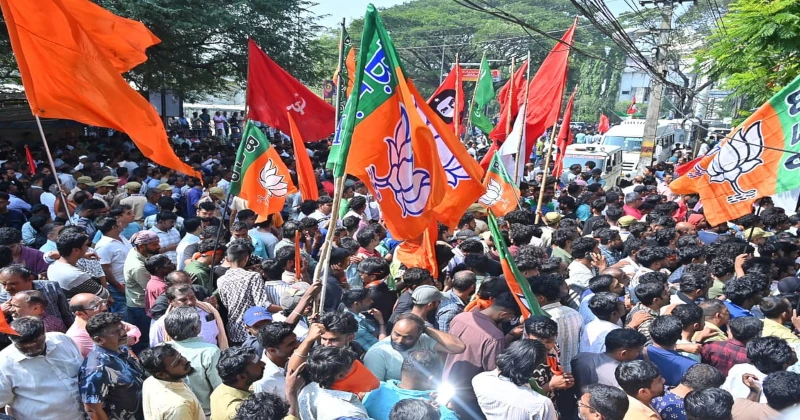
The BJP-led National Democratic Alliance (NDA) on December 13, registered a politically significant victory in the Munambam ward of Kerala’s Ernakulam district, a coastal constituency that has been at the centre of a prolonged and emotionally charged land dispute involving the Kerala Waqf Board.
Munambam has remained under intense public scrutiny since 2019, when the Kerala Waqf Board issued a notification declaring nearly 404 acres of land in Munambam and the adjoining Cherai area as Waqf property. The notification triggered widespread anxiety among more than 500 families, most of them belonging to the Latin Catholic fishing community, who have asserted that they have lived on the land for generations and hold legal ownership over it. Residents have consistently maintained that they possess registered title deeds, revenue documents and evidence of land tax payments spanning several decades. However, following the Waqf notification, the state government reportedly stopped accepting land tax from these families, significantly heightening uncertainty over their ownership rights and livelihoods.
What began as a local land dispute soon escalated into sustained protest demonstrations, sit-ins and legal challenges, drawing attention at both the state and national levels. Under the banner of the Munambam Land Protection Council, affected families organised continuous protests that lasted for more than 400 days, transforming the issue into a major political flashpoint cutting across legal, livelihood and religious concerns. The controversy also featured prominently in debates in Parliament and the Kerala Assembly, particularly after the Union government introduced legislation aimed at strengthening oversight and regulation of waqf properties. The Munambam dispute thus became closely linked to broader political and legal debates surrounding waqf governance.
In early October, the Kerala High Court delivered a major ruling in favour of the residents, holding that the Munambam land could not have been classified as Waqf property. The court described the notification as a land-grabbing tactic and observed that mandatory procedures prescribed under the Waqf Acts had not been followed. The judgment provided a significant morale boost to protesters, many of whom had earlier contemplated boycotting the local body elections before ultimately deciding to participate. The legal battle, however, remains far from settled. On December 12, the Supreme Court stayed the High Court’s declaration that the land was not Waqf property and ordered the maintenance of status quo. At the same time, the apex court allowed a state-appointed inquiry commission to continue its investigation. The Supreme Court also raised questions over whether the High Court had exceeded its jurisdiction by ruling on issues that were pending before the Waqf Tribunal.
Against this backdrop, the NDA’s victory in Munambam is being widely viewed as far more than a routine ward-level outcome. It represents a rare electoral breakthrough for the alliance in Kerala, a state where the BJP has traditionally struggled to convert political visibility into sustained electoral success. During the campaign, the BJP openly aligned itself with the protesters, projecting its support for land and property rights as a central theme. The Munambam dispute appears to have disrupted established voting patterns, with sections of voters previously aligned with the Congress and the Left reportedly shifting their support towards the NDA. The alliance succeeded in wresting the ward from the Congress, which had earlier held the seat through councillor Jesna Sanal.
Munambam has a total electorate of around 1,780 voters. In the ward election, BJP candidate Kunjumon Augustine secured victory with 582 votes, defeating CPI(M) candidate Rocky Binoy Kurishinkal, who polled 551 votes, while INC candidate Daniel finished third with 304 votes. Rival political fronts have contested the NDA’s interpretation of the result. CPI(M) leader Rocky Binoy Kurishinkal, the LDF candidate, said the Left and the state government had consistently stood with the residents and had taken steps to address their grievances. From the UDF, Dani Kottaparambil stated that the Congress was among the earliest parties to support the agitation and had continued to raise the issue at multiple levels. Despite these competing claims, the Munambam verdict is increasingly being viewed as a symbolic shift in a politically sensitive coastal ward and as a morale booster for the BJP as it looks ahead to the 2026 Kerala Assembly elections.