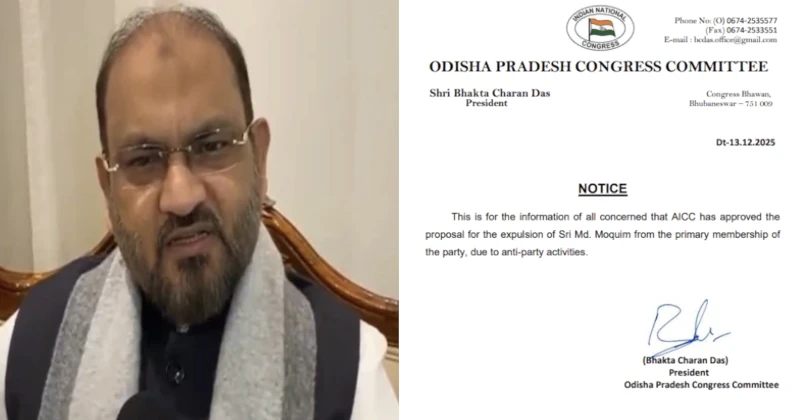
The All India Congress Committee (AICC) has expelled former Odisha MLA Mohammed Moquim from the party’s primary membership, branding his outspoken criticism as “anti-party activities.” The action comes not after electoral sabotage or defection, but after Moquim dared to articulate what many within the party privately acknowledge: that the Congress is drifting, disconnected, and directionless.
The expulsion follows a five-page letter Moquim wrote to veteran leader Sonia Gandhi, warning that the party is passing through one of the most difficult phases in its history. Instead of treating the letter as an internal alarm bell, the Congress leadership chose the familiar route of disciplinary action—punishing the messenger rather than confronting the message.
AICC expels Md. Moquim from the primary membership of the party, due to anti-party activities. https://t.co/ob9ImiiIXI pic.twitter.com/pgInaUoDcn
— ANI (@ANI) December 15, 2025
Moquim, a former MLA from Barabati-Cuttack, raised uncomfortable but critical questions about the party’s leadership structure and decision-making. He pointed to the widening gap between the Congress high command and grassroots workers, a disconnect that has translated into repeated electoral failures across states, including Odisha.
His remarks on Congress president Mallikarjun Kharge were particularly scathing. While acknowledging Kharge’s long political career, Moquim bluntly stated that at 83, the party chief has failed to resonate with India’s youth a demographic that constitutes nearly 65 per cent of the country’s population. For a party struggling to remain electorally relevant, this is not a trivial observation but a strategic warning.
Moquim also questioned the effectiveness of Rahul Gandhi’s leadership, claiming he had not even met the party’s most prominent face in the last three years an astonishing admission that reflects how inaccessible and insulated the top leadership has become.
In his letter, Moquim highlighted how the Congress has systematically sidelined or alienated young and dynamic leaders. He cited the exits of Jyotiraditya Scindia, Milind Deora, and Himanta Biswa Sarma as examples of how neglect and internal politics have driven capable leaders out of the party many of whom are now politically thriving elsewhere.
He stressed that leaders such as Sachin Pilot, DK Shivakumar, A Revanth Reddy, and Shashi Tharoor bring credibility, energy, and mass appeal qualities the Congress desperately needs. Yet, instead of empowering such leaders, the party continues to concentrate authority in what Moquim described as “the wrong hands,” repeating the same mistakes and expecting different results.
He also called for Priyanka Gandhi Vadra to take on a more visible and decisive central role, a suggestion that reflects growing frustration within the party over symbolic leadership without sustained organisational reform.
Moquim flagged the Nuapada by-elections in Odisha as a warning sign, emblematic of the Congress’s shrinking footprint and lack of strategic clarity at the state level. His broader argument was devastating: a series of wrong decisions, misguided leadership choices, and refusal to course-correct have weakened the party from within, leaving it hollowed out and demoralised.
“These consequences are now visible to the entire nation,” Moquim wrote a statement that rings true as the Congress continues to lose elections, leaders, and relevance.