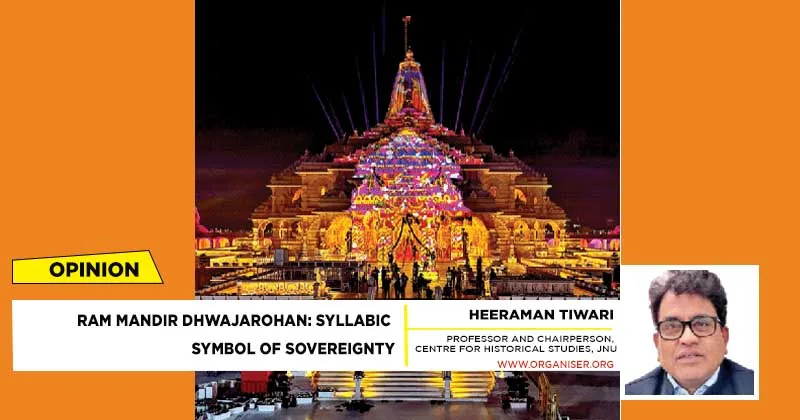
Ram Mandir Dhwajarohan: Syllabic symbol of sovereignty
June 6, 2026
  • Read Ecopy
  • Circulation
  • Advertise
  • Careers
  • About Us
  • Contact Us
Android AppiPhone AppArattai
Organiser
  • ‌
  • Bharat
    • Assam
    • Bihar
    • Chhattisgarh
    • Jharkhand
    • Maharashtra
    • View All States
  • World
    • Asia
    • Europe
    • North America
    • South America
    • Africa
    • Australia
  • Editorial
  • International
  • Opinion
  • RSS @ 100
  • More
    • Op Sindoor
    • Analysis
    • Sports
    • Defence
    • Politics
    • Business
    • Economy
    • Culture
    • Special Report
    • Sci & Tech
    • Entertainment
    • G20
    • Azadi Ka Amrit Mahotsav
    • Vocal4Local
    • Web Stories
    • Education
    • Employment
    • Books
    • Interviews
    • Travel
    • Law
    • Health
    • Obituary
  • Subscribe
    • Subscribe Print Edition
    • Subscribe Ecopy
    • Read Ecopy
  • ‌
  • Bharat
    • Assam
    • Bihar
    • Chhattisgarh
    • Jharkhand
    • Maharashtra
    • View All States
  • World
    • Asia
    • Europe
    • North America
    • South America
    • Africa
    • Australia
  • Editorial
  • International
  • Opinion
  • RSS @ 100
  • More
    • Op Sindoor
    • Analysis
    • Sports
    • Defence
    • Politics
    • Business
    • Economy
    • Culture
    • Special Report
    • Sci & Tech
    • Entertainment
    • G20
    • Azadi Ka Amrit Mahotsav
    • Vocal4Local
    • Web Stories
    • Education
    • Employment
    • Books
    • Interviews
    • Travel
    • Law
    • Health
    • Obituary
  • Subscribe
    • Subscribe Print Edition
    • Subscribe Ecopy
    • Read Ecopy
Organiser
  • Home
  • Bharat
  • World
  • Operation Sindoor
  • Editorial
  • Analysis
  • Opinion
  • Culture
  • Defence
  • International Edition
  • RSS @ 100
  • Magazine
  • Read Ecopy
Home Bharat

Ram Mandir Dhwajarohan: Syllabic symbol of sovereignty

The Dharma Dhwaj at Ayodhya represents the return of Ram’s sacred glory and the fulfilment of a centuries-long civilisational yearning. Its installation marks the transition from historical sorrow to a renewed affirmation of dharma, sovereignty, and cultural continuity

Prof Heeraman TiwariProf Heeraman Tiwari
Dec 2, 2025, 08:30 pm IST
in Bharat, Opinion
Follow on Google News
FacebookTwitterWhatsAppTelegramEmail

The Pataka, also known as Dhwaj, or the sacred triangular flag represents the unstained glory (keerti) of Bhagwan Sri Ram and his most beloved disciple Hanuman makes it flutter unfettered as its flagstaff (danda). This is how Tulsi, the 16th century teller of the life story of Bhagwan Ram, describes the significance of Dhwaj in a most lyrical language. He wrote in his magnum opus, the Ramcharitamanas, “raghupati keerati bimala pataka, danda samaana bhayau jas jaka”. Therefore, the Dhwajarohan or the planting ritual of the flag-hoisting on the cupola, the pinnacle, of the garbhagriha, the sanctum sanctorum, of Ram Mandir at Ayodhya signifies the architectural completion of the sacred abode of Ram, which was torn away by the barbaric Mughal invaders in the 16th century.

The ritual ceremony to install the flag on November 25, 2025 marks the beginning of a new era where transition from the lament and torment of a cruel wound inflicted on the devotees of Bhagwan Sri Ram to a reparation or restoration of the belief that Ram’s abode has now returned to its full glory. The flag has thus always stood for sovereignty and living principles of Sri Ram, whom millions and millions of Bharatiyas consider as the presiding deity of Hindu civilisation. Ram is not only the righteous ruler of the kingdom of Ayodhya, but the God who descended on this land as a human, a prince, to teach by his actions, ethical values and his life how a rule seeped in truth can be established.

Living Ideal of Dharma and Kingship

Ram has been described by almost all the poets, writers, who wrote moving works in the many great languages of Bharat, as an ideal human ruler, a Maryada Purushottam, one who stood for Dharma or righteousness. So the flag at the Ram Mandir in Ayodhya is a Dharma Dhwaj, a symbol of truth and human virtues. Even those who had issues with him, acknowledged generously, that Ram is the personification of Dharma, signified by his flag. The words or the message on the emblem of Sri Ram Janmabhoomi Teertha Kshetra (the board that carries the responsibility of the construction and management of the Ram Mandir in Ayodhya) communicate this powerful symbol, ramo vigrahavan dharmah — Ram is Truth personified. This moving analysis of Ram is communicated to Ravan by his relative Marich from whom Ravan sought help to initiate fight with Ram.
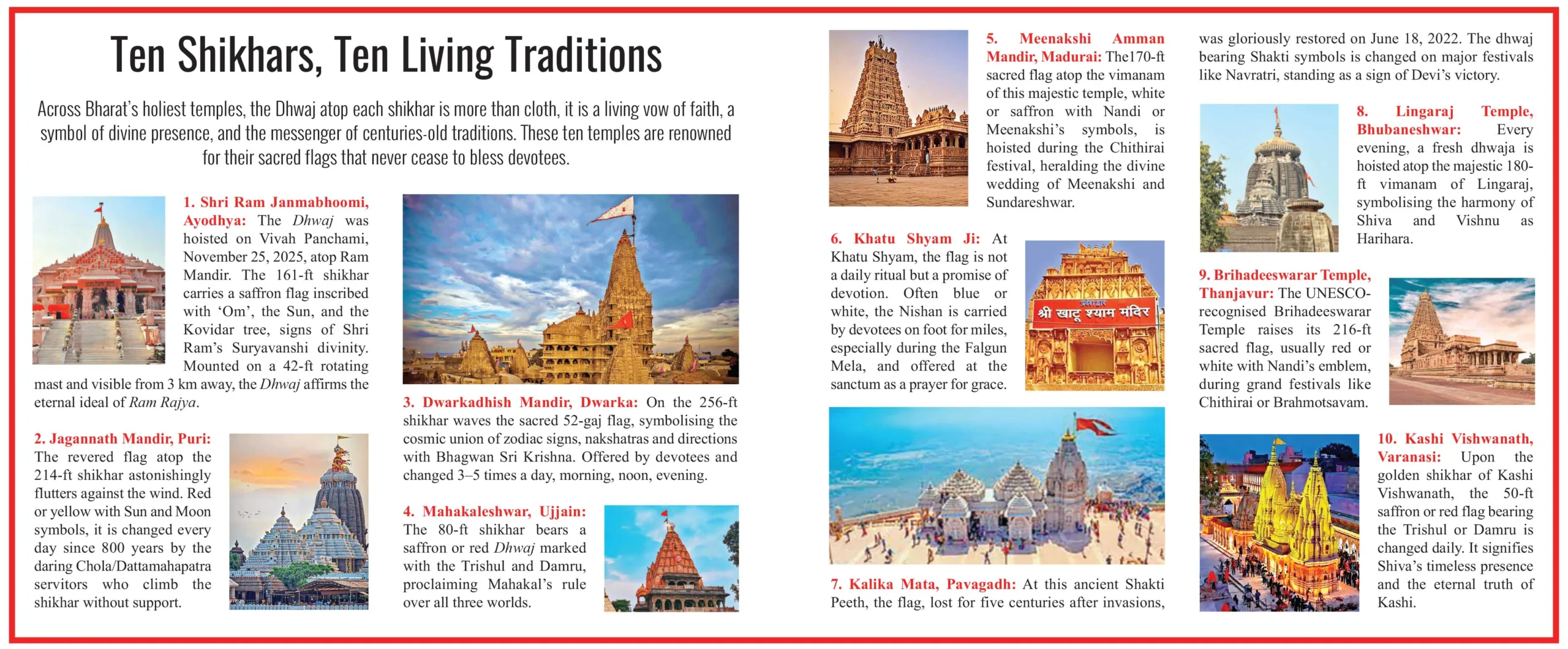
The Dhwaj hoisted on the Mandir carries on it the three civilisational motifs as the signet of the family to which Ram is born, the Suryavansh or the Solar Dynasty: the dazzling disk of the Sun represents the inexhaustible and pure energy, accompanied by the sacred syllables of Om, which reverberates as the eternal and spiritual sound, Shabda, under the calming and fragrant shade of Kovidara tree. This primordial tree has been celebrated over the millennia by hundreds of sages and poets of Bharat as the flowering of pure and prosperous rule of Ram, the order of a society or people which even became the envy of the heavenly order, if there is one.

This gigantic saffron flag, designed and made in right-angle triangular shape, 22 feet in horizontal length and 10 feet in vertical height, scales the top, Shikhara, of the main temple, symbolising renunciation, sacrifice, and the banner of Dharma. The tip of the Dhwaj, in consonance with the pinnacle Kalash or the cupola of the temple, touches the 191th feet from the ground and can be seen from a considerable distance. Thus, the elevation of this Dharma Dhwaj at the Ramjanmabhoomi Mandir dominates the skyline of the sacred city. This ceremony also culminates into a collective emotion of generations of people of the Hindu civilisation, who have waited in silence of torment to see the restoration of the glory of the Ram Mandir in Ayodhya, and reparation of their cultural value, which was sought to have been mutilated.

The journey and struggle of over five centuries, at least, of the people who considered Ram as their Dharma vigraha, the ideal idol, to worship has been wounding and torturous. Revered sage Valmiki describes in his Ramayan the order, the danda of Rama, known as Ram Rajya, “each person under the rule of Ram was contented and all submitted themselves to truth (Dharma); the emotions of the people were becalmed as soon as they though that Ram was their ruler; the climate of Ram Rajya was conducive to living happily; the rains would come only when they were needed and the gentle draft of the breeze tickled delight in the people.”

This ceremony has thus served as the catharsis, the realisation of aspiration and the dream of millions of devotees of Ram.

Topics: Ramjanmabhoomi MandirSaffron FlagDharmaHindu civilisationDharma Dhwaj
ShareTweetSendShareSend
✮ Subscribe Organiser YouTube Channel. ✮
✮ Join Organiser's WhatsApp channel for Nationalist views beyond the news. ✮
Previous News

Reminiscing India-Russia Relations: A testament for strategic autonomy & timetested trust in the great power playbook

Next News

How centuries of division pushed Sikhs away from their divine mission

Related News

Bharateeya Santa Mahaa Parishhad (BSMP) organised its Global Conference at the Ramakrishna Mission

Delhi: Bharateeya Santa Mahaa Parishhad Global holds conference to unite Indic traditions

Tribal communities in India have historically been an integral part of a broader, inclusive civilisational framework rooted in shared cultural and spiritual traditions

Tribal Communities in India: Integral to the Hindu civilisational tradition

Love Jihad and the TCS Nashik Case: A civilizational wake-up call for the Hindu society

Representative Image

Hindutva as political ideology or civilizational framework?

Kodandarama Temple, Ontimitta, Andhra Pradesh

The Legacy of Mala Obanna at Kodandarama Temple: A Doctrine Restoring the Dharma of Bhakt and Bhagwan

India’s Constitutional Morality and Message of Vasudhaiva Kutumbakam – One Earth, One Dharma, One Family, One Future

Load More

Latest News

The Vedic age saw remarkable women sages, known as Rishikas, who composed hymns and shaped India's spiritual and philosophical heritage

Rishikas of Vedic Age: How Gargi, Maitreyi & other women shaped ancient India’s spiritual and philosophical tradition

Police in AAP-Ruled state of Punjab lathi charge sit-in protesters

Punjab: ITI candidates seeking jobs lathi-charged outside PSPCL HQ; opposition slams AAP Govt over police action

From constables to DGP, India's police system follows a structured chain of command that governs law enforcement across the country

From Constable to DGP: Understanding India’s police hierarchy, powers & recruitment system

The terracotta dice that challenges historical assumptions and highlights India's millennia-old civilisational heritage

How a 4,500-year-old terracotta dice is reviving the debate on India’s civilisational continuity & Vedic heritage

The Porumamilla inscription and the ancient science behind a reservoir that survived 650 years

India’s 655-Year-Old Water Policy: The Porumamilla inscription that turned stone into a manual of hydrology

India’s Permanent Representative to the United Nations Ambassador Harish Parvathaneni

India slams Pakistan at UNSC for peddling false narratives on Jammu & Kashmir

Keralam: Pathanamthitta temple property occupied beyond lease period reclaimed by devotees

A series of high-level engagements signals New Delhi's growing focus on building interoperable security networks across the Indo-Pacific

India strengthens Indo-Pacific security architecture with new defence and maritime partnerships

Prime Minister Narendra Modi

“Makes every Indian proud”: PM Modi hails India’s 7.7 per cent GDP growth in FY 2025-26

Once known for maoist violence, Minpa now leads healthcare revolution with telemedicine services in Sukma

From Maoist Stronghold to Healthcare Hub: How Chhattisgarh’s Minpa is transforming through telemedicine & development

Load More
  • Privacy
  • Terms
  • Cookie Policy
  • Refund and Cancellation
  • Delivery and Shipping

© Bharat Prakashan (Delhi) Limited.
Tech-enabled by Ananthapuri Technologies

  • Home
  • Search Organiser
  • Bharat
    • Assam
    • Bihar
    • Chhattisgarh
    • Jharkhand
    • Maharashtra
    • View All States
  • World
    • Asia
    • Africa
    • North America
    • South America
    • Europe
    • Australia
  • Editorial
  • Operation Sindoor
  • Opinion
  • Analysis
  • Defence
  • Culture
  • Sports
  • Business
  • RSS @ 100
  • Entertainment
  • More ..
    • Sci & Tech
    • Vocal4Local
    • Special Report
    • Education
    • Employment
    • Books
    • Interviews
    • Travel
    • Health
    • Politics
    • Law
    • Economy
    • Obituary
  • Subscribe Magazine
  • Read Ecopy
  • Advertise
  • Circulation
  • Careers
  • About Us
  • Contact Us
  • Policies & Terms
    • Privacy Policy
    • Cookie Policy
    • Refund and Cancellation
    • Terms of Use

© Bharat Prakashan (Delhi) Limited.
Tech-enabled by Ananthapuri Technologies