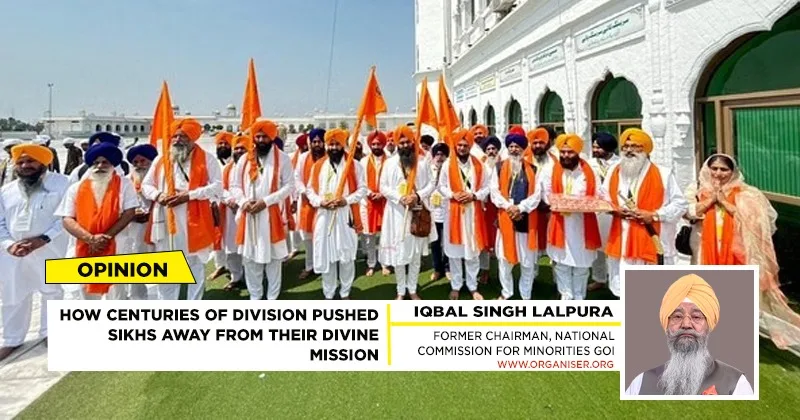
The Sikh community has just concluded the commemoration of the 350th Martyrdom Anniversary of Sri Guru Tegh Bahadur Ji, who sacrificed his life to protect the freedom of worship. Across India and abroad, Government institutions, community organisations, and Sikh bodies spent large amounts of money on events, samagams, processions, sweets distribution, and the illumination of Gurdwaras. Yet, Sikh philosophy places no special spiritual weight on ceremonial dates. In the Guru period, the Misls era, and the reign of Maharaja Ranjit Singh, there is no historical evidence of such grand celebrations. Sikh tradition teaches that every day is sacred, and remembrance lies not in display but in living the Guru’s command. This raises a difficult question: what real gain emerges from heavy expenditure on rituals that the Gurus themselves did not promote? And more importantly, where does the Sikh community stand today, religiously, politically, socially, and psychologically, on the global stage?
The Sikh community was created by Guru Nanak Dev Ji, one who lives with purity, compassion, courage, and service to all humanity. Guru Gobind Singh Ji transformed this saintly tradition into the Sant Sipahi, the “saint-soldier” who protects righteousness fearlessly. This divine army revolutionised the spiritual landscape of India by breaking the old mould of ritualistic religion and establishing the Nirmal Panth.
The Khalsa ended centuries of foreign domination, restored dignity to the oppressed, and replaced ritual with revelation. But as history progressed, divisions within Sikh groups and political Misls weakened this spiritual and military strength. By the time of Maharaja Ranjit Singh, the last sovereign ruler of the Khalsa Raj, unity had already begun to crack. When the British arrived, they found local allies, including some Sikh chiefs, who assisted in taking over Punjab in 1849.
With political power gone, religious institutions also slipped away. Gurdwaras were gradually taken over by hereditary priests (Granthi), and rituals the Gurus rejected began creeping back. A class of miracle-performing Babas, some equating themselves with God or the Guru, some acting as builders or political brokers, diverting Sikhs away from the pure teachings of Sri Guru Granth Sahib Ji and towards personality cults.
The British ensured that no united Sikh leadership emerged. Even constructive movements like the Singh Sabha and later the SGPC had to fight the British system at every step. Alongside genuine reformers, pro-British Sikh leaders were promoted, causing confusion within the community. After Independence, little changed. Congress inherited the British strategy of divide-and-rule, and new Sikh leaders aligned with political interests rather than Panthic principles. Confusion deepened, and the once united community that shook empires found itself struggling for clarity and direction.
As this leadership vacuum expanded, Sikhs, once revered as protectors—began to be labelled as extremists or separatists. There is no strong global organisation that articulates Sikh concerns, counters false narratives, or provides psychological healing to a community that has repeatedly faced violence, discrimination, and political betrayal. Emotional wounds were never addressed. Trauma was inherited across generations, and negative memories became ingrained, affecting behaviour and political reactions. Psychology and medical science explain that continuous exposure to fear or negative messaging increases cortisol levels, weakens memory, distorts judgment, and leads to anxiety or aggression. A community that once produced fearless protectors now often finds itself trapped in cycles of fear, fear of being labelled, fear of losing identity, fear of political manipulation. Many people and groups exploit this fear. Instead of reasoning, many Sikhs are influenced by emotional appeals, conspiracy theories, and social media propaganda. This creates internal suspicion, prevents unity, and leaves the community vulnerable.
The world has changed, and other persecuted communities have adapted. The Jewish community, after facing almost total destruction, rebuilt itself through education, unity, dialogue, and a strong global network. They invested in institutions, research, diplomacy, and collective leadership. While the Jews strengthened themselves across continents, Sikhs ,despite far greater courage and historical strength ,remain fragmented. There is no single Sikh think-tank, no global coordination mechanism, no research institution of international scale, and no unified political voice. The three pillars of democracy, legislature, executive, and judiciary, no longer have meaningful Sikh influence. The fourth pillar, the media, also lacks Sikh presence. Instead, internal divisions continue, often fuelled by groups that emotionally blackmail the masses by projecting themselves as defenders of the faith.
Some leaders keep warning the community that the RSS or the Central Government is the enemy. But this narrative is factually weak. RSS is not an enemy; it simply operates with a wider canvas. Instead of jealousy or fear, Sikhs too must think bigger and create institutions that match global needs. As far as the central government under the present Prime Minister Narendra Modi, is concerned, sincere efforts are being made to provide relief to victims of past massacres and to take action against the guilty. Under his leadership, Indian embassies worldwide now celebrate Sikh history and Gurpurabs, giving global respect to the Sikh faith. Such gestures deserve appreciation, not unwarranted criticism.
Unfortunately, some elements across the border exploit fear to mislead Sikh youth. Guru Gobind Singh Ji said that the “Turk” symbolising oppressors, would flee before the spirit of the Khalsa. But today, instead of confronting fear, some external forces manipulate Sikh vulnerabilities and promote militancy for their own purposes. The world no longer tolerates violence, and such paths only damage the community further. What the Panth needs is not anger or aggression, but clarity, strategy, education, and unity.
The psychological healing of the Sikh community begins with returning to Gurbani. Gurbani is the finest medicine for a wounded mind. Meditation on Naam reduces stress, stabilises the mind, and strengthens emotional resilience. Guru-oriented living brings discipline, clarity, and self-respect. When a community connects with its Guru, ritualism fades, fear recedes, and courage returns in its purest form. Sikhs must also embrace dialogue, within families, within the Panth, and with the nation. Dialogue reduces fear, builds trust, and ends manipulation by vested interests. A community that talks openly cannot be emotionally blackmailed. Another priority is investment in education. The future lies in universities, research centres, digital platforms, and global institutions that promote Sikh history, Sikh rights, Sikh philosophy, and Sikh perspectives in international forums. Knowledge gives power; without it, even the brave becomes helpless.
The Sikh community must also rebuild collective leadership. The fault lies with Sikhs in positions of influence who prefer personal gain over community welfare. The Guru established the Khalsa as a democratic order, where decisions were taken collectively through Gurmatta. This tradition must be revived. Leadership should not revolve around politics, biradari, or foreign influence. It should emerge from wisdom, learning, humility, and service. Wherever possible, Sikhs should build alliances with other communities, strengthening bonds instead of isolating themselves. India is changing rapidly. Sikhs have contributed to every field, defence, industry, agriculture, sports, judiciary, administration, but the community must broaden its canvas to remain relevant in a global environment.
The Sikh Panth has endured martyrdoms, battles, betrayals, and political manipulation for centuries, yet it still stands strong. But standing is not enough; the time has come to rise again with clarity, confidence, and unity. The way forward is simple: return to the Guru’s path, heal the mind, end fear, embrace education, practise dialogue, and build collective leadership. The Gurus created the Sikhs to be protectors of humanity, defenders of truth, and servants of justice. The community must reclaim this divine mission with discipline and unity.
Only then will the spirit of Guru Tegh Bahadur Ji truly be honoured, not through costly celebrations, but by living the values he died to protect. Let us build a permanent friendship between those who wear the Tilak and Janju and the sons of Guru Gobind Singh Ji, who is remembered in the saying: “Na kahun ab ki, na kahun tab ki. Agar na hote Guru Gobind Singh, sunat hoti sab ki.” Such unity will strengthen our community, rebuild our confidence, and help us reclaim our lost glory.