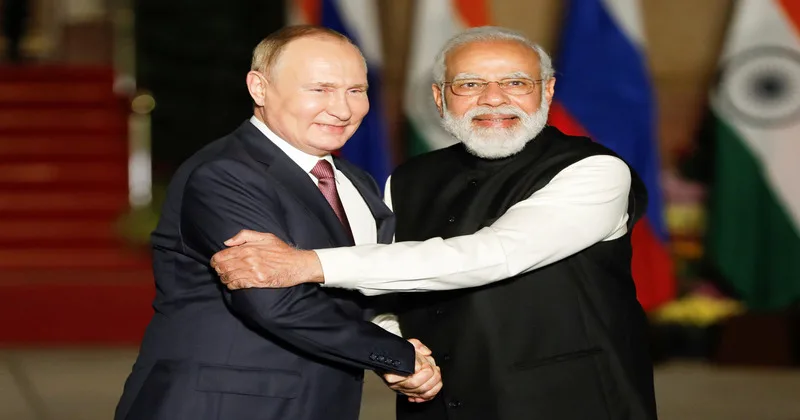
New Delhi is all set for a historic display of the time-tested trust and partnership between India and Russia. The countdown has commenced for the visit of Russian President Vladimir Putin to India for the 23rd India-Russia Annual Summit. The high-stake summit between Prime Minister Narendra Modi and Russian President Vladimir Putin indeed echoes the strength of the decades of friendship which is rooted in mutual respect, trust and bilateral benefit, devoid of any geopolitical overtures.
However, the upcoming summit symbolises greater strategic significance, beyond bilateral accomplishments. It signals a strong message regarding the core principles of New Delhi’s diplomatic book which includes, strategic autonomy, national security, domestic economic stability, mutual respect and prosperity, devoid of any geopolitical assertions. India’s diplomatic book is also etched with the emblem of multi-alignment, with the ultimate motto of securing its national interests. India, indeed walks by these strategic principles, despite the current era geopolitical chessboard which is witnessing an embryonic shift.
The Russian Federation fits in this diplomatic puzzle of India perfectly. A time-tested partner has been a consistent co-traveller in the geopolitical voyage of India. Especially in the current decade, when the world-nations are undergoing once in a century transformation and the geopolitical lexicon is witnessing rapid cross connections with shifting alliances and transactional attitudes, India-Russia partnership stands as the grammar book for a balanced, mutually beneficial and trusted partnership. In this direction, here is a revisit to the diplomatic path of New Delhi and Moscow over decades.
New Delhi-Moscow relations: A grammar note for sound diplomatic ties
Beginning of bilateral relation: The bonhomies between India and Russia date back to 1947 when India achieved independence from British colonialism. India and then USSR relations gained further momentum in the 1950s under the rule of Joseph Stalin. Since then, Russia has been a key development partner for India’s growth story. Russia has been a pivotal partner for India in restoring balance of power in the region of South Asia, especially during the Cold War era, with heightened geopolitical tensions.
A new era of friendship from 1971: India-USSR partnership gained a fundamental fuel for further cooperation, with the signing of the Indo-Soviet Treaty of Peace, Friendship and Cooperation in 1971. This marked the beginning of a new era in diplomatic partnership, in terms of defence ties, trade, investment, space partnership to cooperation in the civil nuclear arena. For example, in 1975, India’s maiden satellite ‘Aryabhatta’ was sent on the launch vehicle of the USSR ‘Soyuz’. In 1988, an agreement was sealed to foresee cooperation in the civil nuclear project at Kudankulam.
Marking comprehensive partnership from 2000: The India-Russia strategic relations, reached a new milestone and heralded a new chapter in the year 2000 with the signing of the ‘Declaration on the India-Russia Strategic Partnership’. Since then, the bilateral relations have reached benchmark heights in a comprehensive way encompassing security, defence, trade, science, technology, trade, culture and people-to-people ties. Since 2000, India-Russia Annual Summit has also been anchored with the visit of Russian President Putin to India. A remarkable number of 22 summits have been completed as of now, thus unlocking a huge potential of bilateral cooperation. President Putin will reach New Delhi this week, for the historic 23rd annual summit, thus aiming to unleash further potential of the strategic ties in an era where world order is evolving into an increasingly contentious zone, militarily, politically and economically.
A ‘Special and Privileged’ partnership from 2010: In the year 2010, India and Russia elevated the bilateral strategic relations to a ‘Special and Privileged Strategic Partnership’. With this, diplomatic relations are in full swing with a series of treaties, MoUs, bilateral exchanges etc. In the year 2021, both nations initiated 2+2 Ministerial dialogue between the Foreign and Defence Ministers of both the countries to further bolster a solid partnership in the security and strategic area.
- India-Russia defence doctrine
Defence relations form a fundamental pillar in the comprehensive India-Russia relations. In the current decade, India is diversifying its defence partners in addition to seeking self-reliance with strong defence indigenization potential. Yet, Russia accounts for 36 per cent of India’s defence imports and is the apex defence partner of the country.
India-Russia defence partnership has shifted from being a mere buyer-seller model to fostering partnership in joint research, co-production and development of the advanced military technologies. BrahMos is the biggest example for this, as lately a BrahMos production unit was unleashed in Lucknow. In fact, the S-400 purchased from Russia, despite opposition from the United States, was hailed as a ‘game changer’ during Operation Sindoor that helped India to etch a strategic edge against Pakistan.
- Bilateral trade, energy partnership and economic security
The India-Russia Intergovernmental Commission for Trade, Economic, Scientific and Cultural Cooperation(IRIGC-TEC) is the key governmental platform to foster bilateral trade and economic partnership. As of 2023-24, India-Russia bilateral trade stands at USD 65.70 billion and both countries aim to achieve the feat of USD 100 billion trade by 2030. The main imports to India include crude oil and other energy products. Meanwhile, India’s exports to Russia comprise pharmaceuticals, steel, iron etc.
India-Russia energy partnership has particularly catched the global attention since the outbreak of the Russia-Ukraine conflict in 2022. Despite, western pressure and lately the Trump tariff threat India continues to import oil from Russia, a clear testament to the fact that India’s strategic autonomy and energy security priorities cannot be compromised for hegemonic ambitions. India has repeatedly asserted that its energy purchase decisions are rooted in protecting the energy security of its 1.4 billion people. By purchasing the Russian oil, India has also played a key role in stabilizing the energy market from extreme price and supply chain volatility. India-Russia energy partnership is thus a strong strategic message to the world that the nation and the interests of its people are of utmost prominence rather than hegemonic ambitions.
- Connectivity and infrastructure credentials
Another key pillar of the India-Russia relations is consolidating ambitious connectivity projects to foster greater trade, investment and people-to-people links. For example, the International North South Transport Corridor(INSTC) connecting India and Russia via Central Asia, Chennai-Vladivostok Eastern Maritime Corridor is a reflection of the connectivity ambitions that are in the path of realizing full potential, which is being delayed due to geopolitical uncertainties.
Russia: A geopolitical factor to seek balance of power
Apart from solid defence, trade and energy relations, New Delhi considers Moscow as a credible partner to ensure balance of power in Asia and beyond in an era of enhanced geopolitical uncertainties and great power competition. Especially in Assia, trusted partnership with Russia helps India to navigate the challenges posed by the expansionist ambitions of China. The China-Russia bonhomie can help India establish a diplomatic deterrence, ensure adequate checks and balances and ultimately defend its national security.
With the never-ending hegemonic ambitions of the US and its shifting alliances based on the geopolitical timing, a time-tested and trusted partner like Russia helps India sail across the strategic challenges. For example, currently, under President Donald Trump, the US is tilting its alliance towards Pakistan, which is a repeat of history. Meanwhile, the Trump administration is irrationally targeting India. At such a critical scenario, Russia is a credible, steady and reliable partner for India, irrespective of the emerging circumstances.
In this backdrop, the upcoming visit of Russian President Vladimir Putin to New Delhi is being keenly watched by the world nations. However, the strategic symbolism is clear. India upholds the principle of multi-alignment and respects its time-tested and stable partner and the geopolitical moves of New Delhi are based on the priorities of national security and prosperity in an increasingly polarised and transactional world. Hegemonic powers cannot dictate the diplomatic moves of New Delhi, is the ultimate reflection.
The path ahead: Crafting bilateral bonhomie and balanced world order
The 23rd India-Russia Annual Summit resonates these ethos and seeks to further consolidate the bilateral relations. In terms of trade, the goal is to articulate pathways to achieve USD 100 billion bilateral trade by 2030. Defence cooperation is the key pillar of the summit. Russia and India aspire to further revolutionise the defence partnership in terms of joint research, production, military exercises, mutual sharing of key naval bases, ensuring logistics support etc. Both nations also aim to channelize more opportunities in each other’s frontiers. For example, India seeks to gain access to the Arctic region, given its resource richness, similarly Russia aims to expand its footprint in the Indian Ocean Region(IOR), thus aiming to accelerate the balance of power. To realize these goals, both nations have sealed the Reciprocal Exchange of Logistics Agreement(RELOS), which is to be ratified by the Russian Parliament.
Reports also assert that India aims to hold talks to purchase the Su-57 fighter jets from Russia. Su-57 is a fifth generation fighter aircraft induced with advanced and cutting-edge technologies. The second military equipment under consideration for the purchase is the S-500. It is said to be the updated version of the S-400 missile system that bolstered India’s offensive and defensive capabilities during Operation Sindoor.
On these lines, the New Delhi-Moscow summit can be articulated as a path to re-energize and reorient the trusted and time-tested partnership which has been carefully choreographed for decades. It is an opportunity to craft futuristic vision statements and realize strategic autonomy. The summit aims to echo the message of multi-alignment and balance of power in a hitherto world poised with polarization and hyper transactionalism where the alliances are oscillating without stability across the great power playbook.