Twin Radio Galaxies systems where two supermassive black holes launch pairs of jets at the same time are among the rarest cosmic structures known to science. Only three such systems have ever been identified and each one offers astronomers a glimpse into some of the deepest forces shaping the universe. The most recent discovery was made in 2022 using India’s upgraded Giant Metrewave Radio Telescope (uGMRT), has now provided scientists a new finding. Researchers have successfully recreated its unusual structure through detailed simulations, allowing them to trace the hidden forces shaping these enormous jets and the galaxies that host them.
This newly discovered object, named TRG J104454+354055 is rare because of its remarkable clarity with which both sets of plasma jets can be observed. Each jet stretches nearly 0.3 million light-years and the two black holes that power them are separated by about 0.1 million light-years. The jets curve, twist and bend forming helical patterns that clearly signal a complicated internal motion. Understanding what causes these shapes has long been a challenge and this system has now offered a chance to find answers.
Cosmic Rarity Born from Galactic Mergers
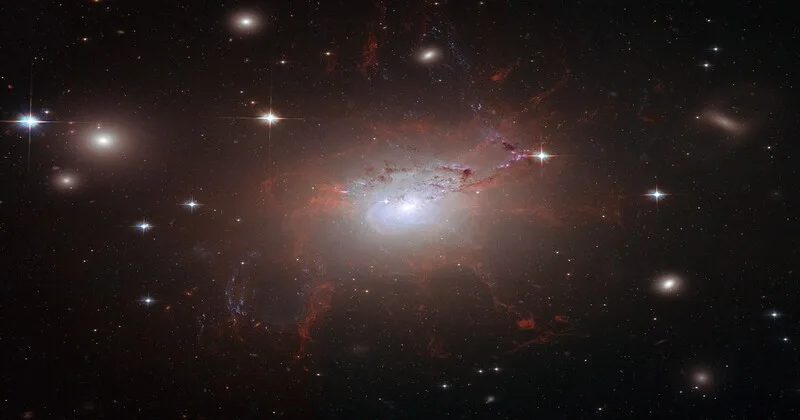
To understand why TRGs are so rare, as it helps to look at how galaxies evolve. Most of the large galaxies contain a supermassive black hole at their center. These black holes grow by drawing in matter, forming a disk of spinning material around them. While feeding few black holes that shoots long and powerful jets of charged particles. These jets travel far into space and are best seen in radio wavelengths.
Galaxies regularly merge with one another and when that happens, their central black holes move closer together. In rare cases both black holes remain active and launch jets simultaneously. When this occur astronomers see two distinct pairs of jets emerging from the same system creating a Twin Radio Galaxy. Only two such systems were known for over three decades, until the discovery of TRG J104454+354055 added a third.
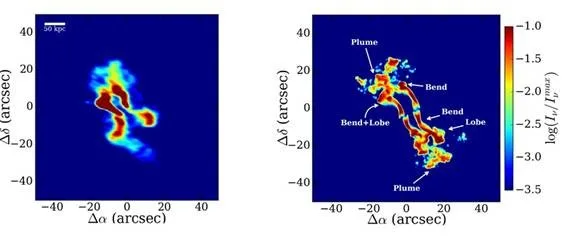
When Indian astronomers examined data from the uGMRT, they found a unique structure of two sets of straight yet slightly curved jets, displaying obvious helical patterns. The symmetry of the structure suggests that both black holes were active at the same time, something extremely unusual happens in galactic evolution.
Even more exciting was the clarity of the jet paths. Unlike earlier TRGs, where the jets appeared faint or distorted, this system has allowed scientists to see bends, lobes and plumes along the entire length. This level of detail provided an excellent opportunity to investigate how the jets formed their present shapes.
Turning Simulations into a Telescope of Time
Research team from the Indian Institute of Astrophysics (IIA) saw this as chance to answer long-standing questions. The team led by scientist Santanu Mondal, used detailed three-dimensional simulations to recreate the system’s evolution. Their goal was to understand how two black holes separated by such a large distance could produce jets that remain neatly aligned yet show a pattern of bends and twists.
They fed various environmental conditions into their models different densities of surrounding gas, different speeds of jet flow and different angles at which the jets might have been launched. None of these factors alone could fully recreate the wiggling patterns seen in the real images. The turning point came when the researchers incorporated a slow and steady precession of the jets.
Precession is a gentle change in direction similar to how a spinning top slowly wobbles even as it continues to spin. For black holes precession can occur when the disk of matter feeding the black hole is slightly misaligned with the black hole’s spin. As the disk shifts the direction of the jet changes gradually over time. The team realized that adding this effect allowed the simulated jets to match the helical shapes seen in the observations.
What the Simulations Revealed
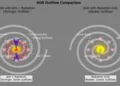
The simulations showed that precession played a decisive role in shaping the observed morphology. Without it the jets would have been relatively straight and free of bends. With precession included, the models produced jets that wiggled laterally while still moving steadily forward and mirroring the pattern seen in the radio images.
A major surprise was the scale at which precession operated. Even though the two black holes are separated by nearly a million light-years, the gravitational tug between them was still strong enough to influence the direction of their jets. This finding suggested that the mutual pull between the black holes has been shaping the jets for nearly 190 million years, steadily guiding their evolution.
The simulations also showed that the jets do not interact with each other. Instead, each pair moves independently by maintaining a parallel course. This supported the idea that both black holes were active simultaneously during the system’s evolution, confirming that TRG J104454+354055 is a genuine Twin Radio Galaxy.
Why This Matters for Astronomy
These findings open doors to a deeper understanding of how jets behave in extreme environments. Jets are among the most powerful structures produced by black holes, much about their formation and motion remains poorly understood. Studies like this one help reveal how the surroundings of a black hole influence the path of these jets, how they deposit energy into space and how they shape the host galaxy.
The research also provides a model for studying future discoveries. With next-generation telescopes like the Square Kilometre Array (SKA) expected to uncover many more unusual radio sources, the ability to recreate jet evolution through simulations becomes essential. The success of this study demonstrates that detailed computer modelling can act as a kind of time machine, allowing astronomers to reconstruct how cosmic structures developed over millions of years.
Step Toward Understanding the Universe’s Rarest Giants
Twin Radio Galaxies remain among the universe’s most extraordinary phenomena. It represents a moment when two massive cosmic engines operate in parallel, producing jets that stretch across vast distances. TRG J104454+354055 discovered through Indian observational capability and explained through Indian-led simulations.
By revealing how gentle shifts in direction, caused by slow gravitational influences can make cosmic structures, the study has added a crucial piece to the complexity of galactic evolution. It shows that even the most powerful features in the universe can be shaped by small but persistent forces acting over immense periods of time. The TRG is not just about two black holes launching jets. It is about how scientists decode the universe one observation, one simulation and one breakthrough at a time.