Indian study shows supermassive black holes halt star formation
June 13, 2026
  • Read Ecopy
  • Circulation
  • Advertise
  • Careers
  • About Us
  • Contact Us
Android AppiPhone AppArattai
Organiser
  • ‌
  • Bharat
    • Assam
    • Bihar
    • Chhattisgarh
    • Jharkhand
    • Maharashtra
    • View All States
  • World
    • Asia
    • Europe
    • North America
    • South America
    • Africa
    • Australia
  • Editorial
  • International
  • Opinion
  • RSS @ 100
  • More
    • Op Sindoor
    • Analysis
    • Sports
    • Defence
    • Politics
    • Business
    • Economy
    • Culture
    • Special Report
    • Sci & Tech
    • Entertainment
    • G20
    • Azadi Ka Amrit Mahotsav
    • Vocal4Local
    • Web Stories
    • Education
    • Employment
    • Books
    • Interviews
    • Travel
    • Law
    • Health
    • Obituary
  • Subscribe
    • Subscribe Print Edition
    • Subscribe Ecopy
    • Read Ecopy
  • ‌
  • Bharat
    • Assam
    • Bihar
    • Chhattisgarh
    • Jharkhand
    • Maharashtra
    • View All States
  • World
    • Asia
    • Europe
    • North America
    • South America
    • Africa
    • Australia
  • Editorial
  • International
  • Opinion
  • RSS @ 100
  • More
    • Op Sindoor
    • Analysis
    • Sports
    • Defence
    • Politics
    • Business
    • Economy
    • Culture
    • Special Report
    • Sci & Tech
    • Entertainment
    • G20
    • Azadi Ka Amrit Mahotsav
    • Vocal4Local
    • Web Stories
    • Education
    • Employment
    • Books
    • Interviews
    • Travel
    • Law
    • Health
    • Obituary
  • Subscribe
    • Subscribe Print Edition
    • Subscribe Ecopy
    • Read Ecopy
Organiser
  • Home
  • Bharat
  • World
  • Operation Sindoor
  • Editorial
  • Analysis
  • Opinion
  • Culture
  • Defence
  • International Edition
  • RSS @ 100
  • Magazine
  • Read Ecopy
Home Bharat

Indian study reveals how supermassive black holes halt star birth & shape the fate of their galaxies

A new study by Indian astronomers reveals how supermassive black holes regulate galaxy evolution by ejecting gas through radiation and high-speed jets, suppressing star formation and offering fresh insights into why some galaxies stop creating stars altogether

Vivek KumarVivek Kumar
Oct 31, 2025, 06:30 pm IST
in Bharat
Follow on Google News
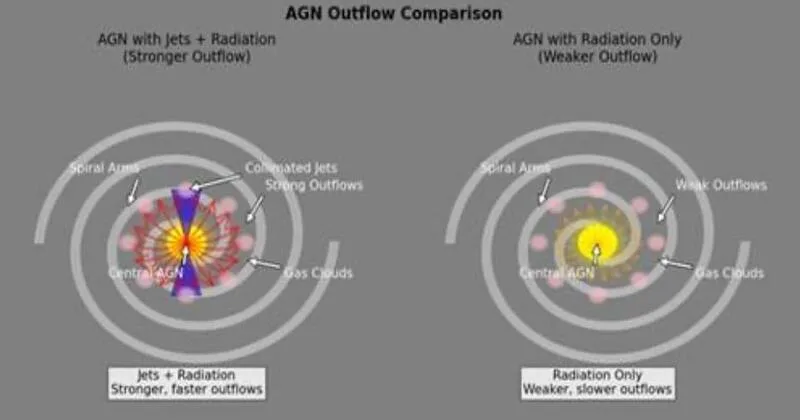
A schematic diagram representing AGN with both jets and radiation drive stronger outflows compared to AGN powered only by radiation, leading to differing impacts on their host galaxies

A schematic diagram representing AGN with both jets and radiation drive stronger outflows compared to AGN powered only by radiation, leading to differing impacts on their host galaxies

FacebookTwitterWhatsAppTelegramEmail

Recent research has shown how supermassive black holes in the centre of galaxies may be holding back the formation of new stars within and around them. This finding not only completes a vital part of the cosmic jigsaw of galaxy evolution but also provides one explanation for why some galaxies seem nearly star-dead in their potential.

Powerful engines of the universe

Supermassive black holes, weighing millions or even billions of times that of the Sun, sit at the centre of many galaxies. Though these giants are famous for their gravitational force, their impact is far beyond devouring matter. They emit huge quantities of energy in the form of radiation and energetic particle jets, shaping their host galaxies in deep ways.

Astronomers have mapped these feedback processes to learn how black holes work with their environment to learn how galaxies change over time. But one mystery remained: what regulates the formation of stars more, the outflow of gas from the black hole’s activity or the powerful radiation spewing out of its environment?

A landmark study from Indian lab

A group of scientists from the Indian Institute of Astrophysics (IIA), a self-governing institute of the Department of Science and Technology (DST), has now given significant answers. In their study, released in The Astrophysical Journal, they have found that both the radiation ejected close to black holes and the jets they shoot into space collaborate to expel gas from the galaxy centres. This energetic duo can successfully stop new stars from forming in those regions.

The research was conducted by Payel Nandi, a PhD student at IIA, with co-authors being C. S. Stalin of IIA and Dhruba J. Saikia of the Inter-University Centre for Astronomy and Astrophysics (IUCAA). By thoroughly studying galaxies across various wavelengths, the researchers revealed how these forces play out and how they influence the evolution of galaxies.

Also Read: Major Conflicts Between Sardar Patel and Nehru: How Nehru’s policies undermined Sardar Patel’s united Bharat vision

Decoding the galactic winds

Employing the data available from the Sloan Digital Sky Survey (SDSS) and the Very Large Array (VLA), two of the United States-based world-class astronomical observatories where the scientists have observed more than 500 local galaxies with active galactic nuclei (AGN). AGN are the areas near supermassive black holes where material is being actively pulled in, with emitting a strong radiation and occasionally creating high-speed jets of charged particles.
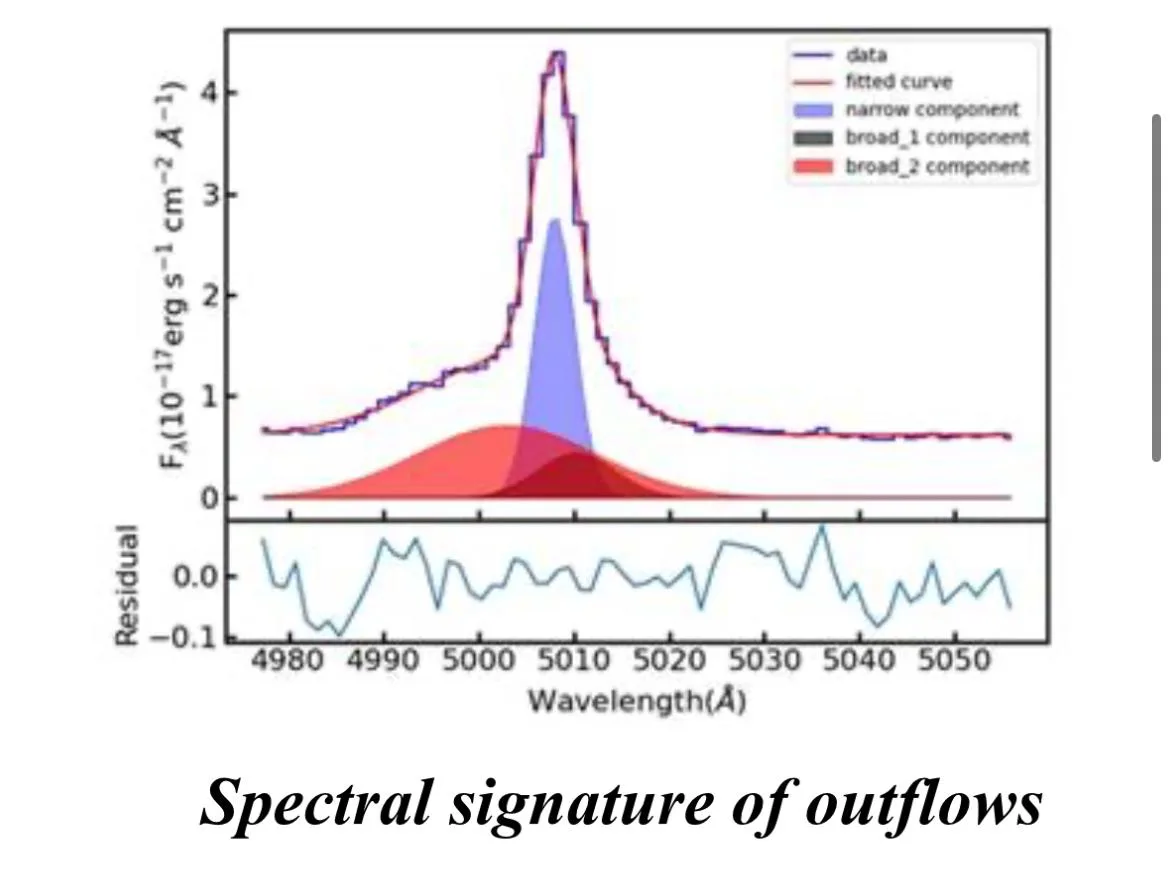
The team focused on the movement of warm ionised gas within these galaxies, essentially the galactic winds blown out by black hole activity. “We found that outflows of warm ionised gas are widespread in AGN,” explains Payel Nandi. “Radiation from the black hole is the main driver, but galaxies with radio jets show significantly faster and more energetic outflows.”

Their analysis showed that outflows occur in over half (56 per cent) of galaxies detected in radio wavelengths, compared to just 25 per cent in galaxies without such emissions. This indicates that the presence of jets, thin, focused streams of matter moving close to the speed of light, greatly enhances the outflow strength. These winds can reach astonishing speeds of up to 2,000 kilometres per second, fast enough to escape the galaxy’s gravitational pull entirely.

When radiation and jets collide

To visualise their results, the team created a schematic model comparing AGN that emit only radiation with those that also produce jets. It clearly showed that galaxies hosting both features have much stronger outflows, meaning they lose gas faster and, as a result, see their star formation nearly shut down in the central regions.

Co-author C. S. Stalin emphasised the value of combining multiple wavelengths of observation “This study highlights how crucial it is to bring together optical and radio data to get a complete picture of galaxy evolution.”

Their findings also revealed a strong link between the energy of these outflows and the total power emitted by the black holes. In galaxies with jets, this relationship became even stronger. While radiation is the main culprit behind these winds, jets act like “boosters,” amplifying the black hole’s ability to eject matter.

Star formation in galaxies depends heavily on the presence of cool, dense clouds of gas. But when a black hole drives much of this gas away or heats it so much that it cannot condense, the galaxy is left starved of raw material for creating new stars. The researchers confirmed this by analysing the optical signatures of the stellar populations and infrared colours, which allowed them to distinguish between gas driven out by black hole activity that is associated with young stars.

Their results clearly pointed to negative AGN feedback, a process where black hole activity suppresses the formation of new stars. In simpler terms, the black hole effectively “starves” its galaxy of the material needed for birth, creating a silent, dormant core.

A step closer to understanding galactic life cycles

This study provides new clarity on one of the most fundamental questions in astrophysics: why do some galaxies stop forming stars while others continue for billions of years? According to co-author Dhruba J. Saikia, “These findings are an important step toward understanding the complex interrelationships between supermassive black holes, radio jets, star formation and the evolution of their host galaxies.”

In the grand cosmic timeline, galaxies seem to go through life cycles, youthful, star-forming phases followed by quieter stages. This research suggests that supermassive black holes may act as the regulators, deciding when a galaxy transitions from one phase to the other. By expelling or warming up the gas that stars require to form, they essentially decide the rate at which their galaxies evolve.

A window into the future of galaxies

This finding also holds implications for the understanding of the evolution of our own Milky Way galaxy. While the black hole at the centre of our own galaxy, Sagittarius A*, is now dormant, it is possible that it may have experienced similar active periods in the past, affecting the star formation rate in the nearby areas.

As astronomers keep exploring the Universe deeper with next-generation telescopes like the James Webb Space Telescope (JWST) and the Square Kilometre Array (SKA) in the future, they will seek to discover more about the way these gigantic forces sculpt galaxies on cosmic time scales. The work of the IIA team is a key part of this endeavour, demonstrating how even the most silent corners of the Universe, the supermassive black holes, have a significant influence on everything around them.

 

Topics: black holeIndian Institute of AstrophysicsGalaxy EvolutionStar FormationSupermassive Black HolesRadio Jets
ShareTweetSendShareSend
✮ Subscribe Organiser YouTube Channel. ✮
✮ Join Organiser's WhatsApp channel for Nationalist views beyond the news. ✮
Previous News

Ghar Wapsi: 140 people revert to Sanatan fold in Sarangarh of Chhattisgarh

Next News

Sagarmanthan 2025: Scripting maritime solidarity, strategising ocean connectivity and securing climate resilience

Related News

Black hole findings by AIIA India

Unlocking Cosmic Secrets: India’s new approach to black holes in tiny galaxies

Indian scientists lift curtain behind the hidden chemistry of a young star

Representative Image

Indian Scientists decoding the universe’s rarest twin radio galaxy

Aditya L1: IIA Director Annapurni Subramaniam says,”First mission that will probe Sun’s innermost part”

The cover page of the April 2022 issue of the science journal Nature Astronomy showcases the image of a 2018 simulation study by Professor Dipanjan Mukherjee (credit: Nature Astronomy)

Study gains new insights into the evolution of galaxies

Load More

Latest News

(Left) Russian President Vladimir Putin (Right) Prime Minister Narendra Modi (Image Credit: ANI)

Russia Day 2026: The ancient civilisational bond between India and Moscow

After the conclusion of the 11th Governing Body meeting of NITI Aayog, the Chief Minister of Tamil Nadu, Joseph Vijay, met Prime Minister Narendra Modi in Delhi

Tamil Nadu: At first NITI Aayog meet, CM Joseph Vijay charts cooperative course with Modi govt unlike DMK

Keralam ex- CM Pinarayi Viajayan and his daughter Veena Vijayan

Keralam: Former CM Pinarayi Vijayan’s daughter Veena Vijayan gets fresh ED summons in Rs 2.78 crore CMRL case

Radical Islamists forced to stop the construction of Bhagwan Ram idol in Bangladesh

Bangladesh: Construction of Bhagwan Ram murti halted amid threats by Islamists; Reflects spiking anti-Hindu hostility

Subash Chander of Bajrang Dal Telangana

Telangana Shocker: VHP demands strict punishment for Md Ghouse in Khammam 12-year-old girl sexual assault case

Rare Rashtrakuta-Era inscription unearthed in Karnataka

Karnataka: Rare Rashtrakuta-Era inscription unearthed, reveals extraordinary bond between king and servant

RBI revokes registration of 135 NBFCs over regulatory violations; 125 financial entities were from West Bengal

Prime Minister Narendra Modi

Even the US bows to PM Modi’s long-standing leadership!

A representative image

A Decade of Revolution: 25 crore out of poverty, 15.8 crore homes with tap water – How Govt schemes changed lives

India–Myanmar Civilisational Connect: Significance of President U Min Aung Hlaing’s visit to India

Load More
  • Privacy
  • Terms
  • Cookie Policy
  • Refund and Cancellation
  • Delivery and Shipping

© Bharat Prakashan (Delhi) Limited.
Tech-enabled by Ananthapuri Technologies

  • Home
  • Search Organiser
  • Bharat
    • Assam
    • Bihar
    • Chhattisgarh
    • Jharkhand
    • Maharashtra
    • View All States
  • World
    • Asia
    • Africa
    • North America
    • South America
    • Europe
    • Australia
  • Editorial
  • Operation Sindoor
  • Opinion
  • Analysis
  • Defence
  • Culture
  • Sports
  • Business
  • RSS @ 100
  • Entertainment
  • More ..
    • Sci & Tech
    • Vocal4Local
    • Special Report
    • Education
    • Employment
    • Books
    • Interviews
    • Travel
    • Health
    • Politics
    • Law
    • Economy
    • Obituary
  • Subscribe Magazine
  • Read Ecopy
  • Advertise
  • Circulation
  • Careers
  • About Us
  • Contact Us
  • Policies & Terms
    • Privacy Policy
    • Cookie Policy
    • Refund and Cancellation
    • Terms of Use

© Bharat Prakashan (Delhi) Limited.
Tech-enabled by Ananthapuri Technologies