Scientists have discovered a unique incident in the history of a young star named T Chamaeleontis, some 350 light-years from our planet Earth. This incident that they were witness to was a peaceful, a partial collapse of the surrounding disk of the young star, revealing a hidden chemical process. This new information is a great resource for understanding the evolution of planetary systems and the preservation of complex molecules during planet forming zones.
T Chamaeleontis also known as T Cha, is a young star like the sun that is still enveloped in a thick disk of gas and dust. Disks surrounding T Cha are known as circumstellar disks and they are where planets form. The disk surrounding the star, T Cha has a huge hole in it, which is estimated to have been caused by the formation of a planet. The star is of great interest to astronomers seeking to learn the behavior of new planets.
The inside part of the circumstellar disk behaves as if it were a dense wall. These dense walls shield the star’s ultraviolet rays from reaching the outside part of the circumstellar disk. These shields are responsible for the protection, although they also obscure the necessary information. Examples of obscured information include molecules such as polycyclic aromatic hydrocarbons abbreviated as PAHs.
PAH have a planar, honeycomb structure composed of carbon and hydrogen atoms similar to benzene rings. They are common in interstellar space and are one of the most primitive chemical compounds from which life might someday arise. It has proved challenging to observe the presence of PAH in the environment surrounding low-mass, Sun-like stars. This is because they do not produce much ultraviolet radiation. Ultraviolet radiation is required to observe the infrared emissions from the PAH.
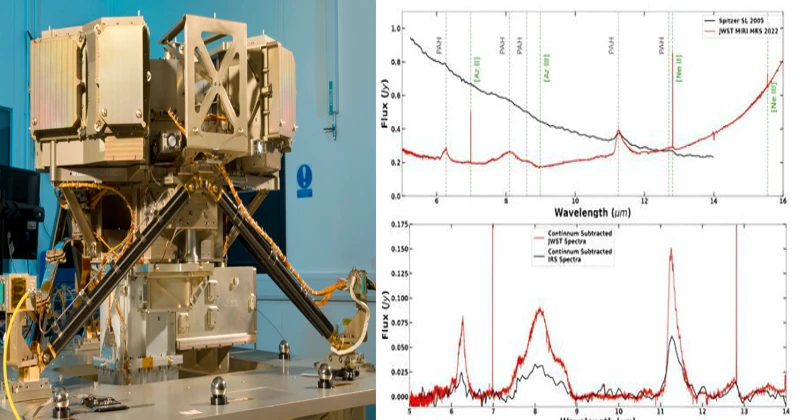
It was at this point that the intervention of chance occurred. In 2022, a series of observations made by the James Webb Space Telescope caught the phenomenon of T Cha at a unique time. The material in the disk was caught falling inward because of a burst of accretion, thinning out the interior wall of the disk. As a consequence, ultraviolet rays radiated outward for the first time in several years.
This sudden illumination caused the PAH molecules in the outer disk to emit brighter signals in the mid-infrared range. This survey was conducted using the Mid-Infrared Instrument (MIRI) onboard the James Webb Space Telescope, which has the sensitivity to pick up even trace signals of chemicals. Researchers at the Indian Institute of Astrophysics, an autonomous body of the Department of Science & Technology processed the data in order to analyze the PAH molecules.
Results have indicated that T Cha is one of the lowest-mass stars with well-detected PAH in its circumstellar disk. This is important as it overturns previous information of PAH being found in sun-like stars. This is what the data analyzed relative to prior data available.
When scientists accessed these archives from the Spitzer Space Telescope in 2002 again, there were trace but definite PAH emissions even then. This indicates that PAH was there in the surroundings of the T Cha system for at least two decades or maybe even longer. The only difference was that in 2002, these PAH emissions were obscured by their visibility in either way because in 2002, these areas were still protected from direct UV emissions in their uncollapsed state, in 2022 the partially collapsed state of PAH emissions were clearly detected by JWST observations.
As the PAH became brighter, their properties did not undergo any changes. The intensity ratio of different emission bands of the PAHs remained more or less the same in the two observation datasets. It is an indication that the molecules did not change over time. As per the research findings, the molecules present inside the disk of T Cha are relatively small and have less than 30 carbon atoms.
This stability is important. This is due to the fact that complex organic molecules like PAHs can resist even when the surrounding conditions are undergoing extensive change with the evolution of a young star.
This study not only demonstrates the interrelation between disk structure, radiation and chemistry in planet-forming disks, but it also utilized a brief variation in the disk to observe the impact of ultraviolet radiation on molecular processes. It also verifies the existence of a relation between the existence of a gap in a disk and the influence it exerts on the chemical environment.
The findings have been published in the Astronomical Journal and demonstrate the one of a kind capabilities of the JWST. At this stage, with the telescope being in its first years of operation, astronomers get a chance to monitor T Cha regularly. By studying changes in the disk and its molecules, astronomers expect to gain a better understanding of Solar System formation, including our Solar System which occurs in a similar manner. What was considered as a thinning of the dust is suddenly became the part of chemistry, thus a formation of planets and life-bearing molecules are no longer a mystery.