Mohan Bhagwat: Strengthening India through culture & discipline
June 29, 2026
  • Read Ecopy
  • Circulation
  • Advertise
  • Careers
  • About Us
  • Contact Us
Android AppiPhone AppArattai
Organiser
  • ‌
  • Bharat
    • Assam
    • Bihar
    • Chhattisgarh
    • Jharkhand
    • Maharashtra
    • View All States
  • World
    • Asia
    • Europe
    • North America
    • South America
    • Africa
    • Australia
  • Editorial
  • International
  • Opinion
  • RSS @ 100
  • More
    • Op Sindoor
    • Analysis
    • Sports
    • Defence
    • Politics
    • Business
    • Economy
    • Culture
    • Special Report
    • Sci & Tech
    • Entertainment
    • G20
    • Azadi Ka Amrit Mahotsav
    • Vocal4Local
    • Web Stories
    • Education
    • Employment
    • Books
    • Interviews
    • Travel
    • Law
    • Health
    • Obituary
  • Subscribe
    • Subscribe Print Edition
    • Subscribe Ecopy
    • Read Ecopy
  • ‌
  • Bharat
    • Assam
    • Bihar
    • Chhattisgarh
    • Jharkhand
    • Maharashtra
    • View All States
  • World
    • Asia
    • Europe
    • North America
    • South America
    • Africa
    • Australia
  • Editorial
  • International
  • Opinion
  • RSS @ 100
  • More
    • Op Sindoor
    • Analysis
    • Sports
    • Defence
    • Politics
    • Business
    • Economy
    • Culture
    • Special Report
    • Sci & Tech
    • Entertainment
    • G20
    • Azadi Ka Amrit Mahotsav
    • Vocal4Local
    • Web Stories
    • Education
    • Employment
    • Books
    • Interviews
    • Travel
    • Law
    • Health
    • Obituary
  • Subscribe
    • Subscribe Print Edition
    • Subscribe Ecopy
    • Read Ecopy
Organiser
  • Home
  • Bharat
  • World
  • Operation Sindoor
  • Editorial
  • Analysis
  • Opinion
  • Culture
  • Defence
  • International Edition
  • RSS @ 100
  • Magazine
  • Read Ecopy
Home Bharat

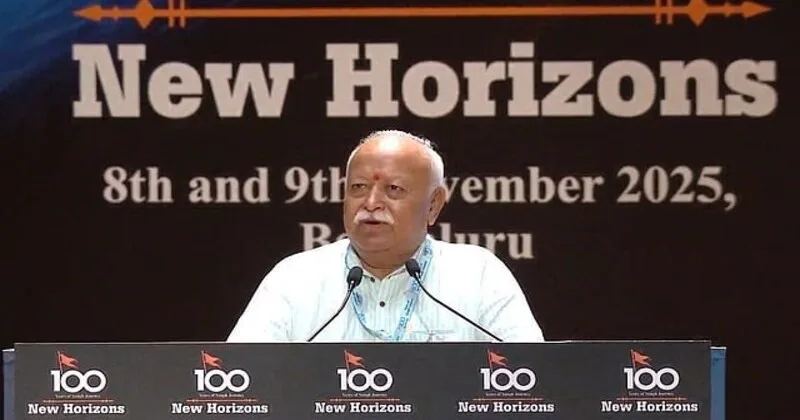
‘RSS at 100 – New Horizons’: Mohan Bhagwat and quest to strengthen India through cultural confidence & inner discipline

Dr Mohan Bhagwat’s Bengaluru address urges India to rediscover the moral and cultural foundations that hold its diverse society together. His call for cohesion focuses not on politics, but on rebuilding trust, character, and civilisational confidence

Debika DuttaDebika Dutta
Nov 19, 2025, 08:00 pm IST
in Bharat, Opinion, RSS in News, Karnataka
Follow on Google News
RSS Sarsanghchalak, Dr Mohan Bhagwat

RSS Sarsanghchalak, Dr Mohan Bhagwat

FacebookTwitterWhatsAppTelegramEmail

Every great civilisation faces a moment when it must pause and ask what truly holds it together. India, with its ancient plurality and restless modernity, stands precisely at such a crossroads. The recent two-day address of Dr Mohan Bhagwat, Sarsanghchalak of the Rashtriya Swayamsevak Sangh (RSS), in Bengaluru was not a partisan proclamation but a civilisational reflection, an appeal to restore the moral and emotional glue that keeps this vast nation from unravelling. His theme was social cohesion, his warning was about the “Breaking India” forces that thrive on our divisions, and his message was both ethical and existential: a society that forgets its shared consciousness endangers its freedom.

Bhagwat’s argument was less political than philosophical. He spoke of unity as a living emotion rather than a mechanical arrangement of interests. For him, the strength of Bharat lies not in power or policy but in sanskriti, the culture that teaches coexistence, restraint, and respect. India, he reminded, has never been a nation forged by conquest but by continuity; its bonds are not legal contracts but moral understandings. When these subtle fibres weaken, no constitution or coercion can prevent disintegration. It was a call to remember that cohesion begins in the mind before it manifests in the state.

The term “Breaking India”, often misunderstood, was used by Bhagwat to describe more than overt hostility. It referred to an ecosystem of ideas, attitudes, and influences that exploit India’s internal differences and cultivate self-doubt about its civilisational worth. He cautioned that cultural colonisation, in the age of social media and ideological mimicry, is far more dangerous than physical invasion. The mind, once deracinated, becomes easy prey for narratives that mock the very foundations of Indian selfhood. His remedy was not aggression but awakening, a revival of confidence rooted in moral discipline and cultural empathy.

The strength of Bhagwat’s position lies in its ethical clarity: he sees social disharmony not as a failure of governance but as a failure of character. When families disintegrate, when self-restraint collapses, when the pursuit of comfort replaces the pursuit of meaning, the social organism begins to decay. The RSS ideal of vyakti nirmaan se rashtra nirmaan, nation-building through individual refinement, emerges from this moral logic. Cohesion, therefore, cannot be legislated; it must be cultivated. And in that sense, the Sangh’s century-long experiment in social service and voluntary organisation has attempted to rebuild trust from the ground upward, not from the corridors of power.

Yet, any serious reader must also engage the philosophical tension implicit in this vision. When cultural revival is presented as the remedy for division, it risks sliding into cultural dominance unless constantly balanced by humility. Bhagwat’s invocation of the term “Hindu” as the civilisational identity of India is meant, in his view, as an inclusive expression — a recognition of shared ancestry rather than religious exclusivity. But the challenge lies in perception: if the cultural centre becomes too pronounced, those at the margins may feel unheard. Social cohesion demands not assimilation but reciprocity. India’s unity has always thrived not by dissolving differences but by harmonising them.

Also Read: Delhi Blast: Investigators reveal terror module planned Hamas-like strikes & rocket attacks ahead of Red Fort incident

Bhagwat’s address, when read generously, also acknowledged this. He called for erasing caste arrogance, nurturing compassion, and cultivating the habit of dialogue. His stress on humility and service suggested that the real obstacle to harmony lies not in external conspiracies but in internal hierarchies — the unspoken barriers that distance one Indian from another. The “Breaking India” forces, he implied, succeed only when these invisible walls remain intact. In urging reform within, he extended the concept of nationalism from the geopolitical to the moral — from protecting borders to purifying conscience.

To view this as a mere ideological sermon would be to miss its resonance with a larger global anxiety. Across the world, societies are fragmenting under the weight of polarisation, misinformation, and rootlessness. Bhagwat’s critique of cultural self-alienation thus mirrors a global concern: the erosion of meaning in an era of abundance. His emphasis on vegetarianism, simplicity, and moral restraint, though often reduced by critics to cultural prescriptions, are, in essence, arguments for ethical minimalism in an age of excess. Whether one agrees or not, the principle he invokes is universal: that inner discipline is the first act of social reform.

The notion of “Breaking India” can, of course, be misused if invoked indiscriminately. Not every disagreement is sedition, not every critic an adversary. A democracy that aspires to moral maturity must learn to separate debate from disruption. Bhagwat’s moral appeal thus needs the complement of institutional openness. Cohesion cannot be achieved through uniformity of opinion but through unity of purpose — the willingness to serve the larger good despite ideological differences. The RSS vision, when stripped of polemic, is an invitation to rediscover that moral fraternity which transcends faith and party alike.

India today stands between two currents, the gravitational pull of its ancient pluralism and the centrifugal drift of modern fragmentation. The task, as Bhagwat implied, is not to choose between them but to reconcile them. To modernise without deracinating, to be plural without being apologetic, to be confident without being coercive, this is the civilisational balance that defines India’s strength. The struggle against “Breaking India” forces, therefore, is not a battle of slogans but of sensibilities; it is the slow, silent work of cultivating respect, responsibility, and restraint in the national temperament.

In the final measure, Dr Bhagwat’s address was less about institutions and more about imagination, the imagination of Bharat as a moral idea rather than a political entity. Whether one stands with or apart from the RSS, one cannot deny the urgency of his question: can a nation endure when its people lose the capacity to trust each other? His answer, drawn from a century of Sangh experience, was both simple and profound, only when the individual heart becomes disciplined in empathy can society rediscover coherence.

To weave India together again, Bhagwat seemed to say, we must first mend the threads within ourselves. And perhaps that, in the end, is the most radical idea of all, that national renewal is not born in power but in conscience, not in uniformity but in understanding. The battle for Bharat’s unity, then, is not on the borders or in parliaments, but in the moral imagination of its citizens.

 

Topics: RSSRSS SarsanghchalakMohan Bhagwatindian civilisationRSS at 100100 Years of Sangh JourneyNew Horizons
ShareTweetSendShareSend
✮ Subscribe Organiser YouTube Channel. ✮
✮ Join Organiser's WhatsApp channel for Nationalist views beyond the news. ✮
Previous News

SIR triggers border exodus: Bengal witnesses mass flight of illegal Bangladeshi immigrants as voter-list cleanup begins

Next News

SIR in Kerala: How Pinarayi govt is relentlessly crippling the electoral process and crushing BLOs of state

Related News

RSS Sarasanghachalak Dr. Mohan Bhagwat at the valedictory address on the concluding day of the 3-day National Conference on "Operationalizing NEP 2020: Integrating Indian Knowledge Systems," held at Art of Living International Centre, Bengaluru organised by Bharatiya Shikshan Mandal.

Bharat’s complete & integrated vision holds the answers that the world today is seeking: Dr Mohan Bhagwat in Bengaluru

Historic Sheetalnath: Centre of gravity for RSS in Kashmir

One Nation, Many Paths: The message of RSS Ekatmata Stotra

Amid rising global conflicts and uncertainty, the idea of ‘Swa’ offers Bharat a foundation for self-reliance, resilience, and civilisational confidence

The Geopolitics of Selfhood: Why the idea of ‘Swa’ is emerging as Bharat’s strategic compass in a turbulent world

PM Narendra Modi disguised as a Sardar during 1975 Emergency (This is an AI generated image)

Emergency 1975: How young Narendra Modi worked underground to support families of jailed satyagrahis

Fifty years after the Emergency, India reflects on a defining test of democracy, freedom and citizen resilience

The Emergency at Fifty: Democracy’s darkest hour, India’s finest test

Load More

Latest News

Former Prime Minister of Bangladesh Sheikh Hasina

Bangladesh: Sheikh Hasina vows return despite death sentence; Aims for restoration of democracy & rule of law in Dhaka

Bhimrao Kamble Sentenced to Death in Pune Child Rape-Murder Case

Pune Nasrapur Child Rape-Murder Case: 65-year-old Bhimrao Kamble gets death penalty in record-time trial

West Bengal CM Suvendu Adhikari (Left) and Former West Bengal Chief Minister Mamata Banerjee (Right)

West Bengal’s OBC Amendment Bill: How Suvendu government seeks to end Mamata’s Muslim reservation framework

People jump into streams in Paris, unable to bear the heat and railway tracks melting in Germany due to heatwaves

Europe heatwaves peak amid human-caused climate change; Death toll crosses 1300, infrastructures melt & NRIs miss India

BKS National General Secretary at a gathering in Jaipur wherein he urged the government to provide 4 times more compensation to the farmers once their land is acquired

Bharatiya Kisan Sangh urges government to pay fourfold compensation to farmers for agricultural land acquisition

The Netherlands' return of the 11th-century Chola-era Leiden Copper Plates to India marks a significant milestone in restoring India's cultural heritage

Historic Homecoming: Netherlands returns 11th-century Leiden Copper Plates to India, preserving legacy of Chola Empire

Keralam: BJP complains to Kannur Collector over oath taken in the name of Allah by UDF, SDPI councillors; seeks action

Reawakening of Bengal

Civilians injured in Afghanistan after Pakistan airstrike

Afghan Govt says Pakistani air strikes kill 36 Civilians, injure 163 amid escalating border tensions

Chinese President Xi Jinping

From Economic Miracle to Authoritarian Revival: Why Xi is rewriting China’s social contract

Load More
  • Privacy
  • Terms
  • Cookie Policy
  • Refund and Cancellation
  • Delivery and Shipping

© Bharat Prakashan (Delhi) Limited.
Tech-enabled by Ananthapuri Technologies

  • Home
  • Search Organiser
  • Bharat
    • Assam
    • Bihar
    • Chhattisgarh
    • Jharkhand
    • Maharashtra
    • View All States
  • World
    • Asia
    • Africa
    • North America
    • South America
    • Europe
    • Australia
  • Editorial
  • Operation Sindoor
  • Opinion
  • Analysis
  • Defence
  • Culture
  • Sports
  • Business
  • RSS @ 100
  • Entertainment
  • More ..
    • Sci & Tech
    • Vocal4Local
    • Special Report
    • Education
    • Employment
    • Books
    • Interviews
    • Travel
    • Health
    • Politics
    • Law
    • Economy
    • Obituary
  • Subscribe Magazine
  • Read Ecopy
  • Advertise
  • Circulation
  • Careers
  • About Us
  • Contact Us
  • Policies & Terms
    • Privacy Policy
    • Cookie Policy
    • Refund and Cancellation
    • Terms of Use

© Bharat Prakashan (Delhi) Limited.
Tech-enabled by Ananthapuri Technologies