
While travelling from Patna to Kalyan Bigha, I met two women. One of them was selling vegetables by the roadside. I sat quietly beside them and slowly started a conversation about politics and how things were going for them. One of them introduced herself as Parvati Devi. She told me, with a sense of happiness, that she had received Rs 10,000 under the Mukhyamantri Mahila Rozgar Yojana. With that money, she had already bought a small goat for Rs 5,000. “Paanch hazaar mein bakri mil gaya,” she said proudly, adding that she hadn’t yet decided what to do with the remaining amount.
Next to her sat Hemalata Devi, who had not received the Rs 10,000 because of an Aadhaar-related issue. Yet, there was no anger in her voice. Instead, she told me something very striking: “Paisa nahi mila hai par vote Nitish ko hi denge. Paisa mil hi jaega. Nitish-Modi bahut kuch diyen hain humlog ko” When I asked why, she explained in simple words, “My daughter studies, roads are built, medicines are free. We live because of his work. If I get the money later, I will increase my vegetable business.”
What stayed with me was not just their words, but the quiet confidence. One woman had received the money and was already planning small investments. The other hadn’t received anything yet, but her trust remained unchanged.
This is not an individual story. During my weeks-long journey in Bihar, I met many women who shared a similar trust. And this trust in Nitish-Modi has now resonated into a hardcore and unshakeble votebank.
If we look at the last three legislative Assemblies of Bihar and observe the increase in the vote share of women, we will see that whereas 1.89 crore women voted in the 2015 legislative election, the number increased in the 2020 election with 2.08 crore. Beating all the previous records and showing the power of women, this year’s vote share surpasses the vote share of males as well in the state. 2.52 crore women participated in this year’s election.
But the situation of women voters in Bihar wasn’t like this earlier. There was a time when the men of the house decided how the women would vote. In the era of ballot papers, women were often deprived of even the basic act of casting their own vote; men did it on their behalf. Now women not only vote, they vote to make or break the governments. From “Tumhara vote dal gaya hai” to “Humko Nitish ji–Modi ji pasand hain, hum unko vote denge; unhone humko sambhal banaya hai,” the women of Bihar have come a long way.
This change didn’t happen overnight, it is the cumulative result of nearly two decades of State-led interventions that began with Nitish Kumar’s first term in 2005.
Bihar started witnessing girl-and women-centric schemes such as the Mukhyamantri Balika Poshak Yojana, Mukhyamantri Balika Cycle Yojana, Mukhyamantri Nari Shakti Yojana, Mukhyamantri Kanya Suraksha Yojana, Mukhyamantri Kanya Utthan Yojana, Mukhyamantri Mahila Rozgar Yojana and several other initiatives that helped women become stronger, more empowered, and increasingly independent.
Since its inception, the Mukhyamantri Balika Poshak Yojana alone has disbursed Rs 2,412.47 crore to 1,94,55,264 girls through Direct Benefit Transfer, ensuring funds reach students without bureaucratic delays. Bihar’s education budget reached Rs 40,450 crore in 2023–24 – the highest allocation among all sectors. The overall State budget rose from about Rs 23,885 crore in 2004–05 to Rs 2.11 lakh crore in 2020–21, with education consistently prioritised.
These numbers narrate how Nitish Kumar, through sustained schemes, not only enabled women to progress in every sphere but also built a solid vote-bank that cuts across caste and religion.
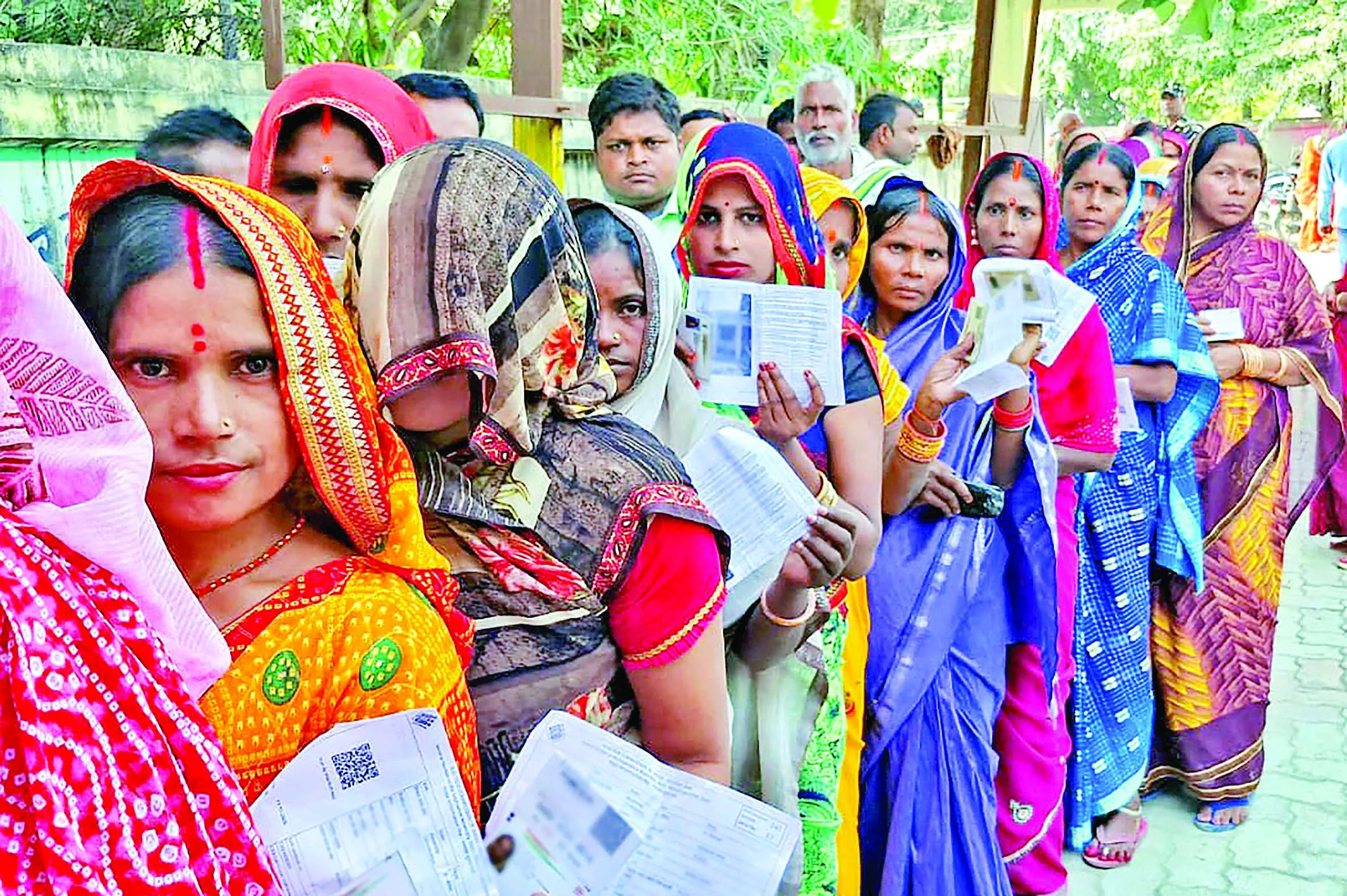
This was not an election decided in the war rooms of political strategists; it was decided at the polling booths where women stood in long lines that often outnumbered men. The Election Commission’s data captures this historic moment with stunning clarity: 71.6 per cent of women voters turned out to vote, compared to 62.98 per cent of men. The women’s turnout went beyond mere enthusiasm. In over a hundred constituencies, women formed the majority of voters at booths. In ten districts, including Kishanganj, Katihar, Purnea, and Supaul, women’s turnout crossed 75 per cent, with the highest touching nearly 89 per cent in Kishanganj. Bihar’s political axis shifted the moment women emerged not as a supplementary vote bank but as a decisive political force.
Senior journalist Santosh Singh, in an interview with me, aptly noted that an entire generation of young women in Bihar has grown up only in the Nitish era. Their political memory does not contain the lawlessness of the 1990s, the fear that once governed movement at dusk, or the patriarchal restrictions that limited mobility, education, and workforce participation. Their experience of Bihar is shaped by the bicycle that took them to school, the reservation in panchayats that allowed their mothers to act as decision-makers, the self-help groups that gave rural women confidence and credit access, and the visible presence of police and governance structures that provided a sense of order. Over these two decades, Nitish Kumar did not merely introduce schemes; he constructed an entirely new political identity. The cycle yojana, once mocked as a small intervention, became a social revolution that carried girls across caste boundaries and village borders. When half the seats in panchayats were reserved for women and 35 per cent jobs in police and government services were set aside for them, women were no longer confined to the narrative of beneficiaries; they became administrators, police officers, financial decision-makers, and political actors in their own right.
If the past built the foundation, the 2025 elections added the final thrust. The Mukhyamantri Mahila Rozgar Yojana became the most powerful bridge between welfare and electoral behaviour. In a state where the caste survey revealed that over 34 per cent of households survive on Rs 6,000 a month or less, direct assistance of Rs 10,000 deposited before polls was not seen as a symbolic election promise. It was immediate help that changed the monthly budget of economically vulnerable households. For women from Scheduled Castes, EBC families, agricultural labour households, and Muslim communities, this assistance was an unmistakable sign of the state’s seriousness toward their financial autonomy.
Rameshwari Devi of Bakhtiyarpur told me, “Jo humko diya hai, usiko vote denge. Nitish paisa diye jisse hum bakri kharide hain aur Modi ration de rahe hain.” She recently received Rs 10,000 under the Mukhyamantri Mahila Rozgar Yojana. With that money, she bought a goat and took farmland on lease. Just before the elections, the first instalment of Rs 10,000 was deposited into the accounts of 1.21 crore prospective women entrepreneurs enrolled under the State’s self-help JEEVIKA network.
These women volunteers not only guided other women to booths but also served as social ambassadors of State schemes. Their presence ensured smoother voting experiences and created a sense of collective political purpose among women who often juggle household responsibilities and limited mobility.
But it would be simplistic to reduce women’s voting behaviour to a direct correlation with cash schemes. Bihar’s female voters did not vote merely for money; they voted because they felt they were seen, heard, and prioritised. They voted because a Government that had shaped their world for two decades was asking for another chance, while the opposition failed to provide a credible alternative vision. Women responded not to slogans but to lived experience, safety on the streets, ease of travel, school access for daughters, predictable governance, and a reliable leadership model embodied jointly by Nitish Kumar and Narendra Modi. The Modi-Nitish combine represented safety, order, continuity, and guarantee, qualities that women valued more than caste loyalty or identity appeals.
The alcohol ban, though contentious among policymakers and economists, holds a very different emotional meaning in the minds of women, especially in rural Bihar. In countless households, the ban symbolised safety, reduced domestic violence, financial savings, and a sense of dignity that had long eluded them. Even with challenges such as illegal liquor networks, the idea of prohibition continues to carry weight among women who saw visible improvements in domestic life. For women voters, the ban remains a deeply personal political issue, one that reinforces their trust in Nitish Kumar’s leadership.
In Bihar, nearly 30 per cent of men in the age group of 15-49 consumed alcohol before the prohibition, the National Family Health Survey 2015-16 reveals. Women in this State faced high levels of intimate partner violence. Moreover, while about 25 per cent of women whose husbands did not consume alcohol experienced violence by their husbands, 75 per cent of women whose husbands got drunk ‘very often’ experienced spousal violence.
From 2013 to 2015, approx. 1,365 cases of domestic violence were registered in Bihar whereas after alcohol ban the number of cases in 2017-19 dropped to only 25 which shows a great impact of liquor prohibition on the lives of women of Bihar.
This is precisely where the Mahagathbandhan faltered. While the NDA was crafting messages around welfare continuity, the opposition was engaged in a miscalculated emphasis on caste identity. The RJD’s decision to field 52 Yadav candidates, making up nearly 36 per cent of its ticket distribution, sent a clear message: that the party’s old tendency to privilege one caste had returned. In a changing Bihar, this was a political misreading. Non-Yadav OBCs, EBCs, Mahadalits, and even segments of Muslim households interpreted this decision as a return to Yadav-dominated politics, which alienated them further. Women, in particular, who have benefited from cross-caste welfare networks, saw no advantage in a political formation that appeared to retreat into old arithmetic.
Tejashwi Yadav’s last-minute promise under the Mai Bahin Maan Yojana sounded attractive, but again the women voters preferred to ‘Trust Nitish-Modi’ for their clean and pro-Mahila image. Bihar’s women voters, who had seen Nitish Kumar deliver schemes year after year, not just in election seasons, were hesitant to trust an untested promise announced on the eve of polling. The opposition’s inability to connect with young women voters was particularly stark. More than 14 lakh new voters aged 18-19 entered the rolls since 2020, most of them young women whose aspirations were shaped by opportunities Nitish-era governance created.
On the day of polling, the visual contrast was striking. In Vaishali, Samastipur and Patna districts, groups of homemakers walked together to booths, leaving behind their daily chores.
The consequences of this political rise of women are far-reaching. For three decades, Bihar’s politics was defined by the opposition between Mandal-Mandir – between caste justice and religious consolidation
The consequences of this political rise of women are far-reaching. For three decades, Bihar’s politics was defined by the opposition between Mandal-Mandir – between caste justice and religious consolidation. But the 2025 mandate has revealed an axis that cuts across both: the axis of women’s welfare and empowerment. Women do not vote as custodians of caste identity. They vote as seekers of stability, safety, and opportunity. Their lived experiences have transformed them into a constituency that moderates caste polarisation, resists divisive narratives, and rewards governments that deliver tangible improvements.
For the NDA, this election showed that women will remain central to governance strategy. For the Mahagathbandhan, it signals a clear warning: any political formation that fails to engage women meaningfully will face structural disadvantages, regardless of caste arithmetic. The 2025 verdict is a reminder that development and welfare are no longer abstract policy ideas; they are lived experiences that shape electoral choices.