On September 20, a video went viral on social media and shocked everyone. It showed two Class 10 students, a boy and a girl, being surrounded and harassed by miscreants in Jamui district. The incident had taken place on the evening of September 19. For someone coming from Bihar, the images were disturbing for another reason: they carried an uncomfortable echo of the Bihar that many believed had been left behind – the Jungle Raj.
The term is intrinsically linked to the political vocabulary referred to about Bihar. It has been associated with the 15 years when Lalu Prasad Yadav and later Rabri Devi headed the State Government. Their tenure from 1990 to 2005 was marked by serious concerns over law and order, caste violence, kidnappings for ransom and the criminalisation of politics. The term itself gained wider currency after the Patna High Court used Jungle Raj in an observation in 1997.
Kidnapping, in particular, became emblematic of that period. Between 2001 and 2004, Bihar recorded 1,527 kidnappings, including 411 in 2004 alone. The State also witnessed a series of caste massacres and high-profile abductions that reinforced a perception that criminals could operate with little fear of the law. When Nitish Kumar–led NDA came to power in 2005, restoring law and order became central to his Sushasan project. His Government strengthened policing, created the Special Auxiliary Police and pushed for higher conviction rates. The change was visible in some key indicators: kidnappings for ransom fell sharply, from the levels seen in the early 2000s to 194 cases in 2006 and 72 by 2010. Murders and ransom kidnappings also declined significantly over his first 15 years in office.
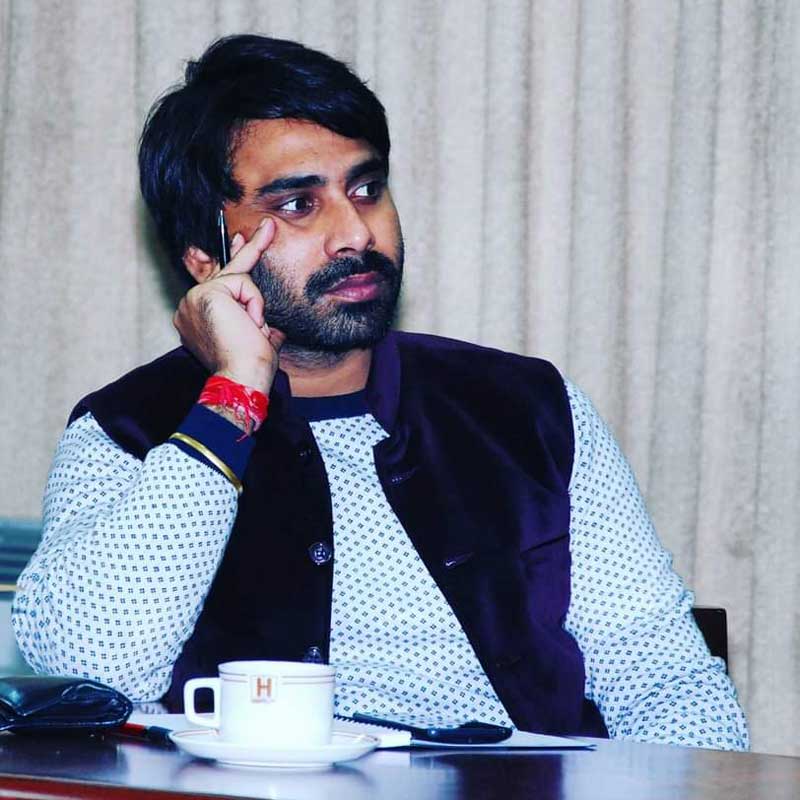
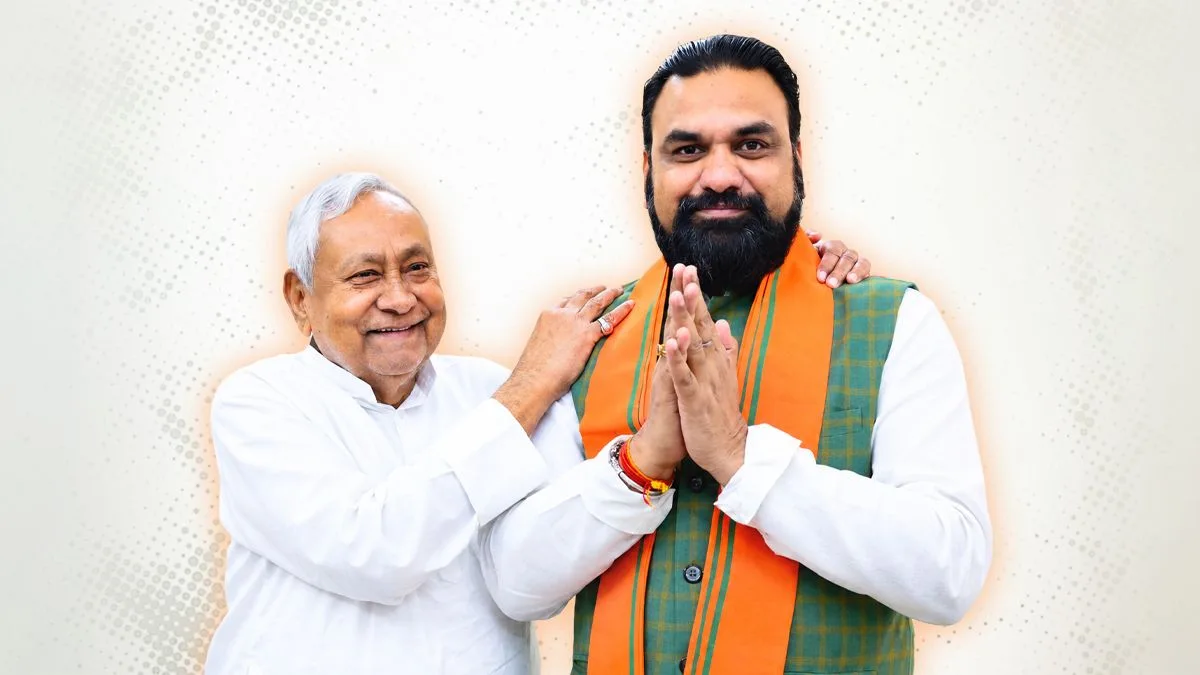
This shift helped Nitish earn the sobriquet Sushasan Babu. That is precisely why the Jamui video is more than another disturbing viral clip. For Bihar, it touches an old nerve. And for Samrat Choudhary, the new and first BJP Chief Minister, who inherited a political legacy built partly on the promise that those days would never return, the question is not simply whether the perpetrators in Jamui will be punished. The larger question is whether the State can be assured that the Jungle Raj is a past phenomenon and not becoming a metaphor for the present.
Senior journalist Santosh Singh, who knows the region closely, makes an important distinction. No police force, he argues, can physically prevent every such incident at every isolated location. Jamui also poses a societal question – about the mentality that makes a group of men believe they have the authority to stop, question, humiliate and assault two youngsters. But that does not absolve the State. The answer, he says, lies in maintaining the “fear of law”, strengthening patrolling and ensuring that the presence and authority of the police are visible.
That distinction perhaps explains the burden Samrat Choudhary has inherited. He is not taking over a Bihar where everything has to be built from zero. In some ways, that would have made the political task easier. He has inherited a Bihar where expectations have already moved to the next level.
THE NITISH BENCHMARK
For nearly two decades, Nitish Kumar shaped the vocabulary Bihar used to judge governance. Roads, electricity, policing, welfare delivery and basic infrastructure became the markers of the Sushasan model. Whatever the shortcomings of his long tenure, the political significance of this change cannot easily be dismissed. Nitish Kumar’s legacy is defined by three broad contributions: infrastructure, welfare and social engineering. Bihar has moved beyond the stage where the political conversation can simply revolve around bijli, sadak aur paani. Samrat’s question is what after that. “Bihar has moved now to the
basic-plus level,” said Santosh Singh. The challenge now is “second and third level of growth”. This is what makes Samrat Choudhary’s job particularly difficult. Nitish inherited a Bihar where little improvement itself could become an achievement. Samrat inherits one where improvement will increasingly be taken for granted.
Nitish could be compared with what came before him. Samrat will inevitably be compared with the demanding – ‘Nitish benchmark’. Nitish leaves behind both policy and infrastructure as well as something less tangible but equally important: he brought Bihar back into national conversation for reasons other than its failures.
Samrat, therefore, cannot simply preserve Nitish’s Bihar. He has to build the next Bihar. The challenge document prepared around this transition captures the distinction well. Bihar spent nearly two decades repairing governance. Those gains have now plateaued. What the state needs next is structural economic change – industrialisation, jobs and urbanisation.
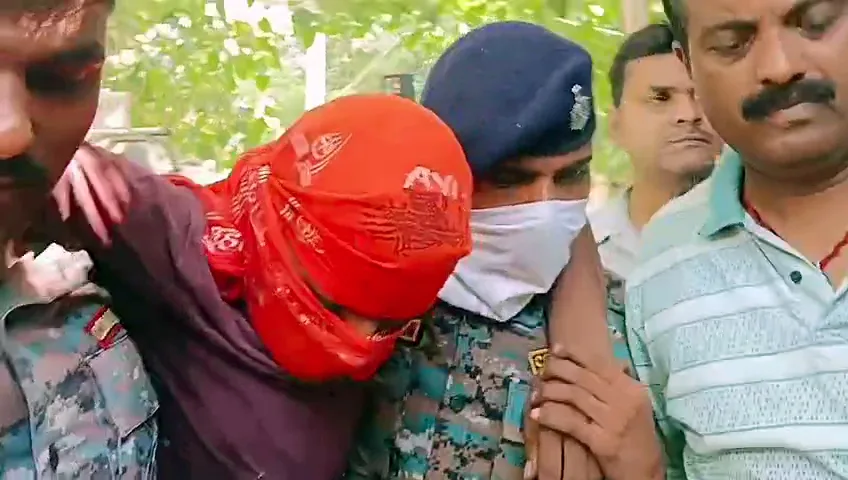
“We are satisfied with the action taken by the government. Within 24–48 hours, three accused were arrested, and the main accused too was held in an encounter. The Chief Minister called us and assured us of our daughter’s education and safety. I just want what happened with my daughter is not repeated.” — Victim’s mother
FROM PALAYAN TO ROJGAAR
Perhaps no issue captures Bihar’s unfinished transformation better than palayan (migration). Migration is not merely an economic statistic in Bihar. It is embedded in family life. A 2025 academic analysis of Census data puts Bihar’s total out-migrant population at roughly 79 lakh in 2011, up from about 55 lakh in 2001 – an increase of around 44 per cent in a decade. There are villages where working-age men spend most of the year in Delhi, Punjab, Maharashtra, Gujarat or elsewhere. There are children who grow up seeing fathers return home only during festivals. There are students whose first serious career calculation is not what will I do, but where will I have to go.
This is where Samrat’s biggest test lies. From the historic Gandhi Maidan on Independence Day 2026, Samrat Choudhary placed employment at the centre of his development pitch, announcing a target of providing one crore jobs and employment opportunities by 2030. Government jobs can help, but they cannot possibly absorb Bihar’s enormous young population. The challenge before the Government is therefore not simply filling vacancies. It is creating an economy in which private employment can expand at scale. Bihar remains heavily dependent on agriculture and remittances, while its manufacturing base and private investment remain limited. Infrastructure has improved, but infrastructure by itself does not create economic transformation.
During the first NDA Government led by Nitish Kumar, basic road connectivity was meant for commuting to the urban centres. Getting electricity in all areas for few hours was a luxury. Now, a highway matters when it carries goods. A bridge matters when it connects production centres to markets.
Electricity matters when factories consume it. A railway network matters when Bihar is exporting products, and not labour. This is the transition Choudhary has to deliver.
Bihar has assets that can turn into economic advantages. Its agriculture can support food-processing industries. Its maize production offers opportunities in starch and ethanol. Its fruits and vegetables can feed value-added industries rather than leaving farmers dependent on raw produce markets.
Food processing, start-ups, agricultural products and ethanol are areas where Bihar could build a larger industrial ecosystem and export beyond the state and even beyond India. That is where Bihar’s industrial policy must begin, not necessarily by trying to replicate Maharashtra or Gujarat overnight, but by building industries around what Bihar already produces and does well.
The ultimate measure should be simple: can a young Bihari choose to stay? Not be forced to stay. Not be prevented from migrating. Migration by choice is mobility; migration because there is no meaningful livelihood at home is compulsion. Changing that equation would be transformational. Speaking to Organiser, CM Samrat Choudhary pointed out, “By 2030, no one should have to leave Bihar merely to work as a labourer. If someone moves outside the state for a good job or a better opportunity, there is nothing wrong with that. People should go wherever they find good opportunities. Our objective is to end migration driven by compulsion.”
TWELVE TOWNS & A POSSIBLE SAMRAT LEGACY
Another idea could become central to Samrat Choudhary’s legacy: the proposal for 12 satellite towns. If these towns actually materialise during Choudhary’s tenure, they could become his defining contribution to Bihar. These towns won’t be an extension of Patna-style urbanisation. Different towns could develop around different purposes – industry, education, healthcare and tourism. Bihar desperately needs such decentralisation. Patna cannot remain the answer to every aspiration. A student should not necessarily have to move to Patna for good education.
A patient should not have to reach Patna for every serious medical requirement. A young entrepreneur should not have to establish a business in the capital because the ecosystem elsewhere simply does not exist. If satellite towns become genuine economic clusters rather than real-estate projects, they can fundamentally alter Bihar’s development geography. But the operative word is if. Announcements do not make legacies. Execution does. That is another burden Samrat Choudhary inherits in an age when voters have become increasingly impatient with foundation stones, PowerPoint presentations and promises whose deadlines keep shifting.
“Bihar has moved now to the basic-plus level,” said Santosh Singh. The challenge now is “second and third level of growth”. This is what makes Samrat Choudhary’s job particularly difficult
CASTE LEADER WHO MUST BECOME BIHAR’S LEADER
Economic transformation, however, is only one part of Samrat Choudhary’s burden. The other is political and social. Bihar politics cannot be understood without caste. Samrat Choudhary’s political ascent has been linked to his Koeri-Kushwaha identity and the broader effort to consolidate backwards-caste support. Yet becoming Chief Minister fundamentally changes that identity.
The coalition that sustains a Chief Minister has to be much wider than the coalition that helps create one. Bihar’s social landscape contains upper castes, OBCs, EBCs, Dalits, Mahadalits and a substantial Muslim population. Holding these constituencies together while navigating competing aspirations will require far more than electoral arithmetic. Nitish Kumar offers an instructive example. He came from the Kurmi community, but over time his political identity grew beyond being described as a Kurmi leader. Samrat must attempt a similar transition. Santosh Singh puts it succinctly: “A politician looks at the next election; a statesman looks at the next generation.”
Now that Samrat Choudhary is Chief Minister, Singh argues, he has to begin looking at that next generation. Caste conferences and community mobilisation may remain part of politics, but they cannot define the Chief Minister. “You have to become the leader of Bihar breaking the caste barriers,” he says, arguing that caste politics, even when politically necessary, should no longer dominate Samrat Choudhary’s public identity. This may be among his hardest transformations. Political identities that help leaders climb are not always the identities that help them govern.
Samrat rose in an intensely caste-conscious political system. He cannot suddenly pretend caste does not exist. Nor can Bihar. But a Chief Minister must show that caste arithmetic is a tool of electoral politics, not the organising principle of governance. The difference will determine whether history remembers him as a successful Kushwaha leader who became Chief Minister or as a Chief Minister who happened to come from the Kushwaha community.
THE FIRST BJP CHIEF MINISTER BURDEN
There is yet another expectation resting on Samrat Choudhary – one that extends beyond him personally. He is Bihar’s first BJP Chief Minister. The BJP debuted in Bihar in 1980, but for decades it either remained outside power or governed as the junior coalition partner of the JD(U). Samrat Choudhary’s elevation therefore, marks a structural shift in Bihar politics. For years, the BJP could share credit and share blame. Now the balance has changed. The political document on the challenges before Choudhary describes his position accurately: being the first BJP Chief Minister is simultaneously an opportunity and a burden.
Expectations from voters, the party and the central leadership are exceptionally high, and his performance will inevitably be read as a test of whether the BJP can independently anchor governance in Bihar. This also makes the promise of the “double engine” measurable. When the same political formation holds power in Patna and New Delhi, administrative coordination should, in theory, become easier. But that also removes an excuse traditionally available to State Governments: Delhi did not cooperate. If investments do not come, if projects remain delayed or if infrastructure does not translate into employment, voters can legitimately ask what exactly the second engine delivered. Samrat Choudhary therefore carries not just his own burden of performance. He
carries his party’s.
THE LAW MUST BE SEEN
And then we return to Jamui. The incident is important precisely because law and order has been central to the political story of Bihar’s recovery. It would be simplistic to suggest that one crime means Bihar has returned to Jungle Raj. No Government can guarantee that no crime will ever occur. The more meaningful test is whether criminals believe they can act with impunity and what happens after they do. Police moved after the Jamui videos emerged. An FIR was registered, an SIT was constituted, and arrests followed. But policing cannot operate only after a crime becomes viral.
This is where Santosh Singh’s argument about the fear of law becomes relevant. Police need to be visible. Patrolling has to be strengthened. He argues that the police’s authority must be felt on the ground. Community policing has its place, but physical policing remains equally important. For Samrat Choudhary, who has consciously cultivated a tough image on crime and mafias, the standard will consequently be higher. His administrative experience as Home Minister means he cannot plead unfamiliarity with the system.
Jamui, therefore, should not be treated merely as an embarrassing viral episode to be survived until the news cycle moves on. It should be treated as a warning. The distance between Patna’s governance claims and the lived reality of an isolated road in Jamui is precisely the distance the Government has to close.
WILL BIHAR REVIVE ITS LOST GLORY?
BJP leadership always talks about preserving and encouraging the historical and cultural aspects of any region, especially one it governs. We all know that Bihar was historically, culturally and intellectually one of the most prosperous regions in the world. For centuries, it served as the political and cultural epicentre of ancient India. So, another challenge for Samrat Choudhary is reviving that lost glory, which is a difficult task. His predecessor already started this process by reviving the Nalanda University. However, a lot needs to be done in the State.
Bihar-based senior journalist Sanjeev Kumar told Organiser, “Union Home Minister Amit Shah has earlier strongly emphasised that Virasat(Heritage) and Paryatan (Tourism) are core thrust areas for Bihar’s development and cultural revival. The initiatives Samrat Choudhary is taking show his positive and visionary approach. It seems he is working in that direction with the help of institutions like Rashtra Bhasha Parishad, Bihar Rajya Hindi Granth Academy, and other institutions.”
Bihar has a huge civilisational legacy. First Chief Minister coming from the Cultural Nationalist party promoting religious and cultural resurgence has to deliver on that front. From Nalanda and Bodhgaya as centres of learning and pilgrimage to Magadh, Pataliputra and Lichavi – the old kingdoms proving Bharat as cradle of democracy – needs to be ingrained in the popular imagination. Present museums and artefacts limit Bihar to Buddha Vihars and Sher Shah Suri, when the intellectual and political legacy of Bihar goes much beyond that. For Bihar to come out of the imagery of backwardness, restoring the faith and pride in that civilisational ethos is also a critical step forward. Nitish acquired the image of a statesman over decades, and such an image cannot be manufactured in a day. But one arena is where Samrat Choudhary can compete immediately: performance.
Build the satellite towns. Bring industries. Create institutes of excellence. Make migration an option, not a necessity. Keep caste in the political subtext, not the
grammar of governance. And ensure that a girl travelling on a road in Jamui does not have to calculate whether the hour, the location or the people around her make her unsafe. These are not small expectations. But that is precisely the point. Samrat Choudhary has not inherited a Bihar with small expectations but the Samrat (Majestic) expectations.