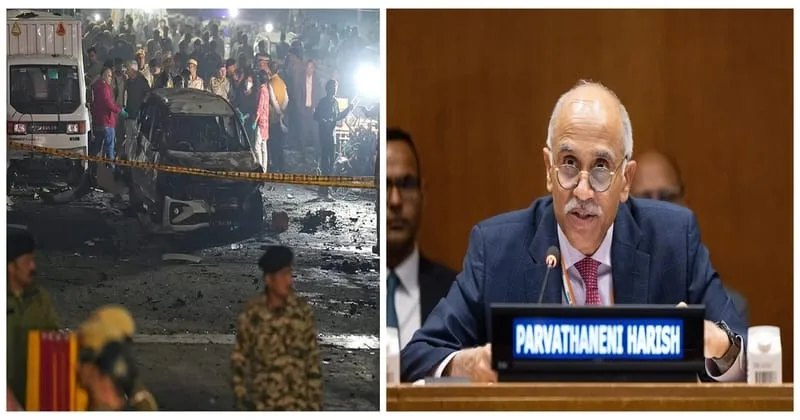
India has called on the UN Security Council to adopt a zero-tolerance stance toward entities that facilitate, sponsor, or finance the trafficking and movement of illicit weapons. The appeal was made by India’s Permanent Representative to the UN, Ambassador Parvathaneni Harish, during a Security Council Open Debate on Small Arms on November 10, just hours after a deadly explosion near Delhi’s Red Fort claimed at least nine lives and left several others injured.
Cross-Border Terrorism in Focus
Addressing the Council, Ambassador Harish underscored India’s long battle against terrorism and the persistent threat posed by the illegal trade of arms. “India has suffered from cross-border terrorism carried out with illicit weapons trafficked across our borders, including now through the use of drones,” he said — a pointed reference to Pakistan.
Harish stressed that terrorist groups and armed non-state actors depend on external backing, funding, and access to weaponry. He warned that the illicit flow and diversion of small arms and light weapons continue to fuel conflict and sustain armed networks worldwide.
Emphasising the need for collective action, India urged stronger international cooperation to curb weapon diversion, dismantle trafficking networks, bolster border security, and improve intelligence and information sharing. Harish also called for the objective and consistent enforcement of UN arms embargoes, describing them as crucial in preventing the inflow of weapons into conflict zones.
He noted that the issue extends beyond security, affecting development, humanitarian stability, and socio-economic growth. Addressing it, he said, requires a blend of security measures and developmental initiatives — including effective national legislation, institutional coordination, real-time data systems, risk management, and stockpile security.
Strengthening UN Mechanisms
Reaffirming India’s commitment to international frameworks such as the UN Programme of Action (PoA) and the International Tracing Instrument (ITI), Harish highlighted the importance of strong national controls, enforcement mechanisms, export regulations, capacity building, and global information sharing to prevent the misuse of small arms by terrorist groups.
“The Security Council must maintain a zero-tolerance approach to terrorism in all its forms and to those who support or enable the trafficking and movement of such weapons,” he asserted.
India’s statement reflects its growing concern over cross-border terrorism and illicit arms flows, especially in the wake of the recent New Delhi attack, and underscores its determination to play a leading role in the global campaign against terrorism and illegal arms trafficking.