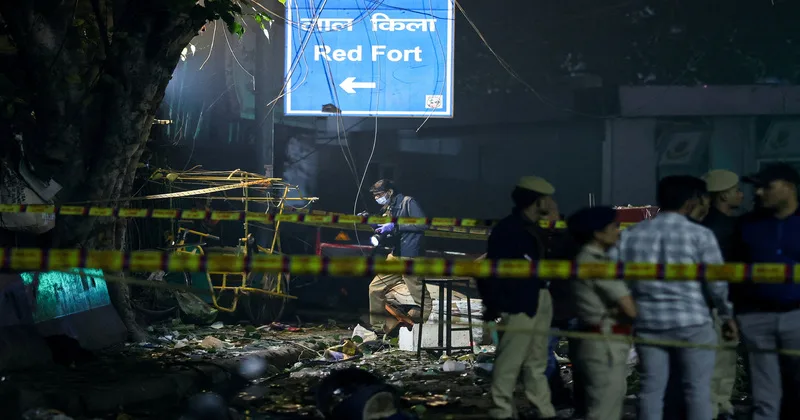
NEW DELHI: The devastating blast near Delhi’s Red Fort on November 10, which left eight people dead and several others injured, has now been linked to a larger transnational terror conspiracy. According to high-level intelligence inputs and the findings of Delhi Police’s Special Cell, the operation was funded and directed from Pakistan, with local modules radicalising educated Indian youth in the name of “religious duty and jihad.”
Sources have confirmed that money trails connected to religious donations and academic grants were used to fund the terror module. What makes this plot particularly alarming is its sophistication — it wasn’t driven by traditional terror recruits but by professionals and students, many of whom were indoctrinated under the cover of social service, education, and faith-based charity.
Investigators believe that the same network had earlier attempted to establish a base in Faridabad, where over 2,900 kilograms of explosives were recovered from two houses. The cache, including ammonium nitrate, detonators, and digital circuit timers, points to industrial-level preparation aimed at executing multiple high-impact attacks in the Delhi-NCR region.
An officer involved in the probe described the ecosystem as a “white-collar Islamic terror syndicate”—a network of radicalised but well-educated individuals using technology, academic institutions, and religious NGOs as fronts for financing and logistics.
The Role of Jammu & Kashmir Police: Quiet Heroes in the Shadows
Officials have credited the Jammu & Kashmir Police (JKP) with playing a decisive role in unmasking the plot. Acting on specific intelligence, JKP tracked communications between known handlers in Pakistan and operatives in Delhi and Haryana, which eventually led to the Faridabad raids.
“If it weren’t for the vigilance and technical precision of the J&K Police, this network could have unleashed catastrophic destruction in Delhi,” a senior intelligence official said. “They not only intercepted crucial encrypted messages but also prevented the transfer of large consignments of explosives into the capital.”
The J&K Police’s counter-terrorism unit reportedly worked in coordination with the National Investigation Agency (NIA) and Delhi Police Special Cell, leading to the arrest of several key operatives. Among them were two doctors from Kashmir, both allegedly linked to Pakistan-based terror outfits Jaish-e-Mohammed (JeM) and Ansar Ghazwat-ul-Hind (AGH).
The Rise of Educated Islamic Extremism
The most disturbing revelation in the probe is the radicalisation of educated Islamic youth — doctors, engineers, and university students — through a mix of religious indoctrination and digital propaganda. Intelligence reports suggest that online forums, encrypted apps, and religious chat groups were used to spread extremist ideologies, targeting impressionable minds under the rhetoric of “defending faith and fighting injustice.”
The Islamic radical narrative, officials say, was carefully tailored to resonate with the educated class — offering a sense of purpose and moral justification for violence. Recruits were told they were “defending religion” while actually becoming pawns in a geopolitical war orchestrated from across the border.
White-Collar Islamic Terror: A New Challenge for India
The Red Fort incident has exposed a dangerous new face of terrorism — one that blends intellect with ideology. These “white-collar Islamic terrorists” use books and holy texts as covers for bombs, lectures as fronts for logistics, and charity as a façade for funding violence.
Security experts warn that this hybrid form of extremism represents the next phase of asymmetric warfare, where India’s educated youth are manipulated into serving as ideological foot soldiers for foreign interests.
Authorities have urged citizens to remain calm but alert. Delhi Chief Minister Rekha Gupta has appealed to residents to avoid rumours and maintain peace, while Home Minister Amit Shah has assured that every angle, including international funding, is under detailed scrutiny.
Meanwhile, the Delhi Police and National Security Guard (NSG) continue combing operations across several parts of Old Delhi, Fatehpur, and Faridabad to locate possible remaining explosives and trace other sleeper cells.
The Red Fort blast investigation has evolved into a defining test of India’s internal security apparatus. It has revealed that terrorism no longer wears a uniform—it wears a suit, carries a degree, and preaches peace while plotting destruction.
As one senior investigator put it, “This is not just an attack on Delhi. It’s a war against the idea of a stable and united India.”