In the quiet fields of Pandua (West Bengal), sixteen kilometres north of Malda town, stands the colossal ruin of what official history calls the Adina Mosque, a fourteenth-century monument often hailed as Bengal’s largest Islamic structure. But among the people of Pandua, another, older truth persists. They know this not as a mosque, but as the Adinath Mandir, the Mandir of Bhagwan Shiva in his primordial form, Adinath. And when one looks closely at the stones, the carvings, the symmetry, and the very spirit of the place, it becomes impossible to ignore the evidence: what is celebrated today as a mosque was, in fact, once the grand Adinath Mandir, one of Bengal’s lost Shaivite shrines.
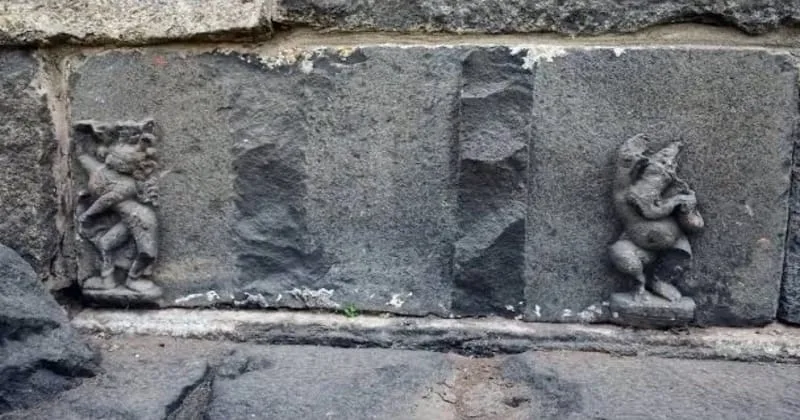
Architecture speaks where words falter, and Pandua’s stones speak loudly. The Adina structure stretches over 500 feet in length, a brick-and-stone colossus unmatched in Bengal’s medieval landscape. Yet, its size is not what demands attention; it is its contradictions. Embedded within the walls are sculptural fragments: lotus medallions, dancing female figures, ornate foliage, and even a small but unmistakable image of Bhagwan Ganesha. These are not decorative coincidences. They belong to the sacred language of Hindu Mandir art, particularly the Pala-Sena style of Bengal. Such carvings were not later additions; they are integrated into the very fabric of the building. The stones themselves proclaim their origin. The so-called mosque was built by reusing the sanctified remains of an earlier Mandir, the Adinath Mandir.
The 1918 Malda District Gazetteer, compiled by British officer G.E. Lambourn, noted the “remarkable incorporation of sculptured Hindu stonework” in the Adina structure. The Archaeological Survey of India (ASI) in its early records described “reused sculptured fragments of earlier buildings.” Neither document, however, identified what those “earlier buildings” were. It is the oral testimony of the people that fills this silence. For the locals of Pandua, there is no ambiguity: “It was the Adinath Mandir,” they say, as their forefathers did.
Even the very name Adina betrays the truth. In Arabic or Persian, the term has no clear meaning connected to faith, architecture, or function. But in Sanskrit, Adinath, the Primordial Bhagwan is one of the most sacred epithets of Shiva. Pandua, before the Islamic conquest, was a known centre of Shaivite devotion. Oral traditions, folk songs, and local chronicles all remember a majestic Adinath shrine once standing where the “mosque” now lies. Linguistically too, the transformation from Adinath to Adina is natural: medieval Persian administrators often truncated local Sanskritic names for convenience, as they did with Saptagram (Satgaon) or Shankarpur (Sankar). The root “Adi” remains intact as a linguistic fossil preserving the memory of the deity even after centuries of political and cultural change.
The region’s history supports this. The Pala and Sena dynasties were the great Mandir-building powers of Bengal, and their devotion to Shaivism is well-documented. Historian R.C. Majumdar’s works, along with accounts by literary figures such as Bankim Chandra Chattopadhyay and Sarat Chandra, describe the widespread destruction of Mandirs during the invasions that followed. Researcher Pranab Ray, in his seminal Banglay Mandir: Sthapatya o Bhaskarjya (“Mandirs in Bengal: Architecture and Sculpture”), confirms that under the Pala-Sena rulers, the distinctive Eastern style of Mandir architecture flourished in Bengal. The remnants of these temples, especially in Triveni, Pandua, and Lakhnauti (Gaur), show identical craftsmanship to the stonework now embedded within the Adina structure.
Ray and other scholars have written clearly: many such Mandirs and palaces were destroyed after the establishment of Muslim rule, their stones used to construct mosques and mausoleums. The Adina complex, built in 770 Hijri (1369 CE) by Sultan Sikandar Shah, stands as the most massive example of this appropriation. The structure contains nearly three hundred pillars, and all are sourced from pre-existing Hindu edifices. British architectural historian Percy Brown was unequivocal: “None of the stonework is original; it was all stripped from pre-existing Hindu structures at Lakhnauti. Many Mandirs and palaces appear to have been dismantled to provide the stone required, and the finest monuments of the Hindu capital were demolished to produce this one Mohammedan mosque.” (Indian Architecture: Islamic Period, 1975, p. 37). Brown’s words confirm that the people of Pandua never forgot that the so-called mosque was built atop the desecrated body of Adinath’s shrine.
Architectural analysis strengthens the claim. The Adina complex’s plan is anomalous among Islamic structures of its period. Its hypostyle layout with a central nave rising above the aisles recalls basilican and mandapa forms, closer to a Hindu Mandirs garbhagriha and mandapa configuration than to a conventional mosque plan. The alignment of its plinth and proportional rhythm of its bays suggest pre-existing foundations. Decorative motifs inside the structure, lotus rosettes, vine scrolls, bell chains, are hallmarks of Pala-Sena ornamentation, alien to early Sultanate art. The artisans of the Sultan, evidently working with plundered temple material, adapted these sacred forms with superficial calligraphy. But beneath the veneer of Islamicate aesthetics lies the enduring geometry of a Hindu Mandir.
The ASI, which maintains the monument today, describes it tersely as “the largest mosque in the Indian subcontinent, built by Sikandar Shah in 1373 AD.” Its official plaque mentions nothing of earlier structures. Yet the ASI’s own internal reports, accessible in archives, acknowledge “reused temple stonework.” Photographs by early ASI officers like E.H.C. Walsh (1911) and J. Anderson (1930s) document sculpted panels depicting deities, proofs now buried in museum archives in India and abroad, including the British Museum. The evidence is material, measurable, and undeniable.
The resistance to acknowledging this truth is modern, not historical. For centuries, local Hindu communities continued to revere the site as Adinath Dham. Folk songs from Malda and Dinajpur mention “Adinath of Pandua.” Pilgrims to other Shiva sites, Baidyanath (Deoghar), Tarakeshwa, invoke Pandua in the same sacred continuum. Oral tradition, far from being myth, preserves the civilisational memory of a people whose sacred geography was brutally redrawn. In the early twentieth century, these memories survived even as official archaeology silenced them under the rhetoric of “Islamic heritage.”
Today, in an era of renewed interest in forgotten histories, the Adinath Mandir’s story has resurfaced, sometimes in sensational forms, but behind the online noise lies a serious historiographical question: why has Bengal’s academic establishment refused to investigate the site’s Mandir origins? Institutional caution is one reason; political discomfort is another. For decades, medieval Bengal’s architecture has been studied only through the lens of “Indo-Islamic synthesis,” an approach that romanticises amalgamation while avoiding the reality of appropriation. Thus, the Adinath Mandir’s identity was buried under the grandeur of a Sultan’s name.
What Bengal needs is not polemic but proof, modern, scientific, and fearless. Ground-penetrating radar surveys could reveal buried foundations beneath the current floor. Petrographic analysis of the plinth stones could determine whether they predate Sultanate construction. Comparative studies with contemporaneous Pala-Sena Mandirs in Gaur, Triveni, and Udaypur could reconstruct the temple’s original form. Only such rigorous inquiry can re-establish, beyond conjecture, that the Adina Mosque stands upon the ruins of the Adinath Mandir.
To assert that truth is not to rewrite history; it is to restore it. The carvings of deities, the linguistic trail of the name, the testimony of villagers, and the admissions of British and ASI officers all form a coherent chain of evidence. The Adinath Mandir was not erased; it was reassembled, its sacred stones rearranged into a monument of conquest. Pandua’s ruin thus stands not merely as a relic of Bengal’s medieval past, but as a witness to its civilisational continuity. The task of historians is not to preserve silence, but to recover memory.
The story of Adinath Mandir, submerged beneath Sultanate glory, awaits scholarly resurrection. In recovering it, we do not divide; we redeem. The stones of Pandua still whisper the name of Adinath. It is time we finally listened.