The stakes of renewed US-China rivalry
June 4, 2026
  • Read Ecopy
  • Circulation
  • Advertise
  • Careers
  • About Us
  • Contact Us
Android AppiPhone AppArattai
Organiser
  • ‌
  • Bharat
    • Assam
    • Bihar
    • Chhattisgarh
    • Jharkhand
    • Maharashtra
    • View All States
  • World
    • Asia
    • Europe
    • North America
    • South America
    • Africa
    • Australia
  • Editorial
  • International
  • Opinion
  • RSS @ 100
  • More
    • Op Sindoor
    • Analysis
    • Sports
    • Defence
    • Politics
    • Business
    • Economy
    • Culture
    • Special Report
    • Sci & Tech
    • Entertainment
    • G20
    • Azadi Ka Amrit Mahotsav
    • Vocal4Local
    • Web Stories
    • Education
    • Employment
    • Books
    • Interviews
    • Travel
    • Law
    • Health
    • Obituary
  • Subscribe
    • Subscribe Print Edition
    • Subscribe Ecopy
    • Read Ecopy
  • ‌
  • Bharat
    • Assam
    • Bihar
    • Chhattisgarh
    • Jharkhand
    • Maharashtra
    • View All States
  • World
    • Asia
    • Europe
    • North America
    • South America
    • Africa
    • Australia
  • Editorial
  • International
  • Opinion
  • RSS @ 100
  • More
    • Op Sindoor
    • Analysis
    • Sports
    • Defence
    • Politics
    • Business
    • Economy
    • Culture
    • Special Report
    • Sci & Tech
    • Entertainment
    • G20
    • Azadi Ka Amrit Mahotsav
    • Vocal4Local
    • Web Stories
    • Education
    • Employment
    • Books
    • Interviews
    • Travel
    • Law
    • Health
    • Obituary
  • Subscribe
    • Subscribe Print Edition
    • Subscribe Ecopy
    • Read Ecopy
Organiser
  • Home
  • Bharat
  • World
  • Operation Sindoor
  • Editorial
  • Analysis
  • Opinion
  • Culture
  • Defence
  • International Edition
  • RSS @ 100
  • Magazine
  • Read Ecopy
Home World North America USA

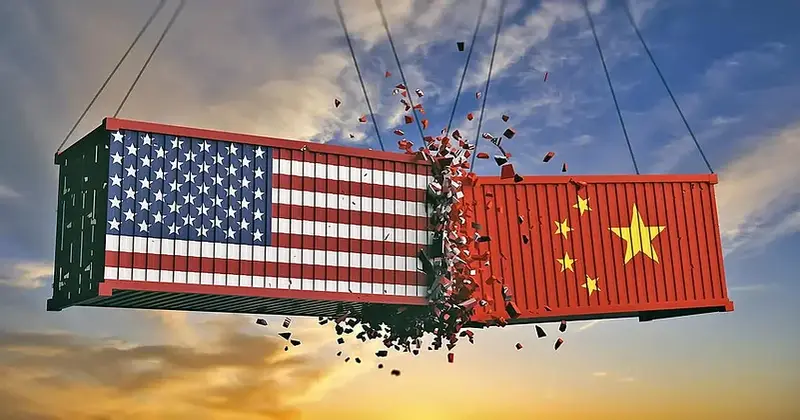
Between decoupling and reordering: The stakes of renewed US-China rivalry

The US-China rivalry will test the strength of the liberal international order. Will trade rules based on cooperation survive? Will multilateral dispute resolution remain trustworthy if major powers disregard it? Will new institutions emerge to mediate between conflicting blocks? The answer depends on how effectively middle powers and groups of like-minded states can counterbalance coercion

Vedika ZnwarVedika Znwar
Oct 15, 2025, 10:00 pm IST
in USA, World, China
Follow on Google News
The stakes of a renewed rivalry between India and China

The stakes of a renewed rivalry between India and China

FacebookTwitterWhatsAppTelegramEmail

In 2025, the rivalry between the United States and China seems to be moving into a more serious, structural phase. What started as occasional trade disputes has now evolved into a complex confrontation that includes trade, supply chains, technology, finance, and security. This rivalry is not just about the two countries; it may reshape the global order, challenge rising powers like India, and speed up the movement towards a more multipolar world.

Trade and economic strategies lie at the heart of the tension. Recently, China enacted broad export controls on rare-earth materials and related technologies, effective from December 1. Foreign firms now need licenses even for using small amounts of Chinese-sourced rare earths. The United States reacted with strong rhetoric and proposed 100 per cent tariffs on Chinese imports starting November 1. Both countries have also introduced fees for each other’s ships, raising the costs of maritime trade. The WTO has warned that bilateral trade could fall by as much as 80 per cent if tensions escalate, though that is a hypothetical scenario. In September 2025, China’s exports to the U.S. dropped by 27 per cent year-on-year, while its overall exports increased by 8.3 per cent as China shifted focus to markets in Southeast Asia, Latin America and Africa.

These actions highlight a larger trend: the growing emphasis on national security in trade. What used to be typical tariff negotiations is now framed in security terms. The U.S. has historically used export controls on semiconductors and China is following suit with rare earths, reflecting the U.S. Foreign Direct Product Rule. Both sides are using essential components in high-tech supply chains as tools of competition.

However, trade is just one part of the rivalry. The competition in technology is intensifying alongside economic pressure. A recent study shows that tensions between the U.S. and China in science and technology are already limiting knowledge sharing in areas where China is nearly at U.S. levels, especially in foundational research. Analysts of global supply chains observe that U.S. imports are moving toward “China+1” partners, particularly ASEAN countries. These new supply chains are still connected to Chinese networks, limiting actual decoupling. In finance, countries are looking for alternatives to dollar-based systems. For example, some are engaging with China’s CIPS payment system and exploring cross-border digital currencies to lessen vulnerability to U.S. sanctions.

Geopolitically, the U.S. and China are competing for influence over maritime routes, alliances and defense strategies. The introduction of reciprocal port fees serves not only as an economic measure but also as a signal of the struggle for control over sea lanes. China’s diplomatic efforts continue; in April 2025, Xi Jinping visited Vietnam, Malaysia and Cambodia to strengthen its influence in Southeast Asia. The competition for strategic locations from Indo-Pacific ports to infrastructure projects in Latin America and Africa will only grow.

What does this indicate for the global order? The older model of U.S.-led unipolarity faces challenges. Although the U.S. maintains military and institutional strength, its ability to uphold a rule-based global system is being tested by increasing resistance and fragmentation. Many analysts are now referring to “ordered polycentrism” as a new governance model, where multiple centers of influence coexist and interact through overlapping institutions. The U.S.-China rivalry might cause a shift in global influence: rather than a single power, we could see several key players such as Washington, Beijing, New Delhi, Brussels, and possibly Moscow with each commanding their own spheres of influence.

In this shifting landscape, India holds a critical position. With some of the highest growth rates among large economies and a favorable demographic situation, India is frequently cited as one of the poles in the foreseen multipolar order. However, India’s strategic options are not limitless. Traditionally, it has taken a measured, non-confrontational stance in the U.S.-China rivalry. Furthermore, it faces structural challenges like the Chinese supply chains are still embedded in Indian manufacturing and China remains a significant trading partner. On a bilateral level, India must navigate tensions over its border with China while balancing Washington’s expectations for strategic cooperation.

As the U.S.-China rivalry grows, India might boost its bargaining power if it acts wisely. It could secure better deals from both sides, such as in arms transactions, technology exchanges, or supply chain partnerships. New Delhi can also serve as a hub for companies looking to reduce reliance on China. It could provide alternative locations for manufacturing and design, especially in areas where India excels, like software and green energy. Nevertheless, India risks being caught in the middle: if open trade norms break down and decoupling intensifies, India’s export opportunities in contested markets might diminish. Additionally, India may face pressure to choose sides or commit to security deals.

In relative terms, middle powers such as South Korea, ASEAN nations, Brazil and South Africa might also find their influence growing. They can act as swing states in supply chains, provide alternative manufacturing sites and negotiate favorable terms with both blocs. However, their ability to exert leverage depends on whether these countries have the institutional strength, economic sophistication, and political independence to do so. Some may be too reliant on one side to act as truly independent players.

Looking ahead, the situation could unfold in different ways. In a pessimistic scenario, the U.S.-China conflict could become entrenched, leading to significant decoupling, divided standards in technology and trade, competing economic blocks, and ongoing security tensions. This would disrupt supply chains, raise costs and split the global economy.

A more moderate forecast could involve periods of de-escalation, where negotiations occur amid crises in rare earths, semiconductor exports, or regional disputes. In this case, the rivalry would remain a significant issue but not an absolute divide. The order would still be contested, yet global institutions, multilateral development banks and trade agreements would continue to play mediating roles.

Even under a moderated scenario, a return to the pre-2018 state of highly integrated globalization seems unlikely. The new reality will likely involve partial re-globalization, characterized by segmented networks, multiple value chains and strategic circuits in key sectors. The WTO’s warning that a breakdown in U.S.-China trade could lower global real GDP by 7 per cent highlights the significant stakes.

This rivalry will test the strength of the liberal international order. Will trade rules based on cooperation survive? Will multilateral dispute resolution remain trustworthy if major powers disregard it? Will new institutions emerge to mediate between conflicting blocks? The answer depends on how effectively middle powers and groups of like-minded states can counterbalance coercion.

Also Read: MoS Kirti Vardhan attends Sharm el-Sheikh peace summit: The diplomatic move by India asserts a firm strategic message

Other nations are not without power: their bargaining strength could grow if they combine economic progress with institutional effectiveness and strategic independence. However, this is not guaranteed; they must invest in their capabilities, pursue flexible foreign policies and avoid overreliance on any bloc.

Ultimately, the U.S.-China rivalry is not merely a bilateral issue; it represents a critical juncture for the global order. If mismanaged, it could fracture economic systems, splinter financial networks and undermine multilateral norms. If approached with caution, it could pave the way for a more diverse, multipolar world which would be chaotic and contested, but potentially more resilient than a fragile unipolar system. The decisions made by middle powers like will play a crucial role in determining the direction we take.


Topics: ChinaUSATrade WarEconomic Rivalry
ShareTweetSendShareSend
✮ Subscribe Organiser YouTube Channel. ✮
✮ Join Organiser's WhatsApp channel for Nationalist views beyond the news. ✮
Previous News

Afghanistan: 12 civilians dead, over 100 injured after Pakistani forces attack; Kabul responds with retaliatory strikes

Next News

Telangana: VHP slams Congress govt, seeks end to police harassment of Hindu Diwali sellers, says festivals hit

Related News

Bangladesh’s reported JF-17 push has triggered fresh scrutiny after India’s Ops Sindoor exposed the vulnerabilities of Pakistani-Chinese defence systems and precision strike capabilities

Shadows of Operation Sindoor: Questions loom over Bangladesh’s JF-17 ambitions amid Sino-Pakistani tech vulnerabilities

As Beijing tightens its grip ahead of June 4, dissidents inside China face surveillance and intimidation while activists abroad keep alive the memory of the 1989 Tiananmen crackdown

Tiananmen at 37: How China suppresses remembrance of the massacre through fear, censorship and surveillance

Tiananmen Square Massacre: When Tanks Met Students—The Night China Crushed Its Democratic Hope!

Tiananmen Square Massacre: When Tanks Met Students—The Night Communist China Crushed Its Democratic Hope!

European Commission President Ursula von der Leyen, Chinese President Xi Jinping and US President Donald Trump

Trade Barriers, AI Battles and Military Containment: The European-US strategic front against China takes shape

Iran President Masoud Pezeshkian and Supreme Leader Mojtaba Khamenei

West Asia Conflict: Did Iran President Masoud Pezeshkian offer resignation owing to the iron fist of IRGC & theocracy?

External Affairs Minister Dr. S. Jaishankar and US Secretary of State Marco Rubio(File Photo)

Marco Rubio India Visit: New Delhi scripts strategic autonomy as US pushes transactional Indo-Pacific agenda

Load More

Latest News

PM Modi to Overtake Nehru as India's Longest-Serving Elected Prime Minister on June 10

PM Modi set to surpass Nehru’s record, become India’s longest-serving elected Prime Minister

A representative image

West Bengal Joins Ayushman Bharat: CM Suvendu Adhikari announces coverage for 1.36 crore families

Representatives of the Hindu Janajagruti Samiti, advocates associated with the case, and the complainant address a press conference in Pune regarding allegations of religious conversion pressure and workplace harassment at Wipro Technologies.

After TCS, another Corporate Jihad: Hindu employee alleges Shahina pressured to convert, HR Zeeshan forced resignation

(Left) Nivedita Menon (Right) Arfa Khanum

Podcast Storm: Nivedita Menon & Arfa Khanum slammed for remarks on ‘Love Jihad’ and Hindu women

Operation Delta Hunt: Gujarat Police arrests 362 illegal Bangladeshis, investigates wider network

Operation Delta Hunt: Gujarat Police arrest 362 illegal Bangladeshi nationals during thes crackdown 72-hour

Bangladesh’s reported JF-17 push has triggered fresh scrutiny after India’s Ops Sindoor exposed the vulnerabilities of Pakistani-Chinese defence systems and precision strike capabilities

Shadows of Operation Sindoor: Questions loom over Bangladesh’s JF-17 ambitions amid Sino-Pakistani tech vulnerabilities

B. Nagendra, Congress MLA and former minister in Karnataka

Karnataka: CBI files chargesheets against Nagendra, Congress leader, ex-minister, 29 others in Valmiki Corporation scam

Representative Image (This is an AI generated image)

From Class 10 to Ayurvedic Doctor: Central Sanskrit University unveils new pathway to BAMS

Heera Group founder Nowhera Shaik (File Photo)

Telangana: ED arrests Nowhera Shaik’s aide in Heera Group Sharia-compliant Rs 3000 Cr investment scam

Governor of Karnataka Thaawarchand Gehlot administered the Oath of Office and Secrecy to Chief Minister D.K. Shivakumar on June 3, 2026

DK Shivakumar takes oath as Karnataka CM, invokes Ajjayya in ceremony

Load More
  • Privacy
  • Terms
  • Cookie Policy
  • Refund and Cancellation
  • Delivery and Shipping

© Bharat Prakashan (Delhi) Limited.
Tech-enabled by Ananthapuri Technologies

  • Home
  • Search Organiser
  • Bharat
    • Assam
    • Bihar
    • Chhattisgarh
    • Jharkhand
    • Maharashtra
    • View All States
  • World
    • Asia
    • Africa
    • North America
    • South America
    • Europe
    • Australia
  • Editorial
  • Operation Sindoor
  • Opinion
  • Analysis
  • Defence
  • Culture
  • Sports
  • Business
  • RSS @ 100
  • Entertainment
  • More ..
    • Sci & Tech
    • Vocal4Local
    • Special Report
    • Education
    • Employment
    • Books
    • Interviews
    • Travel
    • Health
    • Politics
    • Law
    • Economy
    • Obituary
  • Subscribe Magazine
  • Read Ecopy
  • Advertise
  • Circulation
  • Careers
  • About Us
  • Contact Us
  • Policies & Terms
    • Privacy Policy
    • Cookie Policy
    • Refund and Cancellation
    • Terms of Use

© Bharat Prakashan (Delhi) Limited.
Tech-enabled by Ananthapuri Technologies