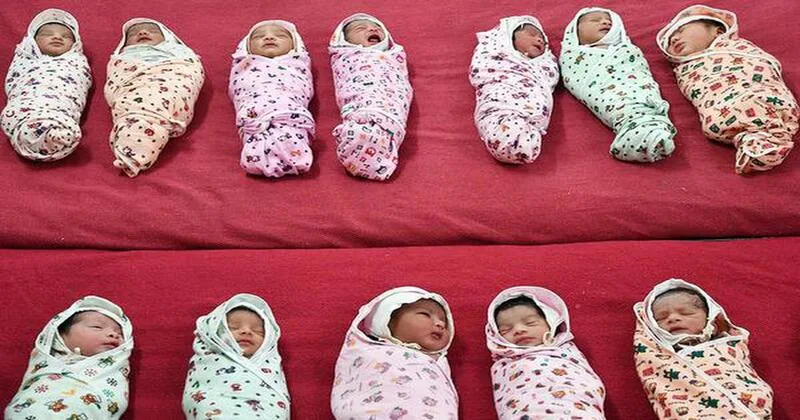
When a young nation stops having children
July 15, 2026
  • Read Ecopy
  • Circulation
  • Advertise
  • Careers
  • About Us
  • Contact Us
Android AppiPhone AppArattai
Organiser
  • ‌
  • Bharat
    • Assam
    • Bihar
    • Chhattisgarh
    • Jharkhand
    • Maharashtra
    • View All States
  • World
    • Asia
    • Europe
    • North America
    • South America
    • Africa
    • Australia
  • Editorial
  • International
  • Opinion
  • RSS @ 100
  • More
    • Op Sindoor
    • Analysis
    • Sports
    • Defence
    • Politics
    • Business
    • Economy
    • Culture
    • Special Report
    • Sci & Tech
    • Entertainment
    • G20
    • Azadi Ka Amrit Mahotsav
    • Vocal4Local
    • Web Stories
    • Education
    • Employment
    • Books
    • Interviews
    • Travel
    • Law
    • Health
    • Obituary
  • Subscribe
    • Subscribe Print Edition
    • Subscribe Ecopy
    • Read Ecopy
  • ‌
  • Bharat
    • Assam
    • Bihar
    • Chhattisgarh
    • Jharkhand
    • Maharashtra
    • View All States
  • World
    • Asia
    • Europe
    • North America
    • South America
    • Africa
    • Australia
  • Editorial
  • International
  • Opinion
  • RSS @ 100
  • More
    • Op Sindoor
    • Analysis
    • Sports
    • Defence
    • Politics
    • Business
    • Economy
    • Culture
    • Special Report
    • Sci & Tech
    • Entertainment
    • G20
    • Azadi Ka Amrit Mahotsav
    • Vocal4Local
    • Web Stories
    • Education
    • Employment
    • Books
    • Interviews
    • Travel
    • Law
    • Health
    • Obituary
  • Subscribe
    • Subscribe Print Edition
    • Subscribe Ecopy
    • Read Ecopy
Organiser
  • Home
  • Bharat
  • World
  • Operation Sindoor
  • Editorial
  • Analysis
  • Opinion
  • Culture
  • Defence
  • International Edition
  • RSS @ 100
  • Magazine
  • Read Ecopy
Home Bharat

When a young nation stops having children

Fertility is collapsing across states – a demographic turning point few are prepared to face

Dr. PraveenYashika YadavDr. PraveenandYashika Yadav
Oct 12, 2025, 05:00 pm IST
in Bharat, Opinion
Follow on Google News
The SRS 2023 report is more than a statistical update – it is a warning. India’s future will be shaped less by how many people it adds today, and more by how few children are being born for tomorrow

The SRS 2023 report is more than a statistical update – it is a warning. India’s future will be shaped less by how many people it adds today, and more by how few children are being born for tomorrow

FacebookTwitterWhatsAppTelegramEmail

India may still be the world’s most populous country, with more than 1.4 billion people, but beneath the surface a quiet crisis is unfolding. Indians are having fewer children than ever before, and the decline is sharper and faster than almost anywhere else in the developing world. The latest Sample Registration System (SRS) 2023 report makes this plain. In urban India, fertility has already slipped below the replacement level of 2.1 children per woman in 17 of 20 major states. Back in 2006, that was true of just 11 states. In rural India, 11 states are now below replacement, compared to only two then. What was once hailed as a victory for family planning is beginning to look like the start of a birth drought.

The pace of decline is striking. In Tamil Nadu, urban fertility fell from 1.8 in 2006 to 1.3 today. Kerala is now at 1.5. Odisha and West Bengal are even lower, at 1.2 and 1.1. Delhi stands at 1.2, figures closer to Tokyo than to a booming Indian capital. Bihar and Uttar Pradesh remain above replacement at 2.2, but even here change is unmistakable. Rural Bihar has dropped from 4.3 children per woman in 2006 to 2.9 today. A Chennai couple may now stop at one child, while a farmer in rural Bihar still expects three. India is living through two demographic realities at once: a fast-aging south and east, and a still-young north.
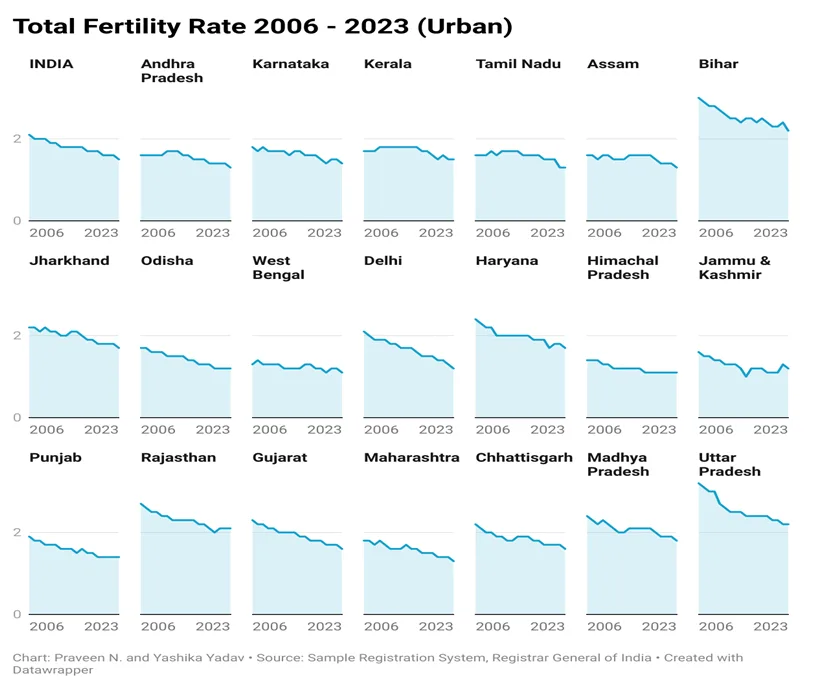
Urban fertility has fallen below replacement in almost every major state. South and east India now mirror European rates, while the north lags but is also declining. (Source: SRS 2023)

For now, the headlines still celebrate India’s population growth – overtaking China, crossing 1.4 billion. But much of this rise is momentum, the children of earlier large generations still coming of age. The real story is happening quietly: families everywhere are choosing smaller households. And that shift has happened so silently that India still talks of “population explosion” when the real story is population implosion.

Rural fertility, once thought resistant to change, is now falling sharply. Bihar and UP remain higher, but the nationwide trend is unmistakable. (Source: SRS 2023)

Once fertility falls below replacement, history shows it rarely climbs back. Japan and South Korea have spent decades trying everything from cash payments for newborns to extended parental leave. None of it has reversed the slide. South Korea’s fertility today is just 0.7, the lowest in the world. India’s numbers suggest it may be heading in the same direction, only faster – and at a stage when it is still far from wealthy.

Also Read: Arthayam: Unique, still universal

Why is this happening? Urbanization is part of the answer: raising children in cities is costly and space is tight. Rising education and workforce participation among women also delay marriage and childbirth. Aspirations have shifted. Where three or four children were once seen as security, today two – or even one – feels enough. Better healthcare and contraception mean families can act on these choices more decisively. What makes India unusual is how quickly these forces have converged across such a vast society. In less than a generation, the country has swung from fearing “too many children” to confronting “not enough.”

The effects are only just starting to be felt. A fall below replacement means fewer workers tomorrow, more elderly relatives to support and higher medical costs in households that already struggle. It shortens the life of the much-talked-about demographic dividend that has powered India’s growth story. Abroad, the warnings are clear. Japan has endured decades of stagnation, while South Korea is spending billions to coax couples into parenthood with little success. If India is unprepared, it could face the same fate.

For years, falling fertility was celebrated as progress. That era has ended. The question now is not how to slow growth but how to prepare for decline. The SRS 2023 report is more than a statistical update – it is a warning. India’s future will be shaped less by how many people it adds today, and more by how few children are being born for tomorrow. The birth drought may prove to be the country’s greatest challenge yet.

Topics: IndiaDemographic DividendFertility rate
Dr. Praveen
Dr. Praveen
Dr. Praveen is a Associate Fellow at the Center of Policy Research and Governance (CPRG), New Delhi. His research focuses on Demography, Education policy, Labor and Marriage market, and Development economics, with a special emphasis on gender equity and female labor force participation [Read more]
Yashika Yadav
Yashika Yadav
Yashika Yadav is Intern at CPRG [Read more]
ShareTweetSendShareSend
✮ Subscribe Organiser YouTube Channel. ✮
✮ Join Organiser's WhatsApp channel for Nationalist views beyond the news. ✮
Previous News

How will the war between Russia and Ukraine end?

Next News

Odisha CM speaks to father of gangrape victim in West Bengal; Assures full support

Related News

“Reuters-You can do better”: US Envoy Sergio Gor slams British news agency over fake narrative on India-US trade deal

External Affairs Minister Dr. S. Jaishankar launched India's campaign for the UNSC chair

India unveils campaign for UNSC seat; EAM Jaishankar outlines SHANTI vision for secure, peaceful & just world order

Commerce and Industry Minister Piyush Goyal

Fact Check: Piyush Goyal rejects Reuters report on India-US trade deal as “false & misleading”; Reaffirms balanced pact

Great Nicobar is emerging as a strategic gateway that strengthens India's maritime reach while increasing pressure on China's Malacca Dilemma

Great Nicobar Project to boost India’s Indo-Pacific leverage, deepen China’s Malacca Dilemma: Report

PM Modi's Gifts to Albanese Blend India's Ancient Craft, Modern Music and Premium Coffee

From Dhokra Sculpture to Colonial Cousins Vinyl: PM Modi’s gifts to Australian PM Albanese showcases cultural heritage

Prime Minister Narendra Modi and New Zealand Prime Minister Christopher Luxon

India-New Zealand Strategic Partnership: A new horizon for New Delhi’s economic diplomacy

Load More

Latest News

PIB organises one-day media workshop Varta

Varta: Bharat targets 15 per cent global orange economy share, IICT unveils massive creative workforce plan

India's Permanent Representative to the UN, Ambassador Harish Parvathaneni, called for urgent reform of the UN Security Council

‘UN must reflect on contemporary realities’: India renews push for security council reform

RSS functionaries with the children after the inauguration of the Mata Revati Bai Sanskar Kendra in Delhi

RSS at 100: Vidya Bharati opens Sanskar Kendra in the name of Dr Hedgewar’s mother, Mata Revati Bai in Delhi

Rudram-1

Rudram-1 in Action: Bharat’s first indigenous missile to hunt and destroy enemy radars

Indian Railways is facing a growing encroachment challenge, with over 1,068 hectares of land under encroachment

RTI Exposes Massive Rail Land Grab: Over 1,068 hectares of Indian Railways land encroached

Madhya Pradesh's Uniform Civil Code draft proposes mandatory registration of live-in relationships

Madhya Pradesh: UCC draft proposes mandatory registration of live-in relationships, divorce & inheritance laws

Devotees gather in large numbers in Puri for Mahaprabhu Jagannath's Nabajaubana Darshan

Odisha: Mahaprabhu Jagannath appears in divine Nabajaubana form after 15-day anasara, thousands gather in Puri

India's Udyam Registration and Udyam Assist platforms are formalising MSMEs and driving inclusive entrepreneurial growth

How Udyam Registration and Udyam Assist are transforming India’s MSME and entrepreneurial ecosystem

Maoist Ravindra Ganjhu (Source: OpIndia)

Jharkhand: Maoist commander Ravindra Ganjhu with bounty of Rs 20 lakh arrested after 16 years

Gyanvapi Complex

Gyanvapi Row: Hindu side demands Mosque premises be vacated, Muslim side rejects mediation; Both seek court verdict

Load More
  • Privacy
  • Terms
  • Cookie Policy
  • Refund and Cancellation
  • Delivery and Shipping

© Bharat Prakashan (Delhi) Limited.
Tech-enabled by Ananthapuri Technologies

  • Home
  • Search Organiser
  • Bharat
    • Assam
    • Bihar
    • Chhattisgarh
    • Jharkhand
    • Maharashtra
    • View All States
  • World
    • Asia
    • Africa
    • North America
    • South America
    • Europe
    • Australia
  • Editorial
  • Operation Sindoor
  • Opinion
  • Analysis
  • Defence
  • Culture
  • Sports
  • Business
  • RSS @ 100
  • Entertainment
  • More ..
    • Sci & Tech
    • Vocal4Local
    • Special Report
    • Education
    • Employment
    • Books
    • Interviews
    • Travel
    • Health
    • Politics
    • Law
    • Economy
    • Obituary
  • Subscribe Magazine
  • Read Ecopy
  • Advertise
  • Circulation
  • Careers
  • About Us
  • Contact Us
  • Policies & Terms
    • Privacy Policy
    • Cookie Policy
    • Refund and Cancellation
    • Terms of Use

© Bharat Prakashan (Delhi) Limited.
Tech-enabled by Ananthapuri Technologies