Starmer’s India Visit: Trade deepening and the real tests ahead
June 6, 2026
  • Read Ecopy
  • Circulation
  • Advertise
  • Careers
  • About Us
  • Contact Us
Android AppiPhone AppArattai
Organiser
  • ‌
  • Bharat
    • Assam
    • Bihar
    • Chhattisgarh
    • Jharkhand
    • Maharashtra
    • View All States
  • World
    • Asia
    • Europe
    • North America
    • South America
    • Africa
    • Australia
  • Editorial
  • International
  • Opinion
  • RSS @ 100
  • More
    • Op Sindoor
    • Analysis
    • Sports
    • Defence
    • Politics
    • Business
    • Economy
    • Culture
    • Special Report
    • Sci & Tech
    • Entertainment
    • G20
    • Azadi Ka Amrit Mahotsav
    • Vocal4Local
    • Web Stories
    • Education
    • Employment
    • Books
    • Interviews
    • Travel
    • Law
    • Health
    • Obituary
  • Subscribe
    • Subscribe Print Edition
    • Subscribe Ecopy
    • Read Ecopy
  • ‌
  • Bharat
    • Assam
    • Bihar
    • Chhattisgarh
    • Jharkhand
    • Maharashtra
    • View All States
  • World
    • Asia
    • Europe
    • North America
    • South America
    • Africa
    • Australia
  • Editorial
  • International
  • Opinion
  • RSS @ 100
  • More
    • Op Sindoor
    • Analysis
    • Sports
    • Defence
    • Politics
    • Business
    • Economy
    • Culture
    • Special Report
    • Sci & Tech
    • Entertainment
    • G20
    • Azadi Ka Amrit Mahotsav
    • Vocal4Local
    • Web Stories
    • Education
    • Employment
    • Books
    • Interviews
    • Travel
    • Law
    • Health
    • Obituary
  • Subscribe
    • Subscribe Print Edition
    • Subscribe Ecopy
    • Read Ecopy
Organiser
  • Home
  • Bharat
  • World
  • Operation Sindoor
  • Editorial
  • Analysis
  • Opinion
  • Culture
  • Defence
  • International Edition
  • RSS @ 100
  • Magazine
  • Read Ecopy
Home World Europe

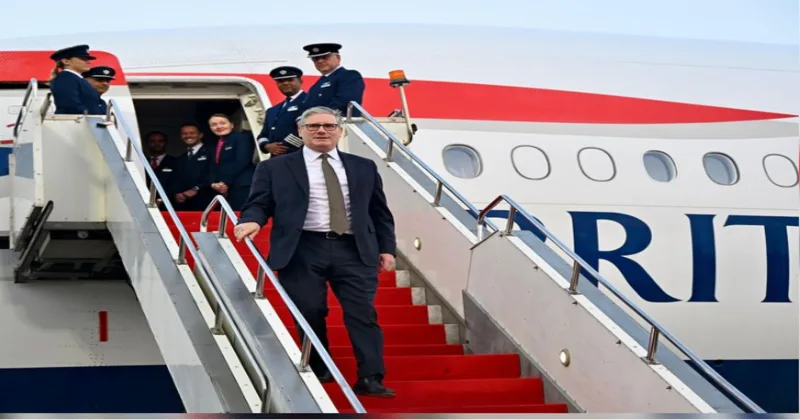
UK PM Starmer’s India Visit: Trade deepening, diplomatic balancing and the real tests ahead

UK Prime Minister Keir Starmer’s visit to India marks a pivotal moment in the evolving partnership between London and New Delhi — one defined by post-Brexit economic imperatives, shifting global alliances, and mutual strategic interests

Vedika ZnwarVedika Znwar
Oct 8, 2025, 12:20 pm IST
in Europe, Bharat, World, International Edition
Follow on Google News
UK PM Starmer’s India Visit: Trade deepening, diplomatic balancing and the real tests ahead

UK PM Starmer’s India Visit: Trade deepening, diplomatic balancing and the real tests ahead

FacebookTwitterWhatsAppTelegramEmail

As UK Prime Minister Keir Starmer arrived in Mumbai on October 8–9, 2025, for his first official visit to India, he brings more than just goodwill. The visit is meant to turn the recently signed UK-India trade pact into real benefits. It also aims to revive bilateral relations after the cooling post-Brexit and to carefully manage the complexities that come with strengthening ties between two large democracies. His meeting with Prime Minister Narendra Modi is seen as a test of whether this outreach can produce concrete outcomes or become mere talk.

Trade and investment are the main focus. London and New Delhi finalized the India–UK Comprehensive Economic and Trade Agreement (CETA) in July 2025 after three years of negotiations. CETA is set to reduce the average tariff on UK goods entering India from about 15 percent to 3 percent, with gradual cuts for sensitive products. The UK government estimates that this deal could boost bilateral trade by £25.5 billion annually by 2040 and add about £4.8 billion per year to UK GDP, along with wage increases and local benefits. On this trip, Starmer is accompanied by a delegation of 125 CEOs, university leaders, cultural figures, and industry leaders from companies like Rolls-Royce, BT, Diageo, British Airways, and the London Stock Exchange. In a symbolic moment, he spoke to passengers mid-flight on a British Airways flight to India, stating, “This is your Prime Minister in the cockpit,” highlighting that this is the largest trade mission the UK has ever sent to India.

Also Read: Bharat gives fiery rebuttal at the UN to Pakistan, exposes its hypocrisy on Kashmir and women’s rights

Despite the fanfare, the real stakes are significant. First, India and the UK need to agree on how to implement CETA, including timelines for ratification, regulatory matching, dispute resolution, rules-of-origin enforcement, and making sure that small and medium enterprises (SMEs) aren’t overlooked by larger companies. The Indian media expects that the Modi–Starmer agenda will cover connectivity, transportation, critical and emerging technologies, pharmaceuticals, fintech, and liberalizing public procurement. India sees the UK as an important partner in its Vision 2035 plan, which involves both countries strengthening cooperation in innovation, energy, defense, education, climate, and personal connections. Second, Starmer must address sensitive matters—migration, visa access, geopolitics, and domestic pressures in both nations.

On the visa issue, there are differing expectations. Indian businesses and the diaspora have long advocated for more flexible work visa access, especially for tech professionals. However, Starmer has made it clear that the UK will not pursue a visa deal during this visit and that immigration policy will stay separate from trade liberalization. The UK faces domestic pressure to control net migration and seems reluctant to change its stance. While this may ease pressure from UK companies for easier access to Indian talent, it risks disappointing Indian business circles and tech professionals who had hoped for progress on visas. If Indian businesses feel that the UK is not willing to reciprocate openness, it could dampen their enthusiasm for UK investments.

Geopolitically, India and the UK share overlapping but sometimes competing interests in areas such as climate, security, digital governance, and regional diplomacy. Modi’s recent messaging, including his social media birthday greeting to Russia’s Vladimir Putin, drew attention in London. So far, Starmer has avoided direct confrontation or criticism. Topics like human rights, regional stability, and cooperation on global challenges like climate change, energy, and vaccines may come up, but both sides will likely approach these issues with care.

There are several potential gains from the visit. Scotch whisky stands to benefit significantly with lower tariffs from the new deal, after years of facing high import duties in India. Plans for increased air connectivity are already underway: British Airways intends to add more flights to India, and new routes like Manchester–Delhi could enhance logistics and tourism. If business deals, joint ventures, or infrastructure partnerships arise from the CEO mission, Starmer can showcase real benefits from the trip. From India’s perspective, attracting UK investments in green energy, defense, and advanced manufacturing aligns with its strategic goals. Additionally, a solid framework for implementing CETA would boost Indian businesses looking for export opportunities in the UK.

However, the visit also has vulnerabilities and possible shortcomings. The lack of visa liberalisation could become a sticking point, leading some in India to lower their expectations about reciprocity. Indian SMEs, often limited by regulations and capacity, may miss out if market access or supply chain alignment is weak. Dispute resolution processes or non-tariff barriers could become contentious, especially if early problems arise. Starmer’s hesitation to publicly address human rights or sensitive diplomatic issues might be viewed by critics as a lack of seriousness about shared values.

Timing and ratification present another uncertainty. The UK Parliament must approve CETA, and any delays could undermine investor confidence. Domestically, Starmer has to balance growth ambitions with the realities of elections—if the UK’s economy falters, he may face criticism for granting concessions abroad without visible benefits at home. India will likewise monitor whether concessions to British firms fit its national interests, especially in strategic sectors.

In the longer term, this visit could help reshape India-UK relations, focusing more on economic growth rather than nostalgic or post-colonial rhetoric. If Starmer and Modi can maintain momentum, they might deepen mutual trust and collaboration—not just in trade, but also in technology, climate action, defense, research, and regional alignment. Yet, failing to produce early successes or misalignments over mobility could lead to frustration and hinder progress.

Starmer’s visit represents a calculated risk. If it comes with clear plans, oversight, and balanced reciprocity, it could mark a shift towards a more productive partnership. For India, the priority should be protecting its interests—not by resisting engagement, but by demanding transparency, fair rules, access for SMEs, protections in strategic sectors, and systems for monitoring progress. India should advocate for technology transfer and capacity building in key areas, insist on strong dispute resolution safeguards, and seek a mid-term review. If the UK maintains its distance on visa liberalization, India may need to adjust its expectations and focus more on areas where reciprocity is simpler, like trade, investment, climate, and research. Ultimately, India’s aim should be to prevent an uneven agreement and ensure that its long-term strategic independence is not compromised for short-term gains.

Topics: CETAUK Prime Minister Keir StarmerComprehensive Economic and Trade AgreementPrime Minister Narendra Modi
ShareTweetSendShareSend
✮ Subscribe Organiser YouTube Channel. ✮
✮ Join Organiser's WhatsApp channel for Nationalist views beyond the news. ✮
Previous News

Trump faces US shutdown turmoil as India emerges as fastest growing major economy defying his “dead” remark

Next News

Indian Air Force Day: From historic wars to modern strikes, IAF demonstrates bravery as it marks 93rd foundation day

Related News

As Khalistani networks seek new platforms beyond the West, Azerbaijan has emerged as a key venue for conferences, campaigns and narratives aligned with the Pakistan-Turkey axis against India.

Khalistan’s New Grazing Ground: Azerbaijan emerges as new hub for Turkey-Pakistan backed anti-India networks

Myanmar President U Min Aung Hlaing and Prime Minister Narendra Modi

PM Modi pushes for democracy in Myanmar; Naypyidaw vows action against insurgents threatening India’s national security

Myanmar President U Min Aung Hlaing and Prime Minister Narendra Modi

India-Myanmar boosts trade via Rupee-Kyat mechanism; Pushes connectivity projects as gateway to Southeast Asia

Uttar Pradesh CM Yogi Adityanath warns those of dire consequences if they disrespect gau mata

Uttar Pradesh CM Yogi Adityanath says “Gaumata is Rashtramata”, warns against cow slaughter posts

Israel Prime Minister Benjamin Netanyahu and Prime Minister Narendra Modi(File Photo)

PM Netanyahu & Israel’s Bonhomie with India: The discomfort of Congress as Bharat-Israel bond deepens

Beyond the Thucydides Trap: Why the rise of India differs fundamentally from China

Load More

Latest News

The Vedic age saw remarkable women sages, known as Rishikas, who composed hymns and shaped India's spiritual and philosophical heritage

Rishikas of Vedic Age: How Gargi, Maitreyi & other women shaped ancient India’s spiritual and philosophical tradition

Police in AAP-Ruled state of Punjab lathi charge sit-in protesters

Punjab: ITI candidates seeking jobs lathi-charged outside PSPCL HQ; opposition slams AAP Govt over police action

From constables to DGP, India's police system follows a structured chain of command that governs law enforcement across the country

From Constable to DGP: Understanding India’s police hierarchy, powers & recruitment system

The terracotta dice that challenges historical assumptions and highlights India's millennia-old civilisational heritage

How a 4,500-year-old terracotta dice is reviving the debate on India’s civilisational continuity & Vedic heritage

The Porumamilla inscription and the ancient science behind a reservoir that survived 650 years

India’s 655-Year-Old Water Policy: The Porumamilla inscription that turned stone into a manual of hydrology

India’s Permanent Representative to the United Nations Ambassador Harish Parvathaneni

India slams Pakistan at UNSC for peddling false narratives on Jammu & Kashmir

Keralam: Pathanamthitta temple property occupied beyond lease period reclaimed by devotees

A series of high-level engagements signals New Delhi's growing focus on building interoperable security networks across the Indo-Pacific

India strengthens Indo-Pacific security architecture with new defence and maritime partnerships

Prime Minister Narendra Modi

“Makes every Indian proud”: PM Modi hails India’s 7.7 per cent GDP growth in FY 2025-26

Once known for maoist violence, Minpa now leads healthcare revolution with telemedicine services in Sukma

From Maoist Stronghold to Healthcare Hub: How Chhattisgarh’s Minpa is transforming through telemedicine & development

Load More
  • Privacy
  • Terms
  • Cookie Policy
  • Refund and Cancellation
  • Delivery and Shipping

© Bharat Prakashan (Delhi) Limited.
Tech-enabled by Ananthapuri Technologies

  • Home
  • Search Organiser
  • Bharat
    • Assam
    • Bihar
    • Chhattisgarh
    • Jharkhand
    • Maharashtra
    • View All States
  • World
    • Asia
    • Africa
    • North America
    • South America
    • Europe
    • Australia
  • Editorial
  • Operation Sindoor
  • Opinion
  • Analysis
  • Defence
  • Culture
  • Sports
  • Business
  • RSS @ 100
  • Entertainment
  • More ..
    • Sci & Tech
    • Vocal4Local
    • Special Report
    • Education
    • Employment
    • Books
    • Interviews
    • Travel
    • Health
    • Politics
    • Law
    • Economy
    • Obituary
  • Subscribe Magazine
  • Read Ecopy
  • Advertise
  • Circulation
  • Careers
  • About Us
  • Contact Us
  • Policies & Terms
    • Privacy Policy
    • Cookie Policy
    • Refund and Cancellation
    • Terms of Use

© Bharat Prakashan (Delhi) Limited.
Tech-enabled by Ananthapuri Technologies