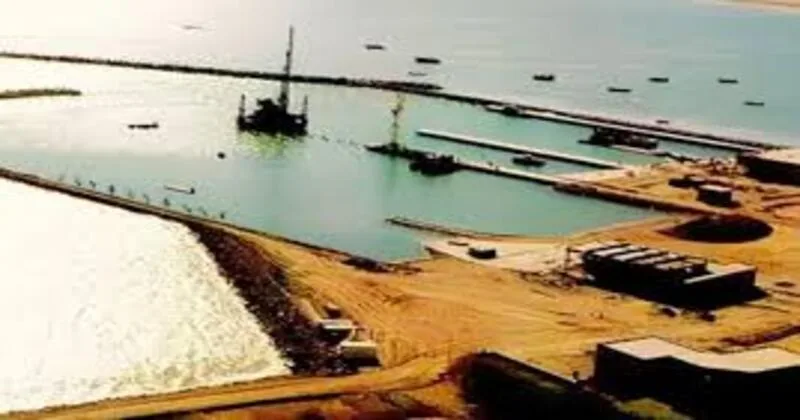
In recent weeks, Pakistan via advisers linked to its army chief, Field Marshal Asim Munir has floated an idea of offering the United States a chance to build, operate or at least invest in a new deep-sea port along the Arabian Sea coast in Pasni, Balochistan. The proposal, valued at up to US $1.2 billion, is framed as primarily civilian and commercial and not a military base but it has stirred immediate attention in strategic and maritime-security circles, especially in New Delhi.
In the public sketch of the plan, Pakistan would link this port to its interior mineral-rich zones via a new rail corridor, enabling export of critical minerals (notably copper, antimony and rare earths) to global markets. The choice of Pasni is strategic: it lies fairly close to the existing Chinese-backed Gwadar port, just about 100 km away (and some media report it to be even closer) and not far from the Indian-supported Chabahar port in Iran. The proposal, in its publicly reported form, explicitly excludes basing rights for U.S. forces, likely to allay overt strategic backlash.
That said, Pakistan’s military establishment has sought to temper expectations. A senior security official has commented that the port idea was never formally adopted, is still exploratory and has not been approved through any government or strategic channel. In other words, what is being discussed may be as much a diplomatic signal as a fully fleshed state policy.
If this port proposal were to gain traction and move from concept to execution, it carries several implications for Pakistan’s economic orientation. For U.S. influence in the Indian Ocean littoral and critically, for India’s maritime security in the long term.
Pakistan is seeking to diversify its strategic and economic partnerships. Over the last decade, Islamabad has been closely tied to China, particularly through the China–Pakistan Economic Corridor (CPEC) and Chinese investment in Gwadar. But Pakistan’s fiscal stress, growing debt burdens and a pressing need for foreign investment might be motivating it to court the US anew. The new port idea would give Washington an entry point into Pakistan’s maritime domain without directly conflicting with Chinese investments. Moreover, by coupling mineral wealth with port connectivity, Pakistan hopes to present a commercially insurance-style offer that appeals beyond pure geopolitics.
For the US, a new port in Pasni adds to the portfolio of access points in the maritime rim of South Asia and the Arabian Sea. While the blueprint reportedly rules out overt military use, over time dual-use infrastructure, logistical support and surveillance capabilities could be layered in. In a region where the US has historically sought access (e.g., in the Persian Gulf, Arabian Peninsula, the Indian Ocean), this may be another piece of the puzzle.
From India’s perspective, this development demands sober attention. India’s long coastline, its dependency on shipping lanes through the Arabian Sea and its maritime strategy have always been sensitive to new dynamics across the western littoral.
First, the proximity of Pasni to Chabahar is noteworthy. India has invested in the Chabahar port in Iran as a means to bypass Pakistan and open trade routes to Afghanistan and Central Asia. If Pakistan upgrades Pasni, it may seek to challenge the utility or attractiveness of Chabahar to trade partners. Although Chabahar and Pasni have distinct geographies and hinterlands, a more developed port on the Pakistani side could undermine the relative advantage that India hopes to leverage through Chabahar.
Second, in strategic terms, even if the Pasni port is formally civilian, over time the infrastructure could support naval logistics, refueling, or surveillance functions, especially if US firms or systems play a behind-the-scenes role. India would need to monitor whether port facilities, depth, docking and connectivity evolve in a manner consistent with military uses. In a region of overlapping maritime interests, subtle capabilities enhancements matter.
Third, this port could add to the dense web of nodes along what is increasingly seen as a geostrategic string of pearls in the Indian Ocean such as ports, logistics hubs, bases, listening stations. India would have to factor in that its western seaboard becomes more congested in terms of surveillance, traffic and strategic contingencies.
Fourth, there are broader security and balance concerns. If Pakistan aligns more with the US and reduces dependence on China in certain domains, India might lose some leverage in influencing Pakistan’s strategic orientation. India is accustomed to keeping a close eye on Pakistan’s military and external alliances; a stronger US presence (even via soft infrastructure) may limit India’s margin of navigation.
On the other hand, the risk to India is not immediate, and several constraints temper the threat. For one, the Pasni port proposal is still unapproved and in early stages. Pakistan’s own military has filtered it as exploratory, not official. Even if the port is built, whether it ever evolves into a true strategic hub is contingent on funding, security conditions in Balochistan and whether the U.S. chooses to commit materially. Building deep-water ports and rail links in a region prone to insurgency and instability is nontrivial. Past projects in Balochistan have suffered delays, cost overruns and security setbacks.
Furthermore, India’s Navy and maritime infrastructure are already among the strongest in the Indian Ocean region. India has invested in coastal surveillance, naval deployments in the Arabian Sea, anti-submarine warfare and partnerships with other littoral states (e.g. Seychelles, Mauritius, Maldives) to maintain presence and monitoring. Even if Pakistan improves its coastal port capabilities, India retains geographic depth and capacity to respond.
India’s long-term maritime security will depend on how it adapts and evolves. In response to Pakistan’s port overture, India may need to redouble investment in its western naval bases, expand monitoring of traffic off Balochistan and deepen partnerships with friendly maritime states. India might also intensify diplomatic and trade outreach in Persian Gulf, Iran and with Central Asian nations to preserve alternative corridors to markets that Pakistan hopes to lure toward Pasni.
One possible scenario is that China, seeing this new U.S. entry, re-evaluates its stakes around Gwadar. If Islamabad attempts to balance China and the U.S., tensions may arise over control, usage or priority of port infrastructure. India could benefit from any fracturing though this isn’t guaranteed.
Pakistan’s proposal to the U.S. for a port at Pasni is a nascent but bold strategic bet. If realized, it could realign maritime dynamics in the Arabian Sea and subtly shift regional access. For India, the immediate impact is limited, but in the medium to long run it adds another node of maritime interest to monitor. One that might blur the boundary between commercial and strategic infrastructure. India’s responses must be calm, forward-lookingand grounded in capability enhancement.