“US tariffs are nothing but dadagiri”: Milind Deora at Organiser-NSE Arthayam in Mumbai 
June 4, 2026
  • Read Ecopy
  • Circulation
  • Advertise
  • Careers
  • About Us
  • Contact Us
Android AppiPhone AppArattai
Organiser
  • ‌
  • Bharat
    • Assam
    • Bihar
    • Chhattisgarh
    • Jharkhand
    • Maharashtra
    • View All States
  • World
    • Asia
    • Europe
    • North America
    • South America
    • Africa
    • Australia
  • Editorial
  • International
  • Opinion
  • RSS @ 100
  • More
    • Op Sindoor
    • Analysis
    • Sports
    • Defence
    • Politics
    • Business
    • Economy
    • Culture
    • Special Report
    • Sci & Tech
    • Entertainment
    • G20
    • Azadi Ka Amrit Mahotsav
    • Vocal4Local
    • Web Stories
    • Education
    • Employment
    • Books
    • Interviews
    • Travel
    • Law
    • Health
    • Obituary
  • Subscribe
    • Subscribe Print Edition
    • Subscribe Ecopy
    • Read Ecopy
  • ‌
  • Bharat
    • Assam
    • Bihar
    • Chhattisgarh
    • Jharkhand
    • Maharashtra
    • View All States
  • World
    • Asia
    • Europe
    • North America
    • South America
    • Africa
    • Australia
  • Editorial
  • International
  • Opinion
  • RSS @ 100
  • More
    • Op Sindoor
    • Analysis
    • Sports
    • Defence
    • Politics
    • Business
    • Economy
    • Culture
    • Special Report
    • Sci & Tech
    • Entertainment
    • G20
    • Azadi Ka Amrit Mahotsav
    • Vocal4Local
    • Web Stories
    • Education
    • Employment
    • Books
    • Interviews
    • Travel
    • Law
    • Health
    • Obituary
  • Subscribe
    • Subscribe Print Edition
    • Subscribe Ecopy
    • Read Ecopy
Organiser
  • Home
  • Bharat
  • World
  • Operation Sindoor
  • Editorial
  • Analysis
  • Opinion
  • Culture
  • Defence
  • International Edition
  • RSS @ 100
  • Magazine
  • Read Ecopy
Home Bharat

“US tariffs are nothing but dadagiri”: Milind Deora at Organiser-NSE Arthayam in Mumbai 

Deora addressed issues ranging from fiscal federalism and rare earth dependency to U.S. foreign policy, Pakistan, and India’s civilisational strengths. His remarks highlighted how Bharat’s Dharmic ethos and economic resilience could shape its global role as it approaches 2047

Subhi VishwakarmaSubhi Vishwakarma
Sep 19, 2025, 11:00 pm IST
in Bharat, RSS in News, Business, Economy, Maharashtra
Follow on Google News
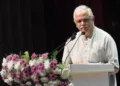
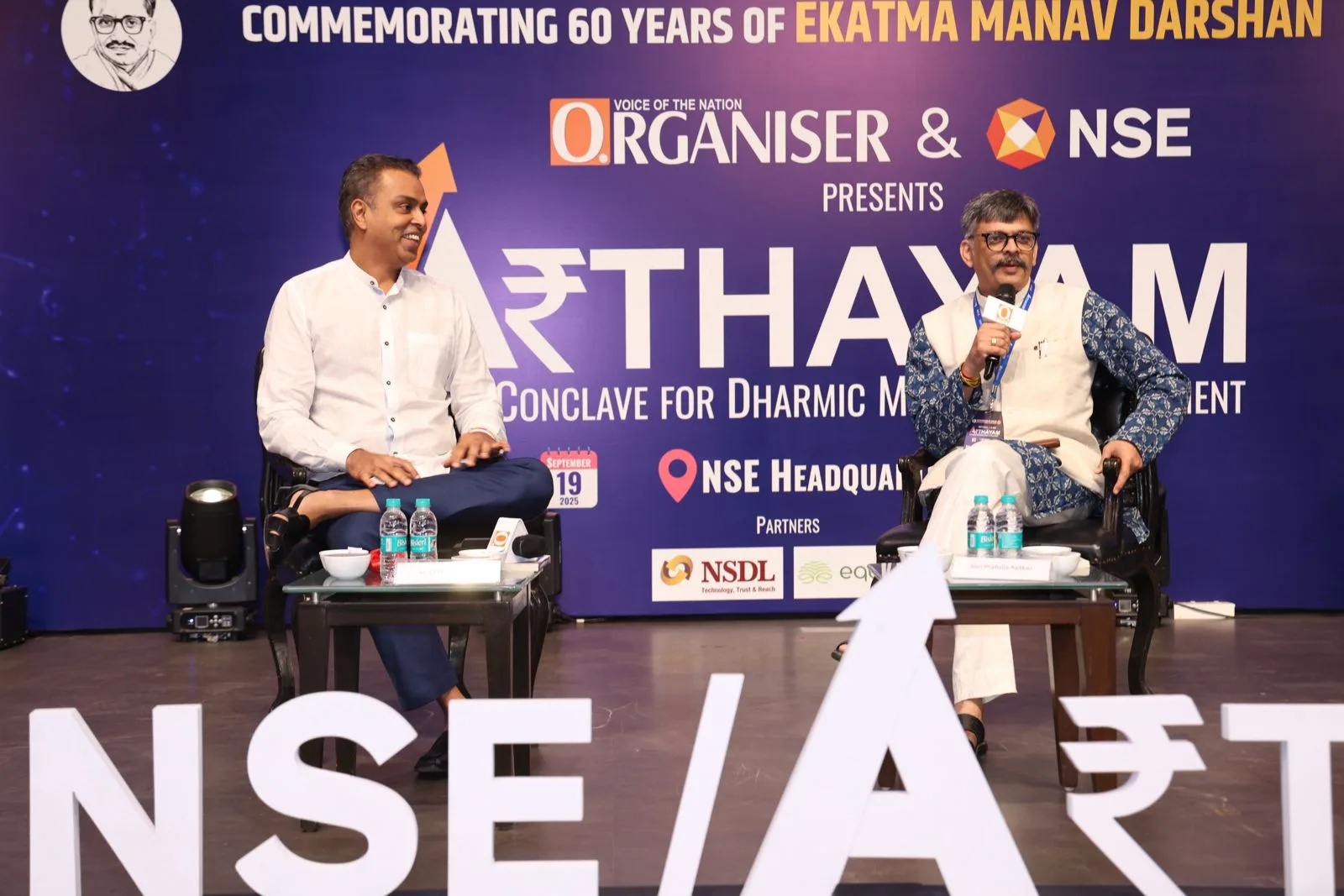
Milind Deora, MP (Rajya Sabha), delivered an engaging session on “Democracy and Diplomacy in the Turbulent World”

Milind Deora, MP (Rajya Sabha), delivered an engaging session on “Democracy and Diplomacy in the Turbulent World”

FacebookTwitterWhatsAppTelegramEmail

The Arthayam Conclave, jointly organised by Organiser and the National Stock Exchange (NSE) in Mumbai on September 19, marked sixty years of Pandit Deendayal Upadhyaya Ji’s philosophy of Ekatma Manav Darshan. The conclave was designed to reimagine Bharat’s developmental and global journey through the prism of Dharma, culture, and sustainability.

One of the most engaging sessions of the day unfolded in the form of a candid Q&A with Shri Milind Deora, Member of Parliament (Rajya Sabha). Speaking on the theme “Democracy and Diplomacy in the Turbulent World,” Deora shared a mix of policy insights, personal experiences, and cultural reflections, offering the audience a grounded yet forward-looking perspective on India’s place in today’s shifting global order.

The interaction touched upon pressing questions of trade, fiscal policy, global strategic alignments, rare earth dependency, America’s foreign policy, and India’s vision for 2047. What stood out was Deora’s ability to weave in anecdotes from his parliamentary delegations abroad with a clear sense of realism about India’s opportunities and challenges.

India’s position in the global trade order

The session began with a question on Deora’s earlier remark that tariffs could be a “blessing in disguise” and how India should position itself in today’s world. Deora responded with the authority of someone who has observed geopolitics up close.

He recalled his visits to Africa, Southeast Asia, and most recently, South America. “Whether it is Papua New Guinea, Brazil, or Colombia, every single country is tired of the Chinese model. They want India to offer them an alternative,” he added.
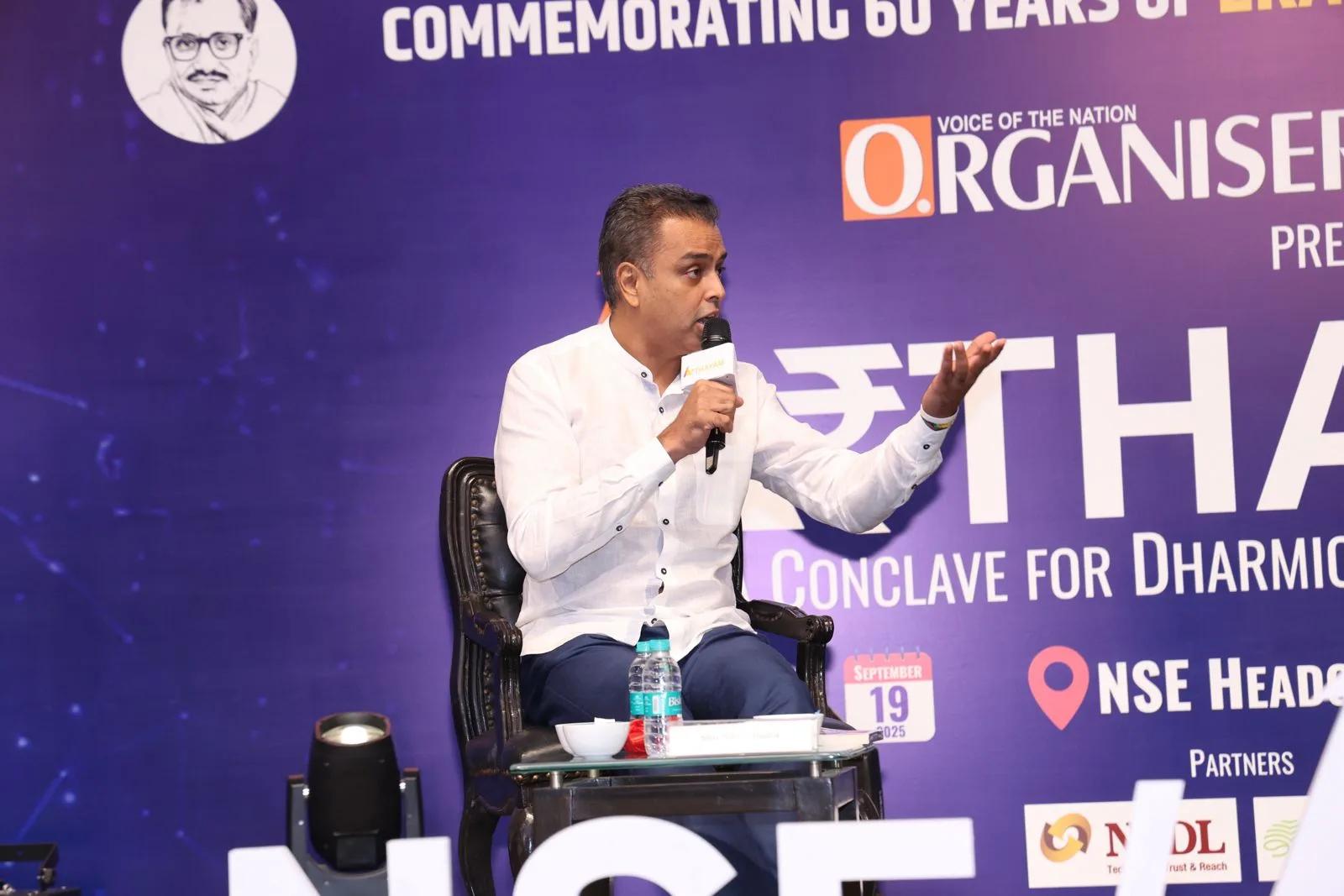
Shri Milind Deora, MP (Rajya Sabha)

Deora argued that India’s globalisation in 1991 was not an act of choice but of compulsion. “We did not globalise because of technology; we globalised because our hands were tied. Today, we need to globalise on our own terms,” he said. For him, the two imperatives are clear, strategic innovation and a strong economy. “Only then will India command genuine respect globally,” he concluded.

Fiscal federalism and capital formation

When asked about fiscal challenges and his role in the Parliamentary Standing Committee, Deora called the question “very political” but responded with candour.

He compared the United States debt-to-GDP ratio of 120 percent with India’s 80 percent, warning that India cannot afford to be complacent. “Yes, our GDP is doing well. But how do we increase revenue while respecting federalism? That is the real question,” he noted.

He stressed that while reforms such as creating a unified market were important, India must strike a delicate balance between raising revenue, empowering states, and ensuring capital formation. “This is where politics meets economics and where prudence becomes most necessary,” he added.

Rare earths and reducing import dependency

On the question of reducing India’s dependency on critical imports like rare earth metals, Deora struck an optimistic tone. He highlighted how India is diversifying its industries and moving towards Atmanirbharta.

“We were once a net importer of defence equipment; today we are on the way to becoming exporters. Similarly, jobs are now being created in electric vehicles, renewable energy, and new-age industries,” he pointed out.

He hailed the government’s move to open the mining sector and encourage recycling of rare earths used in solar panels and wind turbines. “With the right push, India can become a global hub in rare earth extraction and recycling,” he said, underlining how such policies directly tie into job creation and global competitiveness.

U.S. foreign policy, Pakistan and Operation Sindoor

The discussion then shifted to America’s approach post-Operation Sindoor and its continuing engagement with Pakistan. Deora was forthright: “Tariffs are nothing but Dadagiri. I must credit the Prime Minister, 100 out of 100 marks for standing firm in the face of what could have been a major threat.”

Deora explained that America’s foreign policy today is increasingly shaped by domestic compulsions, from the fallout of 9/11 to the debate over illegal immigration. “Whether it is Republican or Democrat, shocks will keep coming. India needs a long-term strategy to weather them,” he said.

He warned of Saudi Arabia’s growing ties with Pakistan but also pointed to India’s own counter-strategy through the Chabahar Port in Iran, which opens the door to Afghanistan and acts as a counterweight to China’s CPEC.

Interestingly, Deora also brought culture into the conversation. “America has an obesity problem. Why can’t we promote Dharmic and Sattvik food globally? That too is soft power. That too is diplomacy,” he remarked, to applause.

Parliamentary diplomacy and brand India

Reflecting on his experience leading parliamentary delegations, Deora recalled the advice of his father, the late Murli Deora. “He always told me, politics and party are secondary; the nation comes first,” he said.

He praised colleagues like Shashi Tharoor for their clarity in international forums but also acknowledged the complexities of engaging with countries unfamiliar with India’s security challenges. “Latin America, for example, has no real understanding of radical Islamic terrorism. You need a different tone there,” he explained.

At the same time, he credited the Modi government for “holding the Indian brand with pride on the world stage.” According to him, this ability to project national confidence has strengthened India’s diplomatic standing.

Vision for 2047: India’s dharmic advantage

The final question centred on India’s vision for 2047, especially in a world where democracies appear increasingly fragile. Here, Deora was most philosophical.

“We should never be ashamed of our model. The West is struggling with dualism, they cannot reconcile internal differences. But India has always had Advaita, the philosophy that resolves duality. That unseen sword is what saves us,” he explained.

For him, India’s Dharmic ethos, rooted in pluralism and philosophical resilience, is not just cultural heritage but a strategic advantage. “While the West falters, we will endure. That is Bharat’s real strength,” he declared.

The session ended with applause from the audience, who were struck by Deora’s mix of realism, conviction, and cultural confidence. His responses reflected both a parliamentarian’s grasp of policy and a civilisational perspective on India’s role in the world.

In many ways, the session embodied the spirit of Arthayam, that India’s diplomacy, economics, and development cannot simply imitate Western templates but must emerge from its own Dharmic and cultural foundations, the true sense of Ekatma Manav Darshan.

Topics: Pandit Deendayal UpadhyayaMilind DeoraEkatma Manav DarshanArthayam ConclaveOrganiser NSE conclave
Subhi Vishwakarma
Subhi Vishwakarma
Subhi Vishwakarma is a journalist known for her reporting on issues such as forced religious conversions, organised missionary and Islamist networks, and grooming gangs. Her political coverage from Jharkhand and West Bengal has garnered significant attention for its depth and ground-level insights. In addition to her work on anti-Bharat activities, she also writes extensively on education, law, and broader social issues. She has previously been associated with SwarajyaMag, Sewa Nyaya Utthan Foundation, and Gems of Bollywood. She can be followed on X at @subhi_karma. [Read more]
ShareTweetSendShareSend
✮ Subscribe Organiser YouTube Channel. ✮
✮ Join Organiser's WhatsApp channel for Nationalist views beyond the news. ✮
Previous News

“Mission of Bharat is to give Dharma to Bharat, not through lectures but by conduct”: Mukul Kanitkar at Arthayam

Next News

“Our strength lies in a relationship-based economic society”: Prof Kanagasabhapathi at Organiser-NSE Arthayam  

Related News

BJP Sthapna Diwas: Bharatiya Janata Party’s journey of ideology, dedication, and national transformation

B.L. Santhosh, National General Secretary (Organisation) of the Bharatiya Janata Party

Our society must transition from rule-based to value-based: B.L. Santhosh

Karnataka High Court stays move to cancel ‘Ekatma Manava Darshana’ conference; victory for freedom of expression

West Asian War: Wave of uncertainty

Tribute to Pandit Deendayal Upadhyaya on his death anniversary: A guiding spirit for ideal journalism

Family Over Individual: The Ideological Core and Design of BJP’s Welfare Architecture

Load More

Latest News

Keralam: Jamaat-e-Islami event features Hamas and Muslim Brotherhood ideologues, raises concerns over Political Islam

Representative Image (This is an AI Generated image)

Uttar Pradesh CM Abhyudaya Scheme: Apply for free civil services, JEE and NEET coaching from June 5

House worth Rs 2 crore of drug peddler bulldozed in J&K

Anti-narcotics campaign in J&K: Police demolish Rs 2 crore residential property linked to drug peddler Sheikh Tasaduq

As fuel shortages rippled across Asia, New Delhi expanded supplies to its neighbours while Beijing sought to turn energy security into strategic influence.

The Hormuz Test: How India’s energy assistance outshines China’s conditional approach

Demographic changes in Bharat’s border districts have raised concerns about migration, security, and social cohesion

Demographic Shift in Border Areas of Bharat: The dangerous design

FIR filed against the Islamists in the Love Jihad case in Bhopal

Love Jihad again in Bhopal: Minor Hindu girl forced to drink beer, trapped and pressured to convert by Islamists

The ₹100 Crore Dhaba: How Amrik Sukhdev Revolutionised Highway Dining in India

The Dhaba Story: The family that changed highway dining

After TCS Controversy, Wipro Faces Fresh 'Corporate Jihad' Allegations as Former Employee Details Harassment, Religious Pressure and Forced Resignation

Exclusive | Corporate Jihad at Wipro? Hindu employee says Shahina told her, ‘Accept Islam, I’ll marry you to a Sheikh’

Mizoram CM Lalduhoma says Myanmar refugee influx has become a burden

Myanmar refugee influx has become a burden on Mizoram: CM Lalduhoma

Prime Minister Narendra Modi

PM Modi to launch Rs 21,770 cr mega projects in Surat & Daman; Infrastructure, healthcare among key projects

Load More
  • Privacy
  • Terms
  • Cookie Policy
  • Refund and Cancellation
  • Delivery and Shipping

© Bharat Prakashan (Delhi) Limited.
Tech-enabled by Ananthapuri Technologies

  • Home
  • Search Organiser
  • Bharat
    • Assam
    • Bihar
    • Chhattisgarh
    • Jharkhand
    • Maharashtra
    • View All States
  • World
    • Asia
    • Africa
    • North America
    • South America
    • Europe
    • Australia
  • Editorial
  • Operation Sindoor
  • Opinion
  • Analysis
  • Defence
  • Culture
  • Sports
  • Business
  • RSS @ 100
  • Entertainment
  • More ..
    • Sci & Tech
    • Vocal4Local
    • Special Report
    • Education
    • Employment
    • Books
    • Interviews
    • Travel
    • Health
    • Politics
    • Law
    • Economy
    • Obituary
  • Subscribe Magazine
  • Read Ecopy
  • Advertise
  • Circulation
  • Careers
  • About Us
  • Contact Us
  • Policies & Terms
    • Privacy Policy
    • Cookie Policy
    • Refund and Cancellation
    • Terms of Use

© Bharat Prakashan (Delhi) Limited.
Tech-enabled by Ananthapuri Technologies