Sikh officer and Australian call for Pacific War memorial
June 16, 2026
  • Read Ecopy
  • Circulation
  • Advertise
  • Careers
  • About Us
  • Contact Us
Android AppiPhone AppArattai
Organiser
  • ‌
  • Bharat
    • Assam
    • Bihar
    • Chhattisgarh
    • Jharkhand
    • Maharashtra
    • View All States
  • World
    • Asia
    • Europe
    • North America
    • South America
    • Africa
    • Australia
  • Editorial
  • International
  • Opinion
  • RSS @ 100
  • More
    • Op Sindoor
    • Analysis
    • Sports
    • Defence
    • Politics
    • Business
    • Economy
    • Culture
    • Special Report
    • Sci & Tech
    • Entertainment
    • G20
    • Azadi Ka Amrit Mahotsav
    • Vocal4Local
    • Web Stories
    • Education
    • Employment
    • Books
    • Interviews
    • Travel
    • Law
    • Health
    • Obituary
  • Subscribe
    • Subscribe Print Edition
    • Subscribe Ecopy
    • Read Ecopy
  • ‌
  • Bharat
    • Assam
    • Bihar
    • Chhattisgarh
    • Jharkhand
    • Maharashtra
    • View All States
  • World
    • Asia
    • Europe
    • North America
    • South America
    • Africa
    • Australia
  • Editorial
  • International
  • Opinion
  • RSS @ 100
  • More
    • Op Sindoor
    • Analysis
    • Sports
    • Defence
    • Politics
    • Business
    • Economy
    • Culture
    • Special Report
    • Sci & Tech
    • Entertainment
    • G20
    • Azadi Ka Amrit Mahotsav
    • Vocal4Local
    • Web Stories
    • Education
    • Employment
    • Books
    • Interviews
    • Travel
    • Law
    • Health
    • Obituary
  • Subscribe
    • Subscribe Print Edition
    • Subscribe Ecopy
    • Read Ecopy
Organiser
  • Home
  • Bharat
  • World
  • Operation Sindoor
  • Editorial
  • Analysis
  • Opinion
  • Culture
  • Defence
  • International Edition
  • RSS @ 100
  • Magazine
  • Read Ecopy
Home Bharat

Sikh Officer, Forgotten Soldiers: Why Australia wants a memorial for 2,800 Indians who died in the Pacific war

Nearly 3,000 Indian soldiers captured by the Japanese were sent to Papua New Guinea during World War II, where 2,800 perished in brutal captivity. At the heart of their survival and enduring friendship with Australian troops stood Major Chint Singh, whose legacy now fuels the call for a permanent memorial in Canberra

WEBDESKWEBDESK
Aug 26, 2025, 12:00 pm IST
in Bharat, World
Follow on Google News
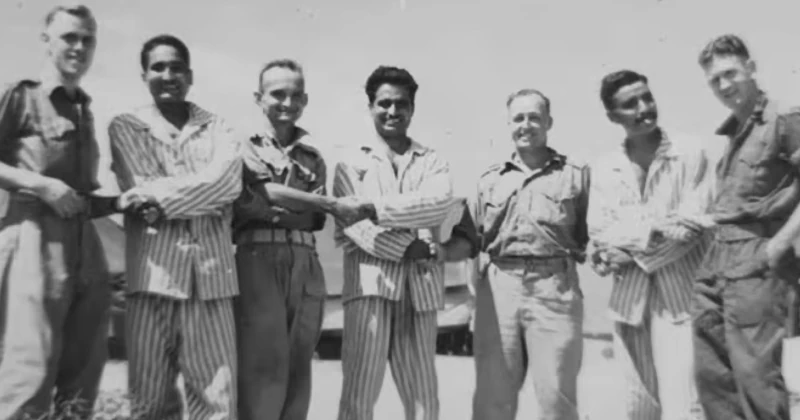
Indian military personnel, including Major Chint Singh (Centre), who survived being prisoners of war in World War 2, pose with Australian soldiers after liberation in Papua New Guinea, 1945. (Source: Firstpost)

Indian military personnel, including Major Chint Singh (Centre), who survived being prisoners of war in World War 2, pose with Australian soldiers after liberation in Papua New Guinea, 1945. (Source: Firstpost)

FacebookTwitterWhatsAppTelegramEmail

A campaign is gathering momentum in Australia to build a permanent memorial in Canberra for the 2,800 Indian soldiers who perished in the jungles of Papua New Guinea during World War II. The demand, however, is not only about commemoration of the dead it is also about honouring a forgotten story of mateship between Indian and Australian troops, symbolised by the extraordinary resilience of one man: Major Chint Singh of the 2nd Dogra Regiment.

While official Indian narratives of the Second World War often focus on the Burma front, the Quit India movement, or North Africa, the Pacific theatre remains almost entirely absent from public memory. Yet it was here, in the sweltering jungles of New Guinea, that nearly 3,000 Indian soldiers transported as prisoners of war from Singapore endured unimaginable conditions under Japanese captivity. By 1945, only 200 of them were alive.

After the fall of Singapore in 1942, close to 3,000 Indian troops were shipped to Papua New Guinea by the Japanese. What awaited them was not combat, but starvation, disease, and brutality. Food and medicine were denied, and soldiers survived by eating grass, snakes, frogs and insects. Despite these inhuman conditions, many clung to the discipline of military life refusing to abandon their soldierly decorum.

Among them was Major Chint Singh. His leadership, presence of mind, and resilience kept a handful of men alive until liberation. His story barely acknowledged in India became etched in Australian memory.

On September 30 1945, weeks after Japan’s surrender, Singh and his skeletal band of survivors stumbled into Angoram, where they first encountered Australian soldiers. Lieutenant F.O. Monk of the Australian Army would later write, “I will never forget the picture of you and your men as you all came ashore at Angoram. It will be with me as long as I live.”

Though emaciated, Singh’s men lined up in full military decorum, saluting and reporting as soldiers. Australians, deeply moved, rushed them to Wewak, where the 15th Australian Field Ambulance provided urgent care. In an extraordinary gesture of camaraderie, Australian soldiers wrote letters home on behalf of the Indians and offered companionship in their recovery.

Weeks later, on November 16 1945, tragedy struck when ten Indian soldiers perished in a plane crash near Rabaul while returning home. Singh, held back to testify before the Australian War Crimes Commission, was devastated.

But in this period, his bond with Australians deepened further. Sharing quarters with officers such as Captain Bruce of the 30th Infantry Battalion, Singh found kinship in unexpected places. In January 1946, he penned a farewell letter to the 6th Australian Division:

“The sympathy, love, and affection shown by every individual of the Division will always be with us… hoping that the friendship of your country and India will continue for all the time.” That letter remains preserved at the Australian War Memorial in Canberra one of the rare documents carrying the voice of an Indian soldier from the Pacific theatre.

Honours soon followed. Major Singh was invited to sign the Japanese surrender flag, which still hangs at the Australian War Memorial a rare tribute for a non-Australian officer. He returned to Australia in 1947 to assist with war crimes testimony, and in 1970, he revisited the region for the 25th anniversary of the war’s end, meeting old comrades and renewing friendships.

In 1971, the Returned and Services League (RSL) erected a memorial at Angoram to honour the 2,800 Indians who never returned. That memorial was later destroyed in floods a second erasure of men already written out of history.

Singh’s son, Narinder Parmar, submitted a proposal in 2022 to erect a permanent memorial in Canberra. Support has been growing, with veterans’ groups and diaspora organisations pressing for recognition of Indian sacrifices on Australian soil.

Also Read: West Bengal SSC Scam: TMC MLA Jiban Krishna Saha arrested after jumping wall and throwing phone to evade ED

The question arises: why build a memorial in Canberra if the soldiers died in Papua New Guinea? The answer lies in the extraordinary bonds formed in those final months. For Australians, “mateship” the notion of loyalty, solidarity and shared sacrifice is sacred. For Singh and his men, that mateship was lived reality. Their rescue, recovery, and dignity were restored not by their own country’s forces, but by Australians.

The proposed Canberra memorial would therefore symbolise not just sacrifice, but a rare international comradeship forged in blood, hunger and survival.

As India and Australia today speak of strategic partnerships in the Indo-Pacific, the story of Major Singh and his men is a reminder that their ties are not merely diplomatic or economic. They are rooted in shared hardship, resilience, and sacrifice.

This is also a reminder of India’s forgotten frontiers in the world wars. While Indian blood is remembered in France (Neuve-Chapelle), Gallipoli, Burma, and North Africa, the Pacific theatre is barely acknowledged in New Delhi’s official commemorations.


Topics: Papua New Guineaindian soldiersWorld War IIPacific warMajor Chint SinghAustralian War Crimes CommissionIndian soldier
ShareTweetSendShareSend
✮ Subscribe Organiser YouTube Channel. ✮
✮ Join Organiser's WhatsApp channel for Nationalist views beyond the news. ✮
Previous News

Chhattisgarh: NIA chargesheets 3 members of CPI Maoist frontal outfit Moolvasi Bachao Manch

Next News

Major Terror Plot Foiled in UP: Mohammad & Shahnawaz arrested with 200 kg explosives on Delhi-bound bus in Baghpat

Related News

India sending rice consignment (Old image used for representative purposes)

Boosting global Agri-trade, India exports 20 MT fortified rice from Chhattisgarh to Papua New Guinea

Representative image

Infantry Day 2025: Remembering the heroes who defended J&K and shaped independent India’s legacy

Israeli textbooks rectifies the facts: Indian soldiers and not British who liberated Haifa from Ottomans

Major correction in Israel textbooks: Indian soldiers liberated Haifa from Ottoman rule and not the British troops

US President Donald Trump 2.0 spurs global shift to strategic autonomy

Kargil Vijay Diwas 2024: Honouring the Indomitable spirit of our Armed Forces

India's External Affairs Minister Subramaniam Jaishankar

India to develop critical infrastructure projects in Marshall Islands as part of Pacific outreach

Load More

Latest News

Representative Image

Viksit Bharat Shiksha Adhishthan Bill 2025: Mandate to promote Bharatiya ‘Gyan’ & ‘Bhasha’

Uttar Pradesh: Digital democracy dialogue ‘Triveni’ concludes; Focused on inclusive growth & cultural discourses

RSS Pune organises workshop on “Preparing for the AI Era”; Experts stress on AI literacy and Atmanirbharata in AI

Assam Governor Lakshman Prasad Acharya leads sacred Buddha relics mission to Mongolia

India- Mongolia Relations: Celebrating the spiritual neighbourhood

The AN-32: Service, sacrifice and the search for a successor

The Baya River of Bihar: How Jan Andolan brought the dying stream back to life

Oplus_16908288

Love Jihad in Assam: Illias Ahmed trapped Noida Hindu girl with fake identity; Held in Guwahati, victim untraceable

UK bans social media for under-16s: Tightens online vigilance to insulate children from digital risks

Maoist Arms Dump Recovered in Malkangiri

Odisha: Another major Maoist arms dump recovered in Malkangiri; Four hidden caches unearthed in last eight days

RSS Sarsanghchalak Dr. Mohan Bhagwat

Consumer centric ‘US model of growth is unsustainable’; Six earths will be needed: RSS Sarsanghchalak Dr Mohan Bhagwat

Load More
  • Privacy
  • Terms
  • Cookie Policy
  • Refund and Cancellation
  • Delivery and Shipping

© Bharat Prakashan (Delhi) Limited.
Tech-enabled by Ananthapuri Technologies

  • Home
  • Search Organiser
  • Bharat
    • Assam
    • Bihar
    • Chhattisgarh
    • Jharkhand
    • Maharashtra
    • View All States
  • World
    • Asia
    • Africa
    • North America
    • South America
    • Europe
    • Australia
  • Editorial
  • Operation Sindoor
  • Opinion
  • Analysis
  • Defence
  • Culture
  • Sports
  • Business
  • RSS @ 100
  • Entertainment
  • More ..
    • Sci & Tech
    • Vocal4Local
    • Special Report
    • Education
    • Employment
    • Books
    • Interviews
    • Travel
    • Health
    • Politics
    • Law
    • Economy
    • Obituary
  • Subscribe Magazine
  • Read Ecopy
  • Advertise
  • Circulation
  • Careers
  • About Us
  • Contact Us
  • Policies & Terms
    • Privacy Policy
    • Cookie Policy
    • Refund and Cancellation
    • Terms of Use

© Bharat Prakashan (Delhi) Limited.
Tech-enabled by Ananthapuri Technologies