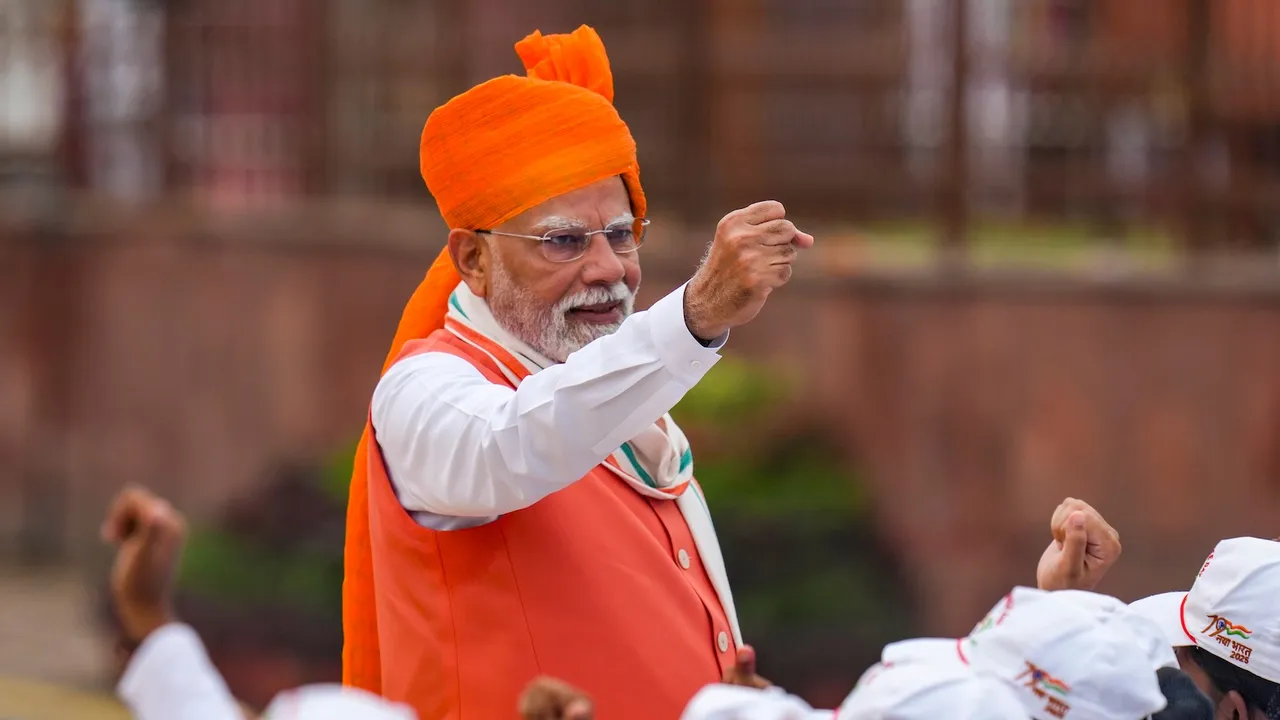
Prime Minister Narendra Modi’s speech on the 79th Independence Day, delivered from the historic Red Fort on August 15, 2025, carried both the weight of history and the force of vision. As India stands at a crucial juncture in its development journey, the Prime Minister’s address made it clear that science, technology, and innovation would be the cornerstones of Bharat’s rise. His words reflected confidence, determination, and a call to action, “Bharat will define its own destiny, set its own terms, and aim to become a developed nation by 2047”. From announcing India’s first indigenously produced semiconductor chip to unveiling plans for a tenfold expansion in nuclear energy and a Rs 1 lakh crore youth employment mission, Modi’s speech highlighted how scientific progress is now inseparable from national progress.
The emphasis was not merely on immediate achievements, but on building long term capacities that will transform Bharat into a global leader in science and industry. The two standout announcements, the launch of India’s first homegrown semiconductor chip and a bold nuclear power expansion plan captured the imagination of scientists, policymakers, and ordinary citizens alike. Together, these initiatives mark a decisive shift from decades of dependence to an era of self-reliance and leadership.
The story of India’s semiconductor journey is one of both missed opportunities and renewed hope. Prime Minister Modi recalled how, almost half a century ago, there were serious attempts to establish semiconductor manufacturing units in India. However, bureaucratic hurdles, lack of vision, and global isolation prevented those efforts from maturing. While nations like South Korea, Taiwan, and later China invested strategically in chip manufacturing and went on to dominate the global supply chain, India watched from the sidelines. This neglect, often referred to as ‘lost decades’, left the country dependent on foreign imports for microchips, the brains behind modern electronics.
Modi’s announcement that India will roll out its first indigenously manufactured semiconductor chip by the end of 2025 represents a historic turning point. It is not just about producing a chip, it is about entering the elite club of nations that control the most critical component of modern technology. Semiconductors power everything from smartphones, laptops, and automobiles to defense systems, satellites, and AI-powered devices. In the 21st century, a nation without semiconductor capability is a nation without technological sovereignty.
The Prime Minister’s ‘mission mode’ approach reflects a seriousness unseen before. India has already established semiconductor manufacturing hubs in Gujarat and Karnataka, with global partnerships ensuring knowledge transfer, but the core promise lies in creating indigenous capacity. If India succeeds in mastering not just chip assembly but also design and fabrication at the nanoscale, it will insulate itself from global supply disruptions such as those witnessed during the COVID-19 pandemic. Further, it opens vast employment opportunities for India’s engineers and researchers, enabling the country to leapfrog into advanced sectors like artificial intelligence, robotics, and quantum computing.
Semiconductors, therefore, are not just an industrial project, but a symbol of India reclaiming its rightful place in the technological order. Modi’s words at the Red Fort made it clear that the age of dependence is over, India is ready to innovate, manufacture, and lead.
If semiconductors represent the digital backbone of modern Bharat, nuclear energy represents its power backbone for the future. In his address, Prime Minister Modi revealed that India is preparing to increase its nuclear power generation capacity by more than ten times by the year 2047. Work has already begun on ten new nuclear reactors, with more in the pipeline.
This announcement is of extraordinary significance. India, despite being a nuclear power since 1974, has historically relied heavily on coal for electricity generation, with renewables like solar and wind growing in recent years. However, the challenge of meeting India’s massive and rising energy demand while keeping emissions low is formidable. If India is to achieve its net-zero carbon emission target by 2070, nuclear power must play a central role. Unlike fossil fuels, nuclear energy provides stable, large scale, and low carbon electricity. Unlike renewables, it is not dependent on weather fluctuations.
By planning a tenfold increase, India is signaling that it is ready to join the front ranks of nuclear energy leaders. Currently, India’s nuclear capacity is modest compared to countries like the U.S., France, or even China. With this bold target, Bharat is committing to building advanced nuclear infrastructure, whether in the form of heavy water reactors, fast breeder reactors, or even upcoming thorium based reactors, which India has a unique advantage in. Thorium, abundantly available in Indian sands, has long been seen as a potential game changer, and Modi’s push could accelerate thorium based energy as a sustainable alternative for the world.
The implications are far reaching. A tenfold expansion in nuclear power will drastically reduce dependence on imported oil and gas, cut carbon emissions, and secure India’s energy future. It will also open up avenues for high skill jobs, international collaborations, and technological innovations in reactor design and waste management. For India, nuclear power is no longer just about strategic deterrence, but about powering the aspirations of 1.4 billion people.
Another major highlight of the Prime Minister’s speech was the announcement of a Rs1 lakh crore mission dedicated to youth employment. While this may sound like an economic measure at first glance, its scientific dimension cannot be ignored. In today’s world, employment opportunities are increasingly linked to advances in technology. The semiconductor and nuclear missions themselves will generate tens of thousands of direct and indirect jobs for engineers, researchers, technicians, and entrepreneurs.
India has the world’s largest youth population, with more than 65 percent of its people below the age of 35. Harnessing this demographic dividend requires aligning education and skills with emerging technologies. Modi emphasized that young Indians must not just be job seekers but also job creators, driving innovation in fields like space, biotechnology, clean energy, and digital technologies. The Rs 1 lakh crore push is therefore an investment not just in employment but in cultivating a scientific workforce for Amrit Kaal, the 25-year period leading up to India’s centenary of independence.
This initiative ties neatly with the recently implemented National Education Policy (NEP 2020), which emphasizes research, innovation, and multidisciplinary learning. With proper implementation, India could witness the rise of a new generation of scientist-entrepreneurs who will power the nation’s growth across sectors.
Taken together, these announcements send a powerful message, India is no longer content with playing catch-up in science and technology. The days of missed opportunities are behind us. Bharat is ready to lead, innovate, and set its own standards. Whether in semiconductors, nuclear energy, or youth driven innovation, the vision is one of self-reliance, resilience, and leadership.
Prime Minister Modi’s words resonate with a larger philosophy. In the 20th century, India struggled with dependence on foreign technologies, from defense imports to basic industrial goods. In the 21st century, as global power dynamics shift and technological competition intensifies, self-reliance is no longer an option, it is a necessity. By 2047, the goal is not just to be a developed nation in economic terms, but to be a scientific power capable of shaping global trends.
Of course, the road to these goals is not without challenges. Semiconductor manufacturing requires immense capital investment, skilled manpower, and precision engineering at the nanometer scale. Global supply chains are tightly controlled by a few players, and India will need to ensure not just entry, but competitiveness in this field. Nuclear energy, too, comes with challenges of safety, waste disposal, and international scrutiny. Building public trust and ensuring transparency in nuclear projects will be crucial.
Moreover, aligning the youth employment mission with real opportunities requires careful planning. Training young Indians for 21st century jobs means overhauling educational curricula, investing in research universities, and strengthening industry-academia linkages.
Yet, if India has proven anything in recent decades, from building its own space program to becoming a global IT leader, it is that challenges are not deterrents, but motivators. With political will, scientific talent, and societal support, the goals outlined on Independence Day are achievable.
On that August morning at the Red Fort, Prime Minister Modi did not just outline policies; he framed a vision of Bharat’s scientific future. From the silicon chip that will power India’s devices to the nuclear reactor that will light its cities, from empowering youth with opportunities to building a resilient economy, his message was unambiguous, Bharat will chart its own course.
As India marches toward 2047, the centenary of independence, the scientific and technological missions announced this year could well be remembered as milestones in its journey to becoming a developed nation. Modi’s call for scientific self-reliance, is a call that urges every Indian scientist, engineer, and youth to participate in building a Bharat that is not just self-reliant but globally respected as a powerhouse of knowledge and innovation.