
Indus Waters Treaty: Hefty Price that Bought Terrorism
June 24, 2026
  • Read Ecopy
  • Circulation
  • Advertise
  • Careers
  • About Us
  • Contact Us
Android AppiPhone AppArattai
Organiser
  • ‌
  • Bharat
    • Assam
    • Bihar
    • Chhattisgarh
    • Jharkhand
    • Maharashtra
    • View All States
  • World
    • Asia
    • Europe
    • North America
    • South America
    • Africa
    • Australia
  • Editorial
  • International
  • Opinion
  • RSS @ 100
  • More
    • Op Sindoor
    • Analysis
    • Sports
    • Defence
    • Politics
    • Business
    • Economy
    • Culture
    • Special Report
    • Sci & Tech
    • Entertainment
    • G20
    • Azadi Ka Amrit Mahotsav
    • Vocal4Local
    • Web Stories
    • Education
    • Employment
    • Books
    • Interviews
    • Travel
    • Law
    • Health
    • Obituary
  • Subscribe
    • Subscribe Print Edition
    • Subscribe Ecopy
    • Read Ecopy
  • ‌
  • Bharat
    • Assam
    • Bihar
    • Chhattisgarh
    • Jharkhand
    • Maharashtra
    • View All States
  • World
    • Asia
    • Europe
    • North America
    • South America
    • Africa
    • Australia
  • Editorial
  • International
  • Opinion
  • RSS @ 100
  • More
    • Op Sindoor
    • Analysis
    • Sports
    • Defence
    • Politics
    • Business
    • Economy
    • Culture
    • Special Report
    • Sci & Tech
    • Entertainment
    • G20
    • Azadi Ka Amrit Mahotsav
    • Vocal4Local
    • Web Stories
    • Education
    • Employment
    • Books
    • Interviews
    • Travel
    • Law
    • Health
    • Obituary
  • Subscribe
    • Subscribe Print Edition
    • Subscribe Ecopy
    • Read Ecopy
Organiser
  • Home
  • Bharat
  • World
  • Operation Sindoor
  • Editorial
  • Analysis
  • Opinion
  • Culture
  • Defence
  • International Edition
  • RSS @ 100
  • Magazine
  • Read Ecopy
Home Bharat

Indus Waters Treaty: Hefty Price that Bought Terrorism

Prafulla KetkarPrafulla Ketkar
Jul 29, 2025, 08:05 pm IST
in Bharat, Editorial
Follow on Google News
FacebookTwitterWhatsAppTelegramEmail

“In reality, war is not the way to make India undivided once again. War can achieve geographical unity, but not national unity. Sovereignty is not just a geographical idea; it is also a cultural and national idea. The country was divided because of the principle of two-nation theory and the tendency to make many compromises. The idea of Akhand Bharat will be achieved if we stay on that principle completely. Those Muslims who lack nationalism now will also come with us later. But only if we stop compromising on the issue of nationalism, that which seems impossible today, can become possible tomorrow. We just have to keep alive the idealist within us.”
– Pt. Deendayal Upadhyaya, in his seminal book ‘Akhand Bharat Kyon?’ (Why Undivided India?) as quoted from a booklet published by the Bharatiya Janata Party under Pt. Deendayal Upadhyaya Prashikshan Mahabhiyan in September 2015

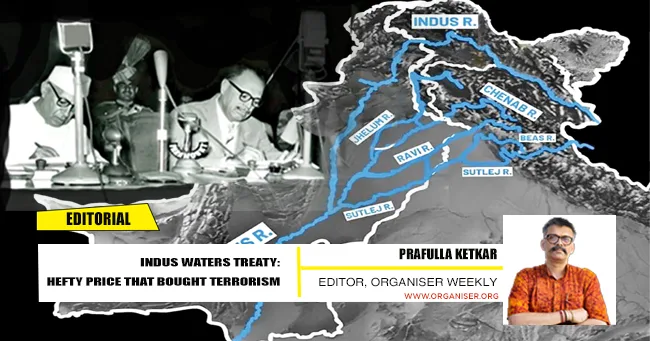
In September 1960, when Nehru signed the controversial Indus Waters Treaty with Ayub Khan, mediated by the World Bank, the then Prime Minister justified it as ‘we purchased peace’ with Pakistan. Can one buy peace for a nation? We need a deeper understanding of what the Nehru-dynasty-led Congress has been trying to achieve, which has proved very costly for Bharat as a sovereign republic.

When Bharat was partitioned, the Nehruvian idea provided similar logic. Even after experiencing the blackmailing and bullying of the Islamists from the Khilafat in the 1920s to the 1946 Calcutta killings, Nehru did not anticipate the violence. On the contrary, he believed, as remarked in his interview with American TV host Arnold Michaelis in 1964, ‘it is better to have Partition than this constant trouble’. He further remarked, “We expected that Partition would be temporary, that Pakistan was bound to come back to us. None of us guessed how much the killings and the crisis in Kashmir would embitter relations”. Really? Did we eliminate constant trouble, or did we invite more woes within and on the borders? Was it an assessment of a statesman or person who was disconnected from the ground reality? Protecting ‘personal laws’ will bring in peace; making Waqf like arbitrary provisions would make ‘them’ secure, recognising ‘Kashmir’ as a ‘secular jewel’ because of the Muslim majority – denying Constitutional rights to people of Jammu-Kashmir would solve Hindu-Muslim tension, all these and many were nothing but the continuation of the same strategy to buy peace.

Unfortunately, when the entire Parliament was in uproar, the same formula was applied while signing the disastrous Indus Waters Treaty ‘in a spirit of goodwill and friendship’. Leaders across the party line and ideological spectrum questioned Nehru, the then Prime Minister, who initially deployed his Irrigation Minister when the discussion was forced in Parliament on the unjust provisions of the treaty. One of the Congress leaders had alleged during the debate that Bharat’s honour was destroyed and respect was sold through the treaty signed in Karachi. The extraordinarily generous water-sharing treaty in favour of Pakistan was the only agreement in the world that compelled the upper riparian state to jeopardise its interests to satisfy the downstream state’s ego. The parity of rivers, with three each flowing from the eastern and western regions, was another flawed argument presented, as the quantity of water carried by these rivers is 4:1. The water crisis in the States of Haryana, Punjab, and Rajasthan could have been resolved if we had harnessed these resources. Jammu-Kashmir was sold with the fallacious idea of special status when all its water resources were given away to a terror-sponsoring nation. What we got against the unfair treaty was terrorism and radicalism.

Peace is not a commodity that you can buy in the international market. It is a process that needs to be enforced in which negotiating or signing a treaty is just one of the instruments. Unless you negotiate from a position of strength, peace cannot be enforced. The negative and exclusionary ideology of Islamism on which the idea of Pakistan was tossed up and eventually materialised would never understand the language of ‘goodwill and friendly feeling’. The Nehruvian Congress never understood this simple and historically proven fact, for which Bharat has paid a hefty price without peace. Following the Pahalgam terror attack, when the Modi-led NDA Government decided to put the treaty in abeyance, there is scope for wider deliberations and resetting the agenda for water diplomacy. Instead of succumbing to pressure and blackmailing techniques, Bharat should ensure strategic, sustainable and prudent utilisation of water resources. If China, as an upper riparian state, can harness the potential of the Brahmaputra basin, so can Bharat, in the case of the Indus river.


Topics: Modi-led NDA GovernmentNehru signedHindu-Muslim tensionIndus Waters Treaty with Ayub KhanIndus Waters Treaty
Prafulla Ketkar
Prafulla Ketkar
Prafulla Ketkar, is the Editor, Organiser (Weekly) since 2013. He has a experience of over 20 years in the fields of research, media and academics. He is also Advisory Committee School of Journalism, Delhi University. He has been writing on issues related to International politics and foreign policy, with special reference to China and Democracy, Hindutva, and Bharatiya Civilisation. He was also a member of the Editorial team of the recently published Complete Works of Pt Deendayal Ji in 15 Volumes. He has 2 books, 29 academic articles, 2 entries in Encyclopedia of India and numerous articles to his credit. [Read more]
ShareTweetSendShareSend
✮ Subscribe Organiser YouTube Channel. ✮
✮ Join Organiser's WhatsApp channel for Nationalist views beyond the news. ✮
Previous News

Operation Sindoor: PM Modi says he ignored US VP’s call on May 9, later warned Pakistan of crushing reply if provoked

Next News

Operation Sindoor: Nation shocked as Congress echoes Pakistan, demands proof attackers were foreign, says PM Modi

Related News

India calls Indus Waters Treaty outdated at UNHRC, says Pakistan cannot seek cooperation while exporting terror

“Indus Waters Treaty outdated”: India slams Pakistan at UN for “exporting terror”

NHPC CMD Bhupender Gupta inaugurated construction activities of the 240 MW Uri-I Stage-II Hydroelectric Project in Uri

J&K eyes round-the-clock power supply: NHPC begins work on 240 MW Uri-I stage II project

Indus Water Treaty In Abeyance

Indus Waters Treaty in Abeyance: Pakistan grapples with India’s tough water policy

P. Harish, India’s Permanent Representative to the UN

India reiterates at UN that Indus Waters Treaty will remain in abeyance until Pakistan ends terror support

Salal reservoir desiltation, hastening hydropower projects top priorities for Modi government with IWT in abeyance

Wullar Lake

J&K: Cutting of willow trees in catchment of Wullar lake undertaken in phased manner to improve water holding capacity

Load More

Latest News

President Droupadi Murmu confers the Padma Shri on former civil servant R.V.S. Mani on June 23, 2026.

Former MHA official RVS Mani honoured with Padma Shri for contributions to internal security

Tamil Nadu: Temple funds only for temple property; TVK govt concedes before Madras High Court

Keralam’s former Industries Secretary, Mohammed Haneesh IAS (Right Side)

Keralam Cashew Scam: Former Industries Secretary Md Haneesh apologises before High Court after contempt proceedings

Tamil Nadu: Assembly Speaker directs all bureaucrats to strictly follow warrant of precedence after Mayor-MLA row

Kamakhya Mandir

Kamakhya Mandir’s Ambubachi Mela: The ancient tradition that honours the menstruation of mother Earth

Amazon in dock for mocking Hindu Gods

Amazon File: From Ganesha to Aryabhata – Has Amazon India become a platform for Anti-Hindu narratives?

The West Bengal Budget 2026–27 aims to drive growth through infrastructure, industry, innovation and welfare

Reimagining Bengal: How the West Bengal Budget 2026–27 seeks to balance growth, welfare & economic transformation

Pratiraksha is Gujarat Police's Aadhaar-based verification platform designed to identify illegal workers and prevent identity fraud in industrial sectors

Pratiraksha: How Gujarat police uses Aadhaar verification to secure industrial workforce against identity fraud

Israel-Iran crisis has highlighted not only shifting dynamics of West Asia but also growing confidence of India's foreign policy

India, Israel and the rise of strategic autonomy in an era of global geopolitical realignment

Saleem and Jaleel arrested in forced religious conversion case

Karnataka Conversion Case: Forced conversion of Hindu woman and minor son sparks outrage; Saleem and Jaleel arrested

Load More
  • Privacy
  • Terms
  • Cookie Policy
  • Refund and Cancellation
  • Delivery and Shipping

© Bharat Prakashan (Delhi) Limited.
Tech-enabled by Ananthapuri Technologies

  • Home
  • Search Organiser
  • Bharat
    • Assam
    • Bihar
    • Chhattisgarh
    • Jharkhand
    • Maharashtra
    • View All States
  • World
    • Asia
    • Africa
    • North America
    • South America
    • Europe
    • Australia
  • Editorial
  • Operation Sindoor
  • Opinion
  • Analysis
  • Defence
  • Culture
  • Sports
  • Business
  • RSS @ 100
  • Entertainment
  • More ..
    • Sci & Tech
    • Vocal4Local
    • Special Report
    • Education
    • Employment
    • Books
    • Interviews
    • Travel
    • Health
    • Politics
    • Law
    • Economy
    • Obituary
  • Subscribe Magazine
  • Read Ecopy
  • Advertise
  • Circulation
  • Careers
  • About Us
  • Contact Us
  • Policies & Terms
    • Privacy Policy
    • Cookie Policy
    • Refund and Cancellation
    • Terms of Use

© Bharat Prakashan (Delhi) Limited.
Tech-enabled by Ananthapuri Technologies