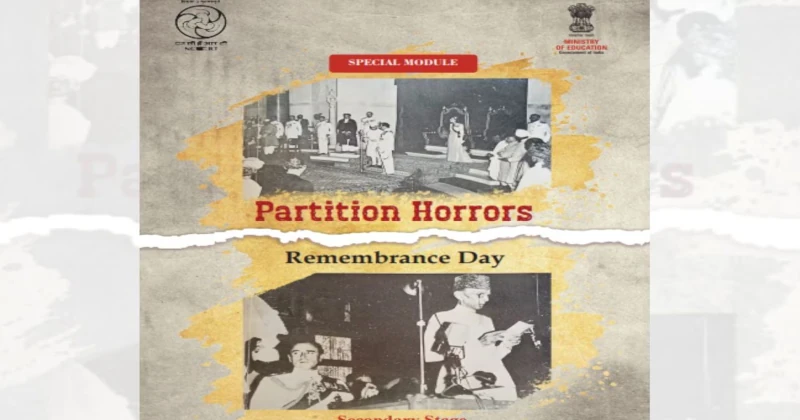
The National Council of Educational Research and Training (NCERT) has made the most significant updates to school history education in decades. The updated political science and history textbooks for Classes 11 and 12 now openly identify Muhammad Ali Jinnah, Lord Mountbatten, and the Congress leadership as the “three culprits of Partition,” showing a major departure from earlier interpretations. For many years, students were taught that the Partition of India was a tragic event caused by growing communal tensions, British divide-and-rule policies, and rushed political decisions in 1947. Earlier textbooks mainly highlighted the human tragedy of Partition, the mass displacement of millions and the violence that broke the subcontinent.
The new NCERT revisions, however, present a very different picture. They argue that Partition was not simply an unavoidable tragedy but the result of political betrayal at the top. The updated text directly blames the Congress Party for putting power before unity, suggesting its leaders actively agreed to India’s division. It states that the country was “bled, broken, and betrayed” by three forces working together: Jinnah’s relentless push for a separate homeland Pakistan, Mountbatten’s rush to push through Britain’s withdrawal, and Congress leaders’ acceptance of Partition in exchange for control over independent India.
The New Partition Module: What Students Will Learn
The newly introduced chapter presents Partition not merely as an outcome of communal clashes but as a power-driven decision shaped by three main actors:
- Muhammad Ali Jinnah – The module describes Jinnah as the main figure behind Pakistan. It says his strong belief in the Two-Nation Theory and refusal to compromise increased the divide between communities. His clear demand for a separate homeland ultimately made Partition “inevitable.”
- Lord Louis Mountbatten – The new chapter blames Britain’s last Viceroy, Lord Mountbatten, for hastily pushing through the Partition plan and focusing more on Britain’s quick exit than on ensuring a smooth and peaceful handover of power. The chapter criticizes Mountbatten’s infamous “divide and quit” approach, which left millions unprotected during one of history’s largest migrations.
- Congress Leadership – The most striking departure from earlier textbooks is the framing of Congress as complicit in Partition. The revised module says senior Congress leaders agreed to the division as the “price for power.” Instead of firmly opposing the plan, they are shown as choosing control over independent India at the cost of breaking Bharat’s unity.
“Congress betrayed the nation, choosing power over unity, thus becoming a partner in dividing Bharat.”
This framing is designed to give students a more politically charged understanding of Partition, contrasting heavily with the earlier portrayal of Congress leaders such as Jawaharlal Nehru and Sardar Vallabhbhai Patel as reluctant but helpless participants in the process.
Why This Matters: Ending “Decades of Whitewashing”
For decades, NCERT history books have faced accusations of “whitewashing” Partition and Congress’s role, largely blaming colonial policies and Jinnah’s stubbornness. The new module, according to its drafters, is meant to correct that imbalance.
An NCERT official, speaking on condition of anonymity, said: “Every student deserves to learn the complete truth. For years, textbooks glorified certain leaders while glossing over the compromises and blunders that led to Partition. This module ensures students understand that India was not only divided by external pressures but also by the choices of its own leaders.”
The revisions are part of a larger textbook revamp exercise initiated after the implementation of the National Education Policy (NEP) 2020. While earlier changes focused on simplifying curriculum, this latest update carries a strong ideological message: to highlight episodes of “betrayal, greed, and colonial manipulation” in modern Indian history.
Historical Context
Partition of India in 1947 led to one of the largest forced migrations in human history. Nearly 15 million people were displaced, and an estimated 1 to 2 million lost their lives in communal violence. Earlier NCERT chapters emphasized the tragedy, human suffering, and the role of British haste. The Congress leaders’ decision to accept Partition was often explained as a “painful compromise to avoid further bloodshed.”
The new version challenges that narrative by stating that Congress was not merely a helpless participant but a willing player, eager to assume power even at the cost of breaking the nation.
Historians note that this marks a paradigm shift in how generations of students will perceive Independence and Partition.
Classroom Impact
From the next academic session (2025-26), students across CBSE-affiliated schools will be reading the revised Partition module. The chapter is likely to generate intense debate in classrooms, as students grapple with the contrasting narratives they may hear at home, in the media, and in textbooks. Teachers have been advised to encourage open discussion while handling the sensitive subject. NCERT is also preparing teacher training guides to help educators address students’ questions objectively.
This update is part of a wider trend in history rewriting in India, where successive governments have revised NCERT books to reflect their ideological perspectives.
- In the 1970s, emphasis was placed on highlighting India’s socialist, secular foundations.
- In the 2000s, revisions introduced greater focus on ancient Indian contributions in science and culture
- The 2020s have seen increased focus on “correcting distortions” related to medieval history and the freedom struggle
The Partition module fits into this broader battle over memory, identity, and political legitimacy. As India approaches its centenary of independence in 2047, the question of how history is told to young citizens has become even more politically charged.
The introduction of this bold new module is a turning point in how India’s next generation will view the country’s division in 1947. For supporters, it represents the end of decades of selective history and the beginning of truth-telling about betrayal and power politics. For critics, it is a dangerous oversimplification that risks politicizing young minds.
One fact is undeniable: students will no longer read Partition as just a tragedy, but as a story of betrayal by leaders, colonial manipulation, and communal ambition.