The partition of Bengal in 1905 unleashed forces that would fundamentally reshape India’s economic destiny. What emerged was not merely a political protest but a civilizational counter-strike against two centuries of systematic economic exploitation. The boycott of Lancashire cloth stood as the most potent weapon in this arsenal of resistance, transforming from symbolic gesture into devastating economic warfare that reached the very heart of British industrial supremacy. This was India’s first authentic Atmanirbhar moment, where consumer choice became an act of national defiance.
The magnitude of this economic battle cannot be understated. By 1850, two-thirds of all cotton clothes worn by Indians were manufactured in England, a staggering reversal from the era when India supplied 25 per cent of the world’s textiles. The transformation of India from textile exporter to raw material supplier represented perhaps the most comprehensive deindustrialization program in recorded history. Lancashire and Manchester had become the world emporium for cotton piece goods, built quite literally on the ruins of Indian craftsmanship. In 1811-12, piece goods accounted for 33% of India’s exports, but by 1850-51, this had collapsed to a mere 3 per cent. The boycott movement represented India’s awakening to this economic colonization and its determination to reverse the tide.
The origins of Lancashire’s dominance lay in a calculated strategy of economic warfare. Through the Calico Acts of the early 18th century, Britain had systematically excluded Indian textiles from European markets while flooding India with British manufactured goods. The East India Company’s monopoly over Indian trade ensured that raw cotton flowed to Manchester at artificially low prices, only to return as finished cloth sold at premium rates. British manufacturers imposed draconian taxes on Indian imports while their own products entered India with minimal duties. By the 1820s, Indian yarn cost twice as much as English yarn, making local production economically unviable. This was not free trade but economic imperialism at its most ruthless.
The systematic destruction of Indian textile industry employed methods that combined market manipulation with outright violence. Weavers who refused to sell exclusively to the East India Company faced imprisonment, flogging, and fines. The company’s agents imposed production quotas and delivery deadlines that forced artisans to abandon their ancestral crafts. Some silk winders, faced with forced labor, went to the extreme of cutting off their thumbs to prevent being coerced into work. This brutal enforcement of economic subjugation transformed India’s once-thriving textile centers into suppliers of raw materials for British mills.
When Bengal’s leaders initiated the boycott call following the partition announcement, they tapped into decades of suppressed economic resentment. The formal proclamation came on August 7, 1905, at Calcutta’s Town Hall, where the famous Boycott Resolution was passed. The movement’s leaders understood that economic nationalism required both negative and positive components. Boycott represented the destructive phase, aimed at crippling British commercial interests, while Swadeshi embodied the constructive alternative of indigenous industrial revival.
Bal Gangadhar Tilak, the movement’s most articulate spokesman, grasped the civilizational dimensions of this economic struggle. “Swadeshi and boycott will be our cry forever and by this we will grow in spite of the wishes of the ruler,” he declared. Tilak viewed the boycott as more than commercial policy; it was a spiritual discipline that would forge national character. He compared it to the teachings of the Bhagavad Gita, arguing that defending one’s economic interests against oppression carried moral sanction. For Tilak, boycott represented the negative weapon that would create space for positive reconstruction through Swadeshi enterprise.
The philosophical framework Tilak developed around boycott reveals the movement’s sophistication. He argued that boycott was not merely about refusing foreign goods but about creating determination among Indians to sacrifice immediate convenience for national good. “The more the people resolved to boycott foreign goods, the more would be the demand for Swadeshi goods,” he explained, understanding the economic logic that would drive industrial revival. Tilak’s vision extended beyond immediate political gains to encompass comprehensive economic transformation that would restore India’s historical position as a manufacturing power.
The scope of the boycott expanded far beyond Manchester cloth to encompass the entire edifice of British commercial domination. Salt from Liverpool, sugar, cigarettes, and luxury goods all became targets of systematic rejection. The movement employed innovative methods of social enforcement that demonstrated sophisticated understanding of market dynamics. Brahmins refused to perform religious ceremonies in houses using European salt and sugar. Washermen declined to clean foreign clothes. Marwari merchants received warnings against importing foreign articles. These measures created a comprehensive social sanction system that made collaboration with British commerce socially unacceptable.
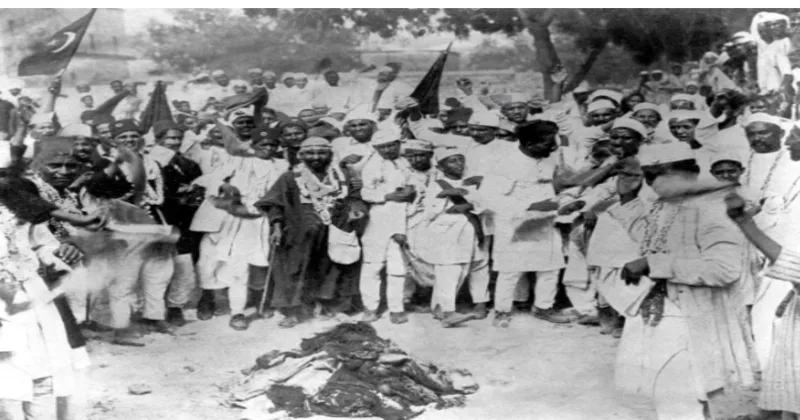
Public burning of foreign cloth became the movement’s most powerful symbolic expression. These bonfires, organized across Bengal and Maharashtra, served multiple purposes beyond mere protest. They demonstrated the movement’s reach into remote corners of the country, created spectacle that attracted public attention, and imposed real economic costs on those who participated. The act of destroying expensive Manchester cloth, purchased at high prices, required genuine sacrifice that proved the depth of nationalist commitment. These ceremonies also served as recruitment tools, drawing new adherents into the movement through dramatic displays of patriotic fervor.
Women’s participation transformed the boycott from male political activity into comprehensive social movement. Urban women refused foreign bangles and utensils, embracing coarse khadi despite its inferior quality compared to Manchester cloth. Female students organized picketing of foreign cloth shops, demonstrating that nationalist awakening had penetrated traditional social barriers. In rural areas, women participated in Swadeshi propaganda meetings, with gatherings of 500 women in single villages contributing jewelry to national funds. This feminine participation proved that economic nationalism had achieved genuine mass character, extending far beyond educated male leadership.
Student involvement provided the movement’s most militant edge. In Bengal, Maharashtra, and southern regions, students organized picketing of shops selling foreign goods while propagating Swadeshi principles. Educational institutions faced government penalties including disaffiliation and suspension of grants when their students participated in agitation. Individual students faced disqualification for government employment, fines, expulsion, and physical punishment. These repressive measures only intensified student commitment, creating a generation of young Indians who viewed economic nationalism as fundamental to political freedom.
The movement’s impact on British economic interests exceeded all expectations. Import of foreign cloth declined by 1.5 crore rupees in 1907 compared to the previous year. Bombay’s textile mills, benefiting from increased demand for indigenous cloth, earned profits of over
2.27 crore rupees with shareholders receiving 43 per cent returns. Many British textile mills faced closure as demand collapsed, creating unemployment in Lancashire that reached crisis proportions. The value of British cloth sold in Bengal districts fell by five to fifteen times between 1904 and 1905. These statistics demonstrate that the boycott achieved its primary objective of inflicting serious economic damage on British commercial interests.
The response from indigenous weavers revealed the movement’s constructive potential. In Bengal’s traditional textile centers, weavers who had abandoned their craft returned to looms as demand for country cloth increased. The number of handlooms in Jessore district rose to 5,000, with sales of indigenous cloth increasing by 20-25 per cent. Santipur dhoti and sari production experienced revival due to demand for fine local textiles. Even coarse cloth found ready markets as patriotic consumers embraced inferior quality as symbol of resistance. This revival demonstrated that economic nationalism could provide viable alternative to colonial industrial structure.
British authorities responded to the boycott’s success with systematic repression designed to crush economic resistance. The Seditious Meetings Act of 1907, the Indian Newspapers Act of 1908, the Criminal Law Amendment Act of 1908, and the Indian Press Act of 1910 created comprehensive framework for suppressing nationalist economic activity. Lathi charges, arrests, and censorship became routine responses to Swadeshi meetings and boycott propaganda. The government’s brutal reaction revealed the extent to which economic nationalism threatened imperial control, forcing authorities to abandon pretenses of liberal governance in favor of naked coercion.
Economic retaliation complemented political repression as British authorities sought to undermine indigenous industrial revival. Import duties were manipulated to favor British goods while penalizing Indian production. The countervailing excise duty imposed on Indian cotton goods in 1894 demonstrated systematic discrimination designed to protect Lancashire interests. Even after granting nominal fiscal autonomy, British authorities retained effective control over Indian trade policy through Imperial Preference arrangements that discriminated against non-British competitors. These measures showed that colonial economic policy served British industrial interests rather than Indian development needs.
The boycott movement’s organizational sophistication reveals careful planning behind apparent spontaneity. Tilak established the Swadeshi Vastu Pracharini Sabha in Bombay, bringing together leaders like S.M. Paranjpe, Khaparde, and Chintaman Vinayak Vaidya. The Bombay Swadeshi Co-operative Stores Company included prominent business leaders like Ratan Tata and Govardhandas Khatau as directors. These institutional structures provided continuity beyond individual leadership while creating mechanisms for sustained economic resistance. The movement’s ability to maintain pressure over several years demonstrated organizational capacity that surprised British authorities.
Popular participation exceeded all expectations as the movement transcended class and religious boundaries. In Bengal, both Hindu and Muslim women joined Swadeshi activities, with Muslim women like Khairunnesa contributing nationalist literature. Processions included more Muslims than Hindus in some instances, disproving British assumptions about communal limitations. Rural participation matched urban enthusiasm, with entire villages adopting Swadeshi practices and contributing to national funds through grain collections. This broad participation base provided the movement with resilience that withstood government repression.
The emergence of weaver cooperatives represented the movement’s most significant institutional innovation. Traditional handloom production, previously organized through exploitative mahajan system, found new cooperative structures that eliminated middleman exploitation. Ex-students from weaving institutes established independent factories, though many closed due to funding limitations. The introduction of fly-shuttle looms increased productivity while maintaining handloom character that satisfied Swadeshi requirements. These institutional innovations provided foundation for indigenous textile revival that continued long after political agitation subsided.
Economic warfare extended beyond textiles to encompass systematic rejection of British commercial presence. Indian textile mills owned or managed by British companies faced boycott despite producing within India. Lists of approved Swadeshi mills were circulated while non-conforming enterprises faced social sanctions. This comprehensive approach demonstrated sophisticated understanding that economic nationalism required discrimination based on ownership and management rather than mere production location. The movement’s leaders grasped that true economic independence demanded Indian control over industrial capacity.
The movement’s legacy transcended immediate political objectives to establish economic nationalism as permanent feature of Indian political consciousness. Gandhi’s adoption of the charkha as symbol of independence drew directly from Swadeshi precedents. The spinning wheel became icon of self-reliance that connected village production with national politics. Gandhi’s insistence that every Indian spin for at least one hour daily represented systematic extension of Swadeshi principles to individual level. This transformation of economic activity into patriotic duty created lasting framework for resistance to economic dependence.
Industrial development during the Swadeshi period laid groundwork for India’s modern textile industry. The Bombay Spinning and Weaving Mill, established in 1851 with Indian capital, provided model for indigenous enterprise. Parsi merchants, utilizing profits from cotton trade, accumulated resources for industrial investment. The boycott movement accelerated this process by creating protected market for Indian production while undermining British competition. Statistical evidence shows dramatic growth in Indian mill capacity during boycott years, with profit rates reaching unprecedented levels. This industrial foundation survived political setbacks to provide basis for later economic development.
The social transformation accompanying economic nationalism created new forms of Indian identity that transcended traditional hierarchies. Wearing khadi became marker of patriotic commitment that crossed caste and class boundaries. The charkha provided employment for rural women while connecting them to national movement. Handloom production acquired social prestige that reversed centuries of declining status for traditional crafts. These changes created cultural framework that supported economic resistance while building foundations for post-independence industrial policy.
Modern parallels between the Swadeshi movement and contemporary Atmanirbhar Bharat initiatives reveal continuities in Indian economic nationalism. Both movements combine demand-side patriotism with supply-side industrial development[28]. The current emphasis on reducing import dependence while building export capacity echoes Tilak’s vision of comprehensive economic transformation[28]. However, contemporary globalization creates challenges unknown to earlier economic nationalists, requiring sophisticated balancing of domestic protection with international competitiveness. The success of modern self-reliance initiatives depends on learning lessons from historical experience while adapting to changed global circumstances.
The Swadeshi movement’s emphasis on consumer choice as instrument of resistance provides enduring model for economic nationalism in democratic societies. Unlike authoritarian approaches that rely on state control, the boycott demonstrated power of voluntary collective action to reshape market relationships. This approach respects individual freedom while channeling private decisions toward national objectives. Contemporary movements can draw inspiration from this model while developing new mechanisms appropriate to current global economic integration.
The Lancashire cloth boycott represented far more than symbolic protest against colonial rule. It constituted systematic economic warfare that inflicted real damage on British commercial interests while laying foundations for indigenous industrial development. The movement’s combination of negative boycott with positive Swadeshi construction provided comprehensive framework for economic resistance that influenced Indian policy for decades. Its success in mobilizing mass participation across social boundaries demonstrated potential for economic nationalism to transcend narrow political interests in service of broader
civilizational revival. Most importantly, it established consumer choice as legitimate weapon of resistance, proving that market relationships could serve nationalist objectives when properly organized and sustained. The lesson for contemporary India remains clear: economic independence requires not just government policy but popular commitment to preferring domestic production over foreign alternatives, making every purchase decision an act of national construction.