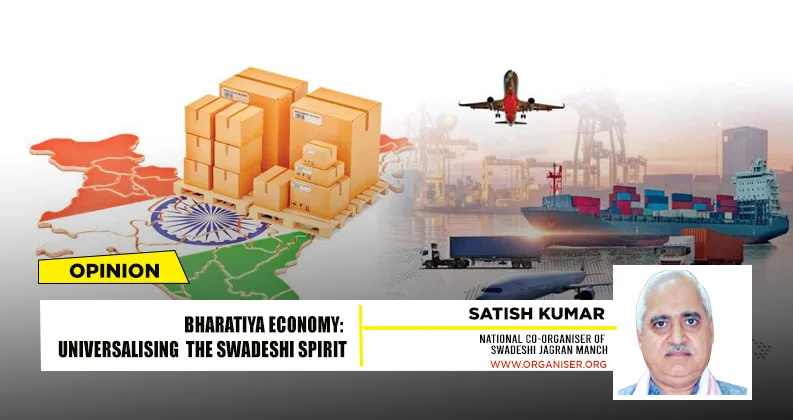
The beginning of 2026 has certainly set a precedent for the coming years, as it brought Bharat two deals that mark a milestone in transforming our geo-economic reality. The “Mother of all deals” with Europe and other deals (also the ongoing talks with the US) are going to transition Bharat’s status from “strategic partner” to indispensable economic-ally. Vande Mataram, the song that became the soul of the Swadeshi Movement, recently celebrated its 150th anniversary. These deals are indeed a homage to Swadeshi in a spiritual sense. While historically Swadeshi was about promoting indigenous goods and self-reliance, in the contemporary realm, it is more about making our goods accessible to global consumers through quality compliance and navigating through the tariffs, which have hitherto become tools of diplomatic manoeuvring and leverage.
Strategy Beyond Handshake
While these deals are hands down a milestone in our trade negotiation history, they bring us home a collective market of $50 tn. The next step would be to assess these deals and chart out a path to reap maximum benefits, along with clearing out the air of misconceptions around them. In this context, let’s first debunk the myth of the strategic trap that the US Interim Trade deal puts us in, a pressure point to undermine Bharat’s sovereign energy choices, one that always misses the pre-Russia-Ukraine War scenario, where Russia accounted for only 3 per cent of oil imports. Bharat shifted to Russian oil because it provided a cost-effective alternative to the volatile markets of West Asia, fuelled by heavy sanctions on Russia. The autonomy of Bharat is intact; rather, our sovereignty has never been better exercised. Today, when we lower oil imports from Russia, it is not giving in to the US pressure but to diversify our energy needs. One could view the move as strategic pivoting towards Europe. Further, the pickle that the US has put itself in could be easily understood with the approaching mid-terms in November 2026 and Mike Carny’s call to middle powers to join hands in unison to lever against the hegemon.
Moving on with Bangladesh and “Cotton Clause”, both nations export roughly $7.5 billion in textiles to the US. They occupy distinct niches: Bangladesh leads in non-knitted apparel (15 per cent US market share), whereas Bharat dominates other made-up textiles with a 19 per cent share. The special clause, which offers zero-tariff access for garments manufactured specifically with US-sourced cotton or man-made fibres. Though this provision aims to challenge Bharat’s $2.7 billion cotton export market to Bangladesh, where Bharat currently holds a 31 per cent share, the threat appears more theoretical than practical. The prohibitive logistics costs of importing raw materials from the US are expected to preserve Bharat’s competitive edge as a regional supplier. Even in a scenario where US cotton replaces 10 per cent of Bharat’s current exports to Bangladesh, the projected loss is a miniscule $1 billion. Furthermore, the simultaneous opening of a $260 billion zero-duty textile market in the EU provides Bharat with a massive strategic buffer, ensuring that its textile sector remains poised for growth despite regional competition.
The next thread of misinformation comes in the form of Apple Saga, where the 2026 Bharat-US trade deal sparked a debate over its potential threat to Bharat’s apple market, particularly for growers in Jammu & Kashmir and Himachal Pradesh. But as it turns out, the threat was never real but a misconception. While the agreement reduces the import duty on US apples from 50 per cent to 25 per cent, the Indian Government maintains that domestic interests are shielded by a Minimum Import Price (MIP) of ₹80 per kg and a strict import quota. Officials argue this move merely shifts existing import demand from suppliers like Turkey to the US without increasing overall import volumes.
The next bone of contention happens to be the Dried Distillers’ Grains with Solubles (DDGS); it is perhaps a strategic necessity to bridge a growing protein deficit in Bharat’s livestock sector. With domestic maize yields at just 3.75 tonnes/hectare, which are 1/3rd of US levels, Bharat’s feed production cannot keep pace with the rapidly expanding poultry and fishery industries. As a high-protein, nutrient-rich byproduct of ethanol fermentation, DDGS serves as a cost-effective alternative to expensive traditional ingredients like soybean meal, helping to stabilise feed costs and contain food inflation. To protect local farmers, the agreement permits only a 5 lakh tonne quota, representing a mere 1 per cent of total domestic consumption. This calibrated opening addresses the craving of poultry, piggery and fishery producers for high-quality nutrition while maintaining strict safeguards on raw Genetically Modified (GM) grains with no intention of promoting DDGs as cattle fodder. Further, the introduction of US products like soybean oil at reduced duties is in exchange for zero-tariff access for $1.035 billion of Indian agri-exports, benefiting rice, tea, and spice farmers. Moreover, strategic safeguards, like Minimum Import Price on apples and strict non-GM certification for feed, insulate rural livelihoods from potential dumping.
Bharat’s Rise in Global Trade
- A New Era of Swadeshi: The 2026 deals represent a spiritual homage to Swadeshi Movement, evolving the doctrine from defensive isolation to a strategy of global indispensability by making Bharatiya goods accessible through quality compliance rather than just self-reliance
- EU FTA Acts as a Catalyst: By securing a comprehensive deal with Brussels, Bharat gained duty-free access to 99.5 per cent of export lines, creating a sense of urgency that pushed American policymakers to finalise an interim trade deal with New Delhi
- Leveraging the China + 1 Strategy: These agreements position Bharat as a high-value manufacturing hub, utilising the China + 1 strategy to attract high-quality FDI and de-risk global industrial supply chains
- Protecting Rural Livelihoods: To insulate domestic farmers, the Government implemented strategic safeguards such as a Minimum Import Price (MIP) of Rs 80 per kg on apples and strict non-GM certifications for livestock feed
- Calibrated Market Opening: Sensitive sectors like dairy and pulses remain strictly excluded from the deals, while products like US soybean oil are permitted primarily as feedstock for producing renewable bio-fuels rather than for cooking
- Shift to Quality Compliance: The deals emphasise that the acceptability of Swadeshi products in markets like Europe depends on adherence to ESG norms and international quality benchmarks, moving the focus from making more to making better
- Strategic Might: Unlike the 1991 reforms born of necessity, the 2026 deals were negotiated from a position of strategic might, reflecting a confident nation with a $4.51 trillion GDP marching toward Viksit Bharat @ 2047
The deal is a powerful catalyst for Bharat’s financial sector too, primarily through enhanced credit demand and foreign investment. SBI Research highlights a strong 0.77 correlation between export growth and trade financing, projecting that every 1 per cent rise in exports will drive a 1.28 per cent increase in export credit. With total annual exports to the US potentially exceeding $100 billion, this creates a massive opportunity for banks to bridge the existing credit shortfall. Furthermore, the agreement bolsters the banking sector’s health. By September 2025, the industry’s Gross Non-Performing Assets (GNPA) had already reached a record low of 2.2 per cent. The deal’s emphasis on the China + 1 strategy is expected to further de-risk portfolios by attracting high-quality Foreign Direct Investment (FDI) into stable manufacturing value chains. This influx of capital and credit is essential for achieving Bharat’s goal of $1 trillion in merchandiseexports by 2030.
Strategy of Global Indispensability
The 2026 trade agreements with the US and EU mark a transformative leap for Swadeshi, evolving from a doctrine of defensive isolation into a strategy of global indispensability. This paradigm shift ensures that Bharat engages with the world as a self-assured economic ally, leveraging the China + 1 strategy to become a high-value manufacturing hub. By securing a competitive 18 per cent reciprocal tariff and a projected $45 billion trade surplus, Bharat is not merely participating in global trade but re-authoring its destiny through excellence and quality.
The vision we hold today protects the soul of our industries by aligning domestic standards with global benchmarks, ensuring that Made in India becomes synonymous with quality. These deals remain rooted in the Swadeshi goal of rural empowerment, utilising safeguards such as the Minimum Import Price and non-GM certifications. Furthermore, our credit-fuelled engine where a 1 per cent rise in exports drives a 1.28 per cent increase in credit is empowering the Antyodaya by fostering local industrial ecosystems. Addressing the recent stint of setting a false narrative around these deals is regressive for this is a march to Viksit Bharat@2047. Bharat is gaining traction; we are no longer bandwagoning the global order. Instead, these deals have effectively made us drivers of growth, allowing us to negotiate from a position of strategic leverage rather than forced necessity. When we adopted the LPG (Liberalisation, Privatisation, and Globalisation) reforms in 1991, we required a closed system to protect a vulnerable economy burdened by internal debt rising to 53 per cent of GDP. In subsequent decades, this necessitated a protectionist stance that warranted caution. However, Bharat of today bears no resemblance to the struggling economy of 1991. With an estimated GDP of $4.51tn in 2026 and a booming role as a global hub for technology and manufacturing, we are the outliers. Today, as we possess a capable, grounded state apparatus alongside world-class export capabilities, the need of the hour is to trust in the spirit of Bharat.