
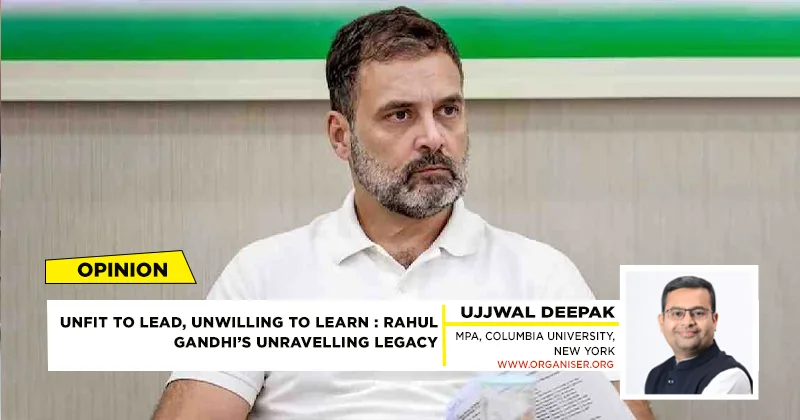
Recently, the Supreme Court rebuked Rahul Gandhi after he alleged without evidence that China had occupied 2,000 sq km of Indian territory. The court’s words were damning: “A true Indian wouldn’t say such a thing. You are a political leader… you have rights under Article 19(1)(g), but you were the Leader of the Opposition, and such statements are not expected.”
The court’s message is clear. While freedom of expression is a fundamental right, statements affecting national security must be made responsibly especially by opposition leaders. Gandhi’s unverified claim not only insulted Indian forces but also gave ammunition to China’s propaganda machine. At a time when India is defending its borders, such comments are viewed as detrimental to national interest. This rebuke from the Supreme Court was not merely legal, it was moral. It underscores how far removed Rahul Gandhi’s worldview is from Indian values, the Constitution, and national sentiment. When the highest court of the land deems a political leader’s remarks as “un-Indian,” it is more than criticism, it is a warning in national interest.
In an another instance, Rahul Gandhi has described India’s thriving economy as a “dead economy” even as global institutions like the IMF and World Bank label it the world’s fastest-growing major economy. In a time of record-breaking advances in start-ups, digital payments, FDI inflow, and manufacturing, Rahul Gandhi’s negativity seems less an expression of genuine concern and more a calculated attempt to tarnish India’s image on international platforms.
Even after the Congress’s crushing defeat in the 2024 Lok Sabha elections, Rahul Gandhi refused to introspect. Instead, he questioned the wisdom of Indian voters, declaring that “democracy is dead,” that “media and institutions are compromised,” and that “we couldn’t have lost. Something is wrong.” Such statements not only insult India’s electorate but also undermine its democratic processes. Most recently, his allegations and threats to the Election Commission are serious charges delivered in a dangerously provocative tone. Such language is unbecoming of an elected representative and undermines the credibility of constitutional institutions.
The dominance of the Nehru-Gandhi family in Indian politics has become a textbook case of “monarchical democracy.” From Jawaharlal Nehru to Indira Gandhi, Rajiv Gandhi, Sonia Gandhi, and now Rahul Gandhi & Priyanka Gandhi, the Congress party has functioned for decades as a dynastic entity rather than a democratic institution. It is less a political organisation and more a hereditary estate where power, ideology, and leadership are passed down the family line. Indira Gandhi’s declaration of Emergency in 1975 was a stark reminder that for the family’s interests, even the nation’s democracy could be suspended. Censorship of the press, mass arrests of political opponents, and pressure on the judiciary were all executed to safeguard dynastic rule.
Under Sonia Gandhi, the Congress evolved into a full-fledged court culture. Rahul Gandhi, without contest or qualification, was anointed the political ‘heir apparent’. Rahul Gandhi’s political journey reflects a deep aversion to internal dissent or democratic engagement. For two decades, Sonia Gandhi presided over the party without internal elections. Rahul Gandhi, despite repeated electoral defeats, was reinstated as party president. Priyanka Gandhi Vadra, with no administrative experience, was promoted on the strength of her surname alone. The result is the collapse of democratic functioning and ideological vitality within the party.
Rahul Gandhi has arguably become the most glaring symbol of political failure within the dynasty. His lack of understanding of national security, public sentiment, and governance is striking. His leadership has not encouraged introspection, but rather led the party down a path of self-destruction. His immature statements, proximity to anti-national elements, and indulgence of divisive discourses have harmed not only the Congress party but also India’s constitutional values and national interest.
Far removed from principles of equality, constitutionalism, and respect for public mandate, Rahul Gandhi continues to see himself as a princely successor. His tone, vocabulary, and political conduct reflect neither democratic sensitivity nor Indian tradition. He behaves as if he is India’s rightful political heir.
Under his leadership, the Congress has turned into a melting pot of strange political alliances. It has aligned itself with leftist ideologies and Islamist hardliners. Gandhi has repeatedly shared platforms with groups that challenge India’s unity, integrity, and cultural ethos. During the anti-CAA protests, Gandhi not only supported violent demonstrations but had the audacity to call the Shaheen Bagh and Jamia agitations “a fight to save democracy”. This indicated a clear political strategy of pandering to one section while ignoring the sentiments of the majority.
Rahul Gandhi’s political demeanour remains steeped in regal arrogance. His conduct in Parliament too reflects a belief that democracy must bow to family legacy. But in a true democracy, accountability, not inheritance should prevail. Rahul Gandhi’s political history is littered with misleading and unverified claims, and his narrative often lacks both evidence and responsibility. His political conduct has frequently been erratic, immature, and irresponsible. A leader’s duty is to uphold India’s dignity abroad, but Rahul Gandhi has repeatedly gone to London, the US, and Europe to portray Indian media as compromised, institutions as puppets, and the judiciary as intimidated.
When the Government of India launched “Operation Sindoor” to uphold the dignity of victims of terrorism, Rahul Gandhi chose to question even this humanitarian initiative. Following the Pulwama attack and the Balakot air strikes, he demanded proof, thereby doubting the Indian Army’s valour and feeding enemy propaganda.
His politics are in stark conflict with India’s cultural and nationalist ethos. An icon like Veer Savarkar is either mocked or targeted by him. He has repeatedly sought to discredit Savarkar’s contributions, branding him a “petition-writer.” Yet, it was Savarkar who endured inhuman torture in the Andaman Cellular Jail in service of India’s freedom. Gandhi’s refrain, “I am not Savarkar, I won’t apologise,” betrays both political immaturity and historical ignorance. Most intellectuals and freedom fighters have acknowledged Savarkar’s sacrifice, even if they differed with his ideology.
The Gandhi family has turned India’s democracy into a personal inheritance. By nurturing dynasticism, corruption, and anti-India sentiments, they have not only weakened the Congress but also set back Indian politics. If India needs a strong opposition, the Congress must first be freed from the stranglehold of the Gandhi family.
India needs an opposition. Principled, constructive, and rooted in national interest. But under Rahul Gandhi, the Congress is steadily transforming into a tool of anti-national forces. If the party hopes to survive, it must emerge from Rahul Gandhi’s shadow. Otherwise, Rahul Gandhi will not just be the Congress’s “political heir”. He will be the symbol of its political downfall.