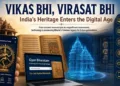
Manuscripts are the future of India, as they preserve millennia of indigenous knowledge in science, philosophy, medicine and culture. Manuscripts reflect the functioning and evolving rules and regulations of society. New foundations for society are built on the foundation of the Manuscript, how society operated over a certain period of time.
In India, preserving and digitising manuscripts is not an easy task, as there is a small but vocal group which fears cultural resurgence and pushing colonial narratives. They often resist such efforts, questioning relevance or ownership. They want to sideline the Indian civilisational legacy from modern discourse and education.
In July 2024, the National Mission for Manuscripts (NMM) mentioned a core mandate to survey, document, preserve, digitise and share India’s rich heritage of manuscripts. Over 100 Manuscript Resource Centres (MRCs) and Manuscript Conservation Centres (MCCs) have been established across the country to conserve, catalogue and disseminate these unique texts. The Mission will allow for the documentation of nearly 5.2 million manuscripts, to preserve 90 million folios and digitise 3.5 lakh manuscripts while covering more than 3.5 crore folios. As per data, nearly 1.4 lakh manuscripts were put on its web portal, of which 75,000 were made available for free public viewing. More than 100 conservation workshops have been organised to train practitioners, and more than 100 books have been published with ancient knowledge.
A major shift was seen in December 2024 when the government restated the Mission, utilising state-of-the-art technological inputs, working in collaboration with IGNCA (Indira Gandhi National Centre for the Arts) to digitise and conserve manuscripts. Various methods like lamination, restoration and de-acidification were utilised, while MRCs and MCCs went on to fill missing manuscripts in the collection and conservation. These centres function as a key centre of preventive and curative conservation operating under national standards.
In March 2025, the Mission had entered a new phase of digitisation when it was renamed Gyan Bharatam Mission, rolled out as a Central Sector Scheme from 2024 to 2031 with a funding of Rs 482.85 crore. The mission formally set itself the target of digitising more than one crore manuscripts in five years, making digitisation a central focus of its work. Through this programme, it is evident that digitisation is now stated as a national priority.
Gyan Bharatam’s approach has six broad and interconnected dimensions.
The first is survey and documentation: the Mission has to systematically catalogue more than 5.2 million manuscripts which are kept in educational institutions, temples, libraries and private hands. In Uttar Pradesh, Sampurnanand Sanskrit University, Varanasi, the deep diving documentation and training activities are scheduled at regular intervals.
Second is conservation: this mission conserves manuscripts using scientific and preventive techniques across its network of MCCs and MRCs. The 90 million folios saved by mid-2024 is a testament to capacity in conservation science. Training workshops over 100 in a year to develop skills among people in manuscript handling, palaeography and other preventive conservation techniques.
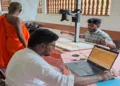
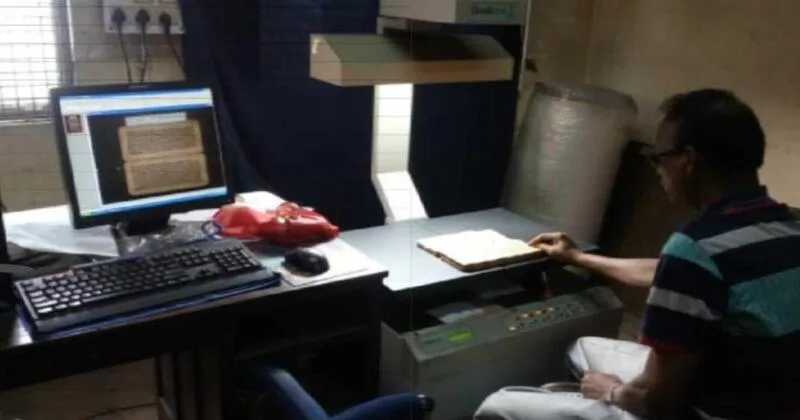
Third is digitisation: the Mission’s output comprises 3.5 lakh manuscripts digitised. This process is carried out under standardised national parameters, high-quality scanning, condition reporting, and metadata tagging. The online repository is gradually increasing with 1.36 lakh manuscripts posted and more than 77,000 available to users so far.
Fourth is publication and research: The Mission also prioritises editing, translating and publishing rare manuscripts through academic scholarship. Over 100 titles have already been published to date, and strategic partnerships with universities are part of the plan.
Fifth is capacity building: training modules include palaeography, manuscriptology and conservation. Through programmes and workshops, the scholarly efforts are expanding with a new generation of manuscript professionals.
Sixth is outreach and awareness: exhibitions, seminars and festivals are commonly referred to as “Manuscript Melas”, and are organised to take manuscripts to local schools, universities and communities to establish public participation with India’s textual heritage.
The Centre for Jain Manuscriptology at Gujarat University and the Centre for Jain Studies at DAVV, Indore, have been recognised as national institutions for digitisation and scholarly work on Jain manuscripts. These efforts highlight the Mission’s outreach in an inclusive manner toward diverse linguistic, religious and philosophical manuscript traditions. This Mission is supported by robust technological foundations.
Digitisation is carried out following standardised procedures by imaging in high-resolution, metadata are multilingual, and condition indexing provides long-term preservation relevance. The scale and approach of Gyan Bharatam is ambitious, and official reports affirm the plan to survey, record, preserve, digitise and make available over one crore manuscripts in five years’ time.
There is an obstacle where more than 80% of manuscripts are held privately, and they must be brought under trust and agreement with individual owners to open up collections to survey and digitisation. Trained staff in rare-script conservation and transcription are still in shortage, though training schemes keep spreading. Delicate and torn manuscripts need careful treatment to avoid harm while scanning and storing them.
If Gyan Bharatam achieves it’s one crore manuscript target by 2029–30, it will be a milestone in history. The establishment of a National Digital Manuscripts Library of such a large volume is unimaginable in the world. This library will be searchable, accessible and annotated with scholarly notes, enabling scholars, teachers and learners. The Mission also foresees integrating manuscript studies into university and school curriculum, which will help in turning India’s textual legacy into a living and educational resource.
At its core, Gyan Bharatam’s narrative is the narrative of Bharat’s cultural renaissance which is turning the invisibility of palm-leaf, birch bark and paper manuscripts into open access and searchable content. The Mission is not just a matter of scanning repositories, it is about rejuvenating civilisational memory, empowering scholarship and recovering India’s textual heritage for citizens. Every digitised folio, every manuscript conserved and every scholar trained is an investment in a safe and civilised future.