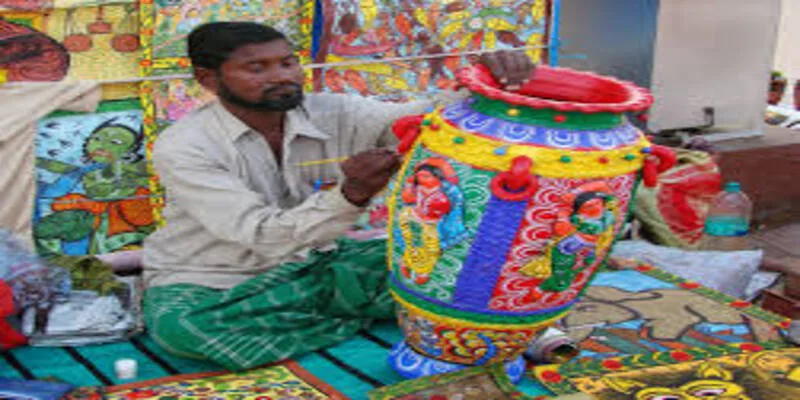
India’s handloom and handicraft heritage is more than an industry—it is a living, breathing embodiment of our civilisational ethos, woven with the threads of memory, identity, and tradition. Across centuries, these weaves and crafts have told stories of communities, beliefs, and ecosystems. Each region of India has nurtured its own distinct form of textile and craft tradition, many of which date back to ancient times. Yet today, many of these exquisite, labour-intensive arts are on the verge of extinction—not due to a lack of skill or legacy, but due to waning public interest, industrial mass production, and the growing disconnect between consumers and their cultural roots.
The significance of handloom and handicraft in India lies not only in its aesthetic brilliance but in its embodiment of sustainable living. These crafts are made from natural fibres, dyed with organic colours, and often woven using manual tools that do not harm the environment. Each handwoven textile or handcrafted object carries the fingerprint of its maker and the nuance of a local tradition that has survived the test of time. Yet, in a world driven by speed, uniformity, and imported trends, such slow and soulful artistry struggles to find its place. What we are witnessing is not just the decline of a business but the erasure of cultural legacies.
Many traditional weaves like the Patteda Anchu of Karnataka, Sikalnayakanpet Kora cotton sarees of Tamil Nadu, and the fine Kodali Karuppur Kalamkari are now produced by only a handful of artisans. Handicrafts like Rogan art from Gujarat, where cloth is painted using castor oil and natural dyes, are now practiced by just one family. Bamboo and cane crafts from the North-East, once thriving in the forest economies of tribal groups, now suffer due to lack of raw material access and market visibility. Even the once-celebrated Bidriware—an intricate metal inlay craft from Karnataka—is fading from public memory. Urban consumers are unaware of these forms, and modern lifestyle aspirations have moved away from the artisanal to the artificial, pushing the traditional into obscurity.
What makes these crafts distinctly Indian is their rootedness in local life. Nowhere else in the world exists such a diversity of weaving traditions, each carrying spiritual, ecological, and social meanings. Odisha’s Sambalpuri sarees draw inspiration from temple architecture and mythology. Bhujodi shawls from Gujarat reflect pastoral life and desert-friendly techniques. Kashmir’s Pashmina is still hand-spun from the undercoat of the Changthangi goat. Unlike mass-produced fabrics, Indian weaves are steeped in identity and geography. A few endangered crafts deserve special mention. Toda embroidery from the Nilgiris, done exclusively by Toda tribal women, features red and black geometric patterns. Chamba rumals from Himachal Pradesh depict epic scenes in double satin stitch. Ganjifa cards of Odisha and Maharashtra are painted storytelling decks produced by only a few master artists. Dhokra metal casting and Bastar ironwork from Chhattisgarh still exist but are losing the attention they once held. Each of these crafts represents centuries of skill. Losing them means losing stories, aesthetics, and the rich cultural diversity that defines India.
Despite this, the handloom and handicraft sector holds immense potential, especially for women. Women form a significant part of this workforce, particularly in weaving, embroidery, and grassroots marketing. In rural households, handloom work provides a viable and dignified source of income, allowing women to work from home, balance family duties, and contribute to household economies. Many women artisans now lead cooperatives, run small businesses, and mentor younger women—turning artistry into economic empowerment. Investing in this sector preserves heritage while fostering gender-inclusive growth.
To preserve these priceless crafts, the effort must be consumer-driven, community-centred, and policy-supported. Government schemes and GI tags help, but real infrastructure, market access, and awareness are essential. Revival projects should treat artisans as collaborators, not recipients of aid. When traditional artisans work with contemporary designers, the results are innovative and market-relevant. Local exhibitions, school-based programs, and digital storytelling can educate younger generations about the value of handmade goods.
The most crucial role, however, is that of the consumer. We must bring these crafts into our everyday lives. Choosing a handwoven saree over a synthetic one, or a bamboo basket over plastic, is a vote for sustainability and cultural continuity. The call to be “vocal for local” must become a lifestyle. This includes not bargaining with artisans, buying directly from weaver clusters, and supporting homegrown businesses that blend tradition with innovation.
Handlooms and handicrafts are not relics—they are adaptable and relevant. From eco-conscious fashion to sustainable decor, they offer solutions rooted in centuries of wisdom. Their revival is not solely the government’s responsibility; it is ours. In a homogenized global market, our indigenous crafts lend us distinction, identity, and pride.
As we celebrate National Handloom Day, let us remember that every thread woven and pattern embroidered is a testament to Indian artisanship. Let us not wait until these crafts are museum pieces to recognize their value. Wear them, use them, gift them, share their stories. A culture that forgets its craft forgets itself. India deserves better. Let us honour our legacy not just in words but in the choices, we make each day.
In recent years, India’s traditional crafts have found global visibility, in part due to the Prime Minister’s conscious efforts to gift indigenous art forms to world leaders. From gifting Pochampally Ikat products to the G7 Summit delegates, to presenting hand-carved Sandalwood artefacts, Gond paintings, and Rogan paintings from Gujarat to state heads, these gestures have not only honoured our artisans but also showcased India’s cultural richness on the world stage. These crafts are not only tokens of goodwill but symbols of our civilisational continuity.
To preserve these priceless crafts, the effort must be consumer-driven, community-centred, and policy-supported. Government schemes and GI tags help, but real infrastructure, market access, and awareness are essential. Revival projects should treat artisans as collaborators, not recipients of aid. When traditional artisans work with contemporary designers, the results are innovative and market-relevant. Local exhibitions, school-based programs, and digital storytelling can educate younger generations about the value of handmade goods.
The most crucial role, however, is that of the consumer. We must bring these crafts into our everyday lives. Choosing a handwoven saree over a synthetic one, or a bamboo basket over plastic, is a vote for sustainability and cultural continuity. The call to be “vocal for local” must become a lifestyle. This includes not bargaining with artisans, buying directly from weaver clusters, and supporting homegrown businesses that blend tradition with innovation.
Handlooms and handicrafts are not relics—they are adaptable and relevant. From eco-conscious fashion to sustainable decor, they offer solutions rooted in centuries of wisdom. Their revival is not solely the government’s responsibility; it is ours. In a homogenized global market, our indigenous crafts lend us distinction, identity, and pride.
As we celebrate National Handloom Day, let us remember that every thread woven and pattern embroidered is a testament to Indian artisanship. Let us not wait until these crafts are museum pieces to recognize their value. Wear them, use them, gift them, share their stories. A culture that forgets its craft forgets itself. India deserves better. Let us honour our legacy not just in words but in the choices, we make each day.