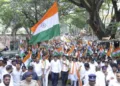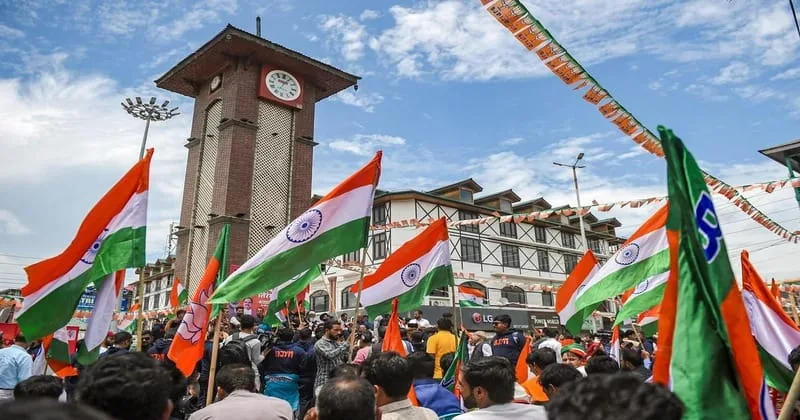
As a prelude to Independence Day 2025, the Har Ghar Tiranga Campaign has been launched to reflect the true spirit of patriotism and unity in the Union Territory of J&K. The campaign has become almost an annual event since August 5, 2019, the historical day when the draconian provisions of Articles 35A and 370 were revoked and the separate Constitution and flag of J&K were laid to rest forever, signifying the end of separatism of all sorts promoted by valley-centric political parties. The tryst with Tiranga of the Dogras of Jammu is not only their love for the national flag, but is a saga of struggle and sacrifices for the unity and sovereignty of Bharat.
The hoisting of the Indian National Flag in J&K has been a politically and emotionally charged act, often reflecting the socio-political divergence of the region, with the State opposing rather than promoting the hoisting of the National Flag. The successive state governments since 1950 saw the hoisting of Tiranga as a symbol of Indian dominance and the State Flag as a symbol of the State’s “Special Status” associated with its autonomy.
The struggle and sacrifices of our elders must be continuously highlighted to educate the current generation so that the real martyrs are honoured and remembered by the generations to follow. The struggle in the Jammu region during Sheikh Abdullah’s rule (1948–1953) over the hoisting of the Indian national flag, the Tiranga, is a significant episode tied to the broader Praja Parishad agitation. This movement, led by the Jammu Praja Parishad, a nationalist party founded in 1947, sought the full integration of J&K with India, opposing the special status granted under Article 370 and Sheikh Abdullah’s policies, which were seen as promoting Kashmiri Muslim dominance and autonomy. The slogan “Ek Vidhan, Ek Nishan, Ek Pradhan” (One Constitution, One Flag, One Leader), became the moving force behind the protests against the hoisting of the National Conference (NC) flag alongside or instead of the Tiranga, which many in Jammu, particularly Dogras, viewed as a symbol of separatism. The hoisting of the NC flag was perceived as a deliberate attempt to assert Kashmiri dominance and undermine Indian sovereignty. Key Events related to the Tiranga and Praja Parishad Agitation are summarised below.
On January 15, 1952, tensions escalated when Sheikh Abdullah hoisted the NC flag at an official function at Gandhi Memorial College in Jammu and asked students to salute it. Students objected, leading to their penalisation and sparking widespread unrest. This incident fuelled a 38-day hunger strike by students, supported by the Praja Parishad, who demanded the Tiranga be hoisted as the sole symbol of Indian sovereignty. On February 8, 1952, a large procession in Jammu in solidarity with the students led to a 72-hour curfew and the arrest of Praja Parishad leader Pandit Prem Nath Dogra. The Praja Parishad accused Abdullah of undermining Indian sovereignty by promoting the NC flag and pushing for autonomy, which they saw as a step toward an independent, Muslim-majority state.
This led to the Praja Parishad-led civil disobedience movement launched in November 1952, intensifying protests against Abdullah’s policies. The movement gained momentum with support from national organisations like the Bharatiya Jana Sangh, Hindu Mahasabha, and Akali Dal. Protests often centred on hoisting the Tiranga to assert Jammu’s integration with India. Demonstrations faced severe repression, including curfews, arrests, and police firing. The first recorded death took place in 1952 when a Praja Parishad karyakarta, Mela Ram, was killed while hoisting the national flag at Chhamb Police Station. Two months later, three more activists died in police firing at Sunderbani. On January 11, 1953, a demonstration of 5,000 people in Hiranagar was fired upon, killing two and injuring over 70. On January 30, 1953, six protesters were killed and 125 were injured in Jourian during a procession. A significant incident occurred on March 1, 1953, when three Praja Parishad activists were killed while attempting to hoist the Tiranga at Ramban.
The Abdullah administration’s response was heavy-handed, with around 2,500 arrests, including Praja Parishad leaders, and reports of over 30 deaths due to police firing across Jammu. The movement gained national attention when Bharatiya Jana Sangh president Syama Prasad Mookerjee joined the agitation. On May 11, 1953, Mookerjee attempted to enter J&K to support the protests but was arrested at Lakhanpur and died in detention on June 23, 1953, under controversial circumstances, sparking outrage across India. This became the first custodial political murder in the history of independent India. Yet the Government of India, led by Pandit Nehru, turned a blind eye to the custodial killing of his former cabinet colleague, despite the mother of Syama Prasad Mookerjee making an emotional appeal to Pandit Ji to order an enquiry.
The Praja Parishad’s protests, including attempts to hoist the Tiranga, were seen as a challenge to Abdullah’s authority. The government’s crackdown, including arrests and violence, was criticised as undemocratic all over the country. But Pandit Nehru, due to his blind love for the Sheikh, held a different view and termed the Jammu Dogras as anti-national for opposing the separatist policies of the NC government led by Sheikh Abdullah. The Jammu Dogras can never forgive Pandit Nehru for the insult hurled at them despite the armed suppression faced by them during attempts to hoist the Tiranga. Look at the audacity of Sheikh Abdullah and the National Conference, while the patriotic Dogras were killed and murdered for attempting to hoist the National Flag, the arsonists and looters ofJuly 13, 1931 were declared as martyrs and July 13 was celebrated as a State event every year till the nationalist LG of Jammu and Kashmir Mr Manoj Sinha abolished the same. The agitation peaked in 1953, contributing to Sheikh Abdullah’s arrest on August 9, 1953, on charges of sedition after his speeches questioning Jammu and Kashmir’s accession to India. The Praja Parishad called off the agitation on July 7, 1953, following Mookerjee’s death and appeals from Prime Minister Jawaharlal Nehru.
But the Tryst with Tiranga did not end here. The return of Sheikh Abdullah to the state politics after an accord with Prime Minister Indira Gandhi in 1975 witnessed the return of assertion of separatism, autonomy and exclusive politics. His son and successor, Dr Farooq Abdullah, faithfully carried forward his agenda. The tide of events that followed led to the darkest period of the political history of J&K, leading to the mass exodus of Kashmiri Hindus from their homeland. The supremacy of Tiranga was again challenged, and it was left to the nationalist parties like the Bharatiya Jan Sangh and later the Bharatiya Janata Party to contest them. Some of the significant events are Ekta Yatra led by Murli Manohar Joshi in 1992, and BJP’s Ekta Yatra led by Bharatiya Janata Yuva Morcha (BJYM) in 2011. BJP led the opposition to the statement of Mehbooba Mufti, who claimed that no one in Kashmir would hoist the Tiranga if Article 370 were abrogated. In 1920, she created the same drama by claiming that she would not hoist the Tiranga till the state flag was restored. She was challenged by the BJP by hoisting the Tirangas all over the Valley, including the Lal Chowk.
The most significant event was when, in 2015, the newly elected MLAs of the BJP refused to hoist the J&K State Flag alongside the Tiranga, highlighting the tension between national unity and state autonomy that was brewing with valley-centric parties batting for the same. The sacrifices of the Dogras of Jammu have not gone to waste since the Tiranga now flies exclusively everywhere in the Union Territory of J&K, highlighting the victory of nationalism over separatism.