India visions of a permanent human presence in space, has made a crucial step ahead not through rockets or satellites but with experiments with boots on the ground in Ladakh’s far-flung Tso Kar Valley. At 15,000 feet above sea level, where oxygen levels are low and terrains are harsh, Indian Space Research Organisation (ISRO) has undertaken the Himalayan Outpost for Planetary Exploration (HOPE), as an analog mission to understand the experience of a Martian-like environment and space exploration.
HOPE is not just an experiment but a stepping stone towards ISRO’s long-term ambitions, such as sending Indian astronauts into orbit, landing on the Moon by 2040 and further space exploration projects. This programme is part of the Indian Human Spaceflight Programme, guided by ISRO’s Human Space Flight Centre (HSFC), which is slowly developing the physiological, psychological and operational foundation for India’s manned space mission.
HOPE: Earth Based Simulation for Space Conditions
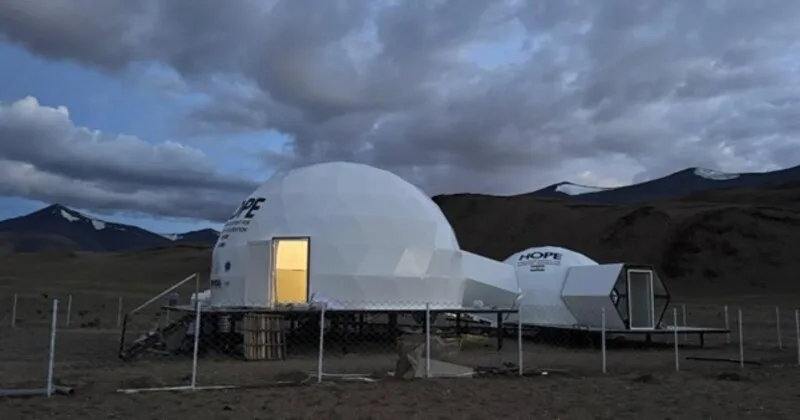
The HOPE installation contains a specially constructed analog habitat consisting of two interlinked modules, where a crew residential area of 8 metres in diameter and a service module of 5 metres is interlinked to work seamlessly. These modules are intended to copy conditions of a future planetary station by providing limited space, self-sustaining life support and rigorous workflow procedures.
For ten days from August 1-10, 2025, two analog crew members will reside within this module, performing a variety of scientific experiments and mission operations in a simulated environment of isolation, confined space and strict schedule . Tso Kar was chosen for its Martian and lunar analog mission conditions. The valley has high UV radiation, extreme cold, low atmospheric pressure and saline permafrost which is an optimum analog to simulate extraterrestrial environment. This enables ISRO to conduct legitimate ground-based testing of life-support technologies and crew adaptability.
Scientific Goals and Institutional Participation
HOPE is much more than an equipment test; it is an inter-disciplinary mission consisting of India’s finest research organizations. Participating institutions in this experimental program include IIST and RGCB, Trivandrum, IIT Bombay, IIT Hyderabad, Institute of Aerospace Medicine (IAM), Bengaluru. These institutions are carrying out seminal studies on genomic, epigenetic, physiological and psychological parameters. The goal is to determine how isolation, disrupted circadian cycles and enclosed spaces impact human biology and performance.
The analog mission also certifies health-monitoring systems and tests operational processes like sample acquisition, microbial control, emergency response and real-time data acquisition which will be the key elements of future crewed missions.
Industry Collaboration and Public-Private Participation
India’s changing space ecosystem has allowed the HOPE mission to involves private industry partner as a facilitator to ISRO in terms of logistics, infrastructure and mission implementation. This partnership is a pragmatic result of the government’s reforms in the space sector to enable more industry participation.
HOPE becomes a model of the government-private partnerships that can enhance space readiness. From the building of modules to data observation systems, this partnership is critical to developing scalable and modular technologies appropriate for long planetary missions.
During the inaugural session, Dr. V.Narayanan stressed that this analog mission is more than a simulation, rather it is a rehearsal for the future. He also mentioned the Hon’ble Prime Minister Shri Narendra Modiji’s visions where the space sector has been opened up to enable greater participation from Indian industry.
HOPE a short-term milestone for Gaganyaan
While HOPE is a part of India’s long-term goals for the Moon, it also has short-term uses for enhancing the Gaganyaan mission, the first Indian manned space mission to Low Earth Orbit (LEO). Here’s how:
1. Crew Health Policies: Evaluating wearable biometric sensors and autonomous medical diagnostics directly feeds into onboard systems in Gaganyaan’s crew module.
2. Confinement Information: Analyzing psychological reactions to isolation and confinement refines crew selection and training models for astronauts aboard on Gaganyaan.
3. Communication Systems: Simulated operations between mission control and the crew during HOPE develop effective communication and response systems.
4. Environmental Controls: Analog habitat provides a ground-based verification of life-support systems such as CO₂ scrubbing, recycling of oxygen and waste management that will be essential to the success of Gaganyaan.
5. Operational Readiness: Through execution of daily task timetables and drill, the analog mission simulates the endurance and performance limits relevant to orbital missions of short duration. HOPE complements Gaganyaan as a field lab, where actual-world data is employed to refine flight systems, crew procedures and mission protocols.
Long-duration spaceflight is as much a psychological test as a technological one. HOPE assists in answering important questions: How does a crew handle boredom? How do stress, fatigue, and fragmented sleep patterns influence judgment?
The psychological and emotional health of the analog crew is being tracked through ongoing assessment. This information is vital in the development of sound astronaut support systems, particularly for single-person or small-team missions where psychological resilience is a prime factor in the success of the mission.
Apart from human spaceflight, several of the technologies will be tested at HOPE, having practical applications in the real world. Portable health diagnostic equipment, remote communication networks, modular shelters and waste recycling equipment can be applied in India’s border regions, disaster relief camps and remote research stations.
A Roadmap to 2040: Moon and Beyond
India has already made a commitment to make a manned lunar landing possible by 2040. Missions such as HOPE construct the operational experience required for setting up semi-permanent bases on the Moon. It defines habitat architecture and crew autonomy to emergency evacuation and surface operations.
Analog missions also develop Indian-specific databases, Indian physiology under stress, how Indian diets affect metabolism in enclosed environments and how technology developed in India performs under stress. Such information is essential to developing sovereign human spaceflight systems.
HOPE is not merely a technical effort. It’s a symbol of confidence, capability and self-reliance with which a nation is aspiring to reach the stars. This endeavour reflects a change in how India plans to get ready for its space destiny, not only by machines but by prioritizing human experience and endurance. With every simulation, India is writing its own space exploration manual.
This ten-day analog mission began in Ladakh,on August 1, 2025. The larger impact of HSFC team which led the Ladakh Human Analog Mission (LHAM) in November, 2024 was groundbreaking. As well as this team partnered in the recently concluded ten-day Isolation Study ‘Anugami’ involving ISRO’s Gaganyatri in July, 2025. It is giving real-time responses to the multidimensional question that how do we prepare humans with hardware in space?
From supporting the near-term Gaganyaan programme to setting the stage for lunar missions, HOPE is a landmark moment in India’s space journey. It turns vision into strategy and dreams into preparation. One day, when Indian cosmonauts are walking on the Moon or maybe Mars, they will be carrying with them the lessons, that they first learned in the frozen emptiness of Tso Kar Valley. HOPE is where India’s path to the universe gets its ground on Earth.