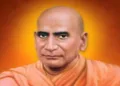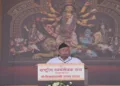





On Vijayadashami today, RSS Sarsanghchalak Dr Mohan Bhagwat recalled Swami Shraddhanand during his annual Vijayadashami address in Nagpur, noting that 100 years had passed since the Arya Samaj reformer, educationist and freedom fighter laid down his life. Dr Bhagwat emphasised the importance of remembering great personalities who sacrificed their lives to protect religion and society, highlighting Shraddhanand’s enduring legacy of service, social reform and national awakening.
Who was Swami Shraddhanand?
Swami Shraddhanand was born as Munshi Ram, also known as Lala Munshiram Vij, on February 22, 1856, in Talwan village in the Jalandhar district of Punjab. His father, Lala Nanak Chand, served as a police inspector under British rule.
Munshi Ram received his early education in Varanasi and later studied law in Lahore. He practised law before turning towards social and religious reform. His encounter with Swami Dayanand Saraswati, the founder of the Arya Samaj, proved decisive in shaping his outlook.
Initially sceptical of Dayanand’s teachings, Munshi Ram was deeply influenced by his emphasis on Vedic learning, social reform and intellectual courage. He subsequently joined the Arya Samaj and dedicated himself to its reformist mission.
In 1917, he formally embraced sannyasa and adopted the name Swami Shraddhanand. His transition from a legal career to religious and social service marked a significant turning point in his life.
Gurukul Kangri and the vision of indigenous education
Education was central to Swami Shraddhanand’s reform programme. He believed that education should develop character, discipline and a sense of national responsibility while remaining rooted in Indian traditions.
The Arya Samaj had established Dayanand Anglo-Vedic schools to combine modern learning with Vedic values. However, differences emerged within the movement over the role of Western education. Shraddhanand supported the traditional gurukul model, which emphasised residential education, moral discipline and learning rooted in Indian culture.
He established Gurukul Kangri near Haridwar in 1902. The institution became an important centre for indigenous education and cultural revival. Shraddhanand served as its first acharya, and his sons also studied there.
The gurukul reflected his conviction that Indians needed an education system capable of nurturing self-respect and preparing future generations for national service. Its subsequent development into a university extended the educational legacy of the initiative.
Role in India’s freedom struggle
Swami Shraddhanand’s work extended beyond education and religious reform. He actively participated in the national movement against British rule and opposed repressive colonial measures, including the Rowlatt Act.
The Jallianwala Bagh massacre of April 1919 intensified opposition to British rule across India. At a time when holding a Congress session in Amritsar was considered difficult, Shraddhanand supported the decision to convene the Indian National Congress there and presided over its session that year.
He also participated in protests against colonial repression in Delhi. Accounts of the period describe him confronting British forces during a protest at Chandni Chowk, demonstrating his willingness to stand between the authorities and demonstrators.
His participation in the freedom struggle reflected a broader understanding of national service: political independence, he believed, needed to be accompanied by social reform and the regeneration of Indian society.
A historic address at Jama Masjid
One of the most striking episodes associated with Swami Shraddhanand took place in 1922, when he addressed a gathering at Delhi’s Jama Masjid. He recited Vedic mantras before delivering his speech.
The event was remarkable in the political and religious climate of the time. It demonstrated his willingness to engage with audiences beyond his own religious community and brought together his commitment to Vedic traditions and public discourse.
Shraddhanand also wrote on religious and spiritual questions in Hindi and Urdu. Through his public speeches and writings, he sought to influence debates on religion, society and national identity.
Shuddhi movement and Hindu consolidation
Swami Shraddhanand became a prominent figure in the Shuddhi movement, which sought to bring people who had converted from Hinduism back into the Hindu fold. He regarded the movement as part of a wider effort to organise Hindu society and strengthen its social and religious institutions.
In the early 1920s, he expanded this work, particularly in parts of present-day Uttar Pradesh and Rajasthan, including Agra, Mathura and Bharatpur. In 1923, he became president of the Bharatiya Hindu Shuddhi Sabha and organised campaigns aimed at reconversion.
The movement emerged amid intense debates over religious identity, conversion and community mobilisation. It attracted support among sections of Hindu society but also generated opposition and heightened tensions between religious groups.
Shraddhanand’s role in Shuddhi became a defining aspect of his public life. His advocacy of Hindu consolidation brought him into conflict with opponents of the movement and placed him at the centre of contentious religious and political debates of the period.
A crusader against untouchability
Despite his emphasis on Hindu consolidation, Swami Shraddhanand also argued that Hindu society needed to address discrimination within its own ranks. He worked for the upliftment of communities subjected to untouchability and supported efforts to widen their access to education and religious institutions.
Dr B.R. Ambedkar recognised his contribution, describing him as “the greatest and most sincere champion of the Untouchables,” according to the historical account cited in contemporary discussions of Shraddhanand’s life.
Shraddhanand believed that social divisions weakened Hindu society and that reform required meaningful efforts to improve the position of disadvantaged communities. His work linked social equality with his broader vision of national and cultural renewal.
His support for temple-entry initiatives, including the Vaikom Satyagraha in Kerala, also reflected his opposition to exclusion based on caste.
Journalism, Hindi and women’s education
Swami Shraddhanand understood journalism as a means of spreading ideas, encouraging public debate and advancing social reform. He founded the Urdu newspaper Tej and the Hindi newspaper Arjun, using the press to discuss national, cultural and religious issues.
He also promoted Hindi written in the Devanagari script. His support for Indian languages was connected to his belief that education and public communication should reach wider sections of society.
Beyond journalism, he advocated women’s education and worked for the welfare of the poor. These efforts complemented his educational initiatives and his commitment to social reform.
His public life therefore combined religious advocacy with practical initiatives in education, publishing and community service.
Why was Swami Shraddhanand assassinated?
Swami Shraddhanand was assassinated in Delhi on December 23, 1926, while recovering from pneumonia. His work in the Shuddhi movement had placed him at the centre of increasingly contentious religious debates.
Historical accounts identify Abdul Rashid as his assassin. According to the reports, Rashid approached Shraddhanand’s residence on the pretext of discussing religious matters and shot him at close range.
His assassination sent shockwaves through the country. It was widely viewed in the context of the religious tensions surrounding conversion, reconversion and community mobilisation during the 1920s.
Nevertheless, the circumstances of Shraddhanand’s death became part of the wider debate over religious intolerance, freedom of expression and the consequences of escalating communal hostility in colonial India.
A legacy remembered by history
Swami Shraddhanand’s life brought together several strands of India’s early 20th-century public life: the freedom struggle, indigenous education, social reform, religious debate and Hindu consolidation.
His establishment of Gurukul Kangri gave institutional form to his educational vision. His journalism helped advance debates on language and national identity, while his work against untouchability demonstrated his concern with social inequality.
His association with the Shuddhi movement remains a contested part of his legacy, reflecting the wider tensions surrounding religious identity and conversion in colonial India. Yet his contribution to education, social reform and the national movement continues to make him a significant figure in modern Indian history.
Nearly a century after his assassination, Swami Shraddhanand remains remembered for the causes to which he dedicated his life. His story highlights both the reformist energies of the period and the dangers posed by religious intolerance and political violence.