India’s diverse social fabric often sees robust debates around policy initiatives, particularly those touching upon cultural, religious, and educational spheres. Over recent decades, various governments have introduced reforms aimed at fostering national integration, modernising societal structures, or ensuring uniform application of laws. Within this dynamic landscape, certain policy proposals have encountered significant opposition from segments of the Islamic community and their representative organisations, who often articulate concerns regarding the preservation of religious identity, traditional practices, or minority rights.
This report details ten cases where Islamic organisations opposed education or policy initiatives because they were seen as incompatible with Islamic moral principles.
Opposition to Zumba lessons in Kerala schools
In June 2025, several Islamic organisations in Kerala, including the Samastha Kerala Sunni Yuvajana Sangham (SYS), strongly opposed the introduction of co-educational Zumba sessions in schools. Their objections stemmed from concerns about modesty, appropriate attire, and a perceived conflict with Islamic moral values. Leaders from groups like the Wisdom Islamic Organisation voiced apprehension about potential pressure on students and teachers to participate, labelling the initiative “inappropriate” and, if made mandatory, even “vulgar.” In response, Kerala’s Education Department defended the programme, asserting that Zumba was a scientifically backed method for stress relief and drug prevention. They emphasised that sessions were conducted with students in school uniforms and were not intended to offend cultural or religious sentiments.
Protest against shifting students from unrecognised Madrasas
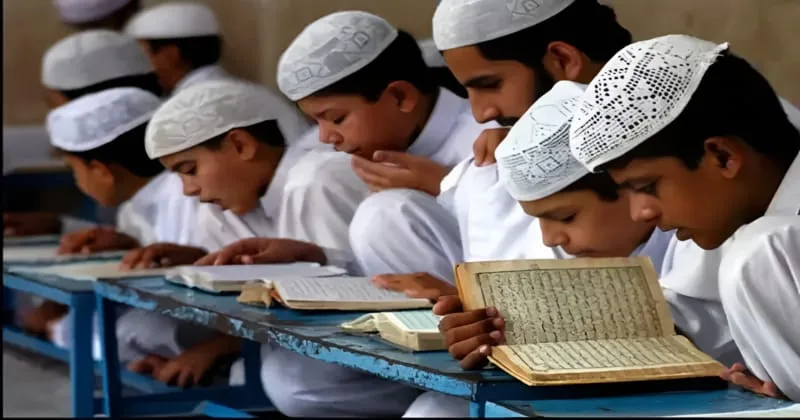
In July 2024, the Jamiat Ulama-e-Hind protested an order from the Uttar Pradesh administration. This order, issued in June 2024 following a letter from the NCPCR, mandated the transfer of all students from unrecognised madrasas, as well as non-Islamic students from government-aided madrasas, to mainstream schools. This directive was expected to affect approximately 7 lakh students across 8,500 madrasas. The influential Islamic organisation, led by Maulana Mahmood Asad Madni, demanded the withdrawal of the order, arguing it violated minority rights under Articles 29 and 30 of the Constitution, infringed upon religious freedoms, and incorrectly categorised modern madrasas as “unrecognised.”
Subsequently, the Supreme Court stayed the NCPCR’s directive, following petitions filed by Jamiat Ulama-e-Hind, thereby halting all related orders in Uttar Pradesh and other affected states, such as Tripura, and preserving the autonomy of approximately 1.7 million madrasa students.
Hijab controversy in Karnataka colleges
In February 2022, Islamic student groups, including the Campus Front of India (CFI), protested after several government Pre-University (PU) colleges in Karnataka denied entry to students wearing burqas and hijabs. This action followed interim orders from the Karnataka High Court, resulting in chaotic scenes, heightened security, and class disruptions in various districts, including Udupi, Shivamogga, Bijapur, and Kalaburagi. Islamic students firmly maintained their stance on wearing religious attire, asserting that the burqa was fundamental to their faith and refusing to remove it for entry. While some students were accommodated in separate rooms, others opted to stay away from classes entirely.
Opposition to yoga in schools
In November 2021, the All India Muslim Personal Law Board (AIMPLB) publicly rejected the government’s push to make yoga and Surya Namaskar compulsory in schools. The AIMPLB deemed these practices unconstitutional and incompatible with Islamic beliefs, particularly due to the element of sun worship embedded in Surya Namaskar. They launched a nationwide protest campaign, garnering support from secular allies and framing their opposition as a defense of religious freedom and minority rights. AIMPLB leaders contended that public schooling should remain secular and warned that enforcing such rituals threatened India’s pluralistic social fabric, signalling coordinated resistance across community and civil society groups.
Concerns over draft National Education Policy
In July 2021, Islamic student groups, including the Student Islamic Organisation, along with other student unions like the Student Federation of India, raised concerns that the Draft National Education Policy (NEP) was “against constitutional values.” They argued that the policy consolidated multiple agencies (RSA, NTA, NRF) under a single central authority, thereby undermining state autonomy and violating the constitutional division of educational powers under the federal structure. The policy was also criticised for its pro-market orientation, raising fears of privatisation and entrenched elitism. Opponents contended that the NEP lacked adequate safeguards for underprivileged groups, including marginalised children (SC/ST, refugees, and children in conflict), highlighting a significant gap in ensuring equitable access to education. Additionally, the NEP’s promotion of “Indian knowledge systems” was criticised for failing to represent the diversity of India’s cultural and religious traditions. Its language policy was also seen as overemphasising Hindi or Sanskrit without sufficient support for mother-tongue or regional languages, which critics claimed violated the spirit of Articles 29-35 of the Constitution.
Muslim clerics opposed Assam government’s decision to close state-run madrasas
In October 2020, Islamic clerics and madrasa officials in Assam voiced strong opposition to the state government’s decision to close all 614 government-run madrasas by November 2020. Assam’s education minister had announced the move, citing the unacceptability of funding religious education with taxpayer money within a secular education system. Prominent Muslim clerics and madrasa officials, such as Imam Mofidul Islam and retired Madrasa Board officer Md. Hasan Ali warned that these closures would abruptly disrupt the education of thousands of students who relied on these institutions for both religious and secular instruction. While the government planned to convert madrasas into secular state schools and reassign 148 contractual madrasa teachers to general schools, the clerics insisted that any curricular reforms should preserve religious teachings rather than eliminate them.
Islamic bodies in MP opposed move to teach patriotism in Madrasas
In April 2017, Islamic bodies in Madhya Pradesh, led by the Co-ordination Committee for Indian Muslims (CCIM), opposed a government initiative to introduce patriotism lessons exclusively in madrasas. They labelled the move as discriminatory and indicative of distrust toward the Islamic community. Leaders contended that patriotic education should be implemented across all schools, not just madrasas, to ensure fairness and uphold constitutional values. Major organisations including Jamaat-e-Islami Hind, Jamiat-ul-Ulama-e-Hind, AIMPLB, and IUML jointly condemned the proposal and demanded its immediate withdrawal.
Rajasthan clerics threaten school boycott over mandatory Surya Namaskar
In April 2015, approximately 120 Muslim clerics in Rajasthan, including members of Jamiat Ulama-e-Hind, issued a warning that they would advise students from their community to boycott classes if mandatory Surya Namaskar was not withdrawn. They characterised the practice as a religious imposition incompatible with Islamic beliefs. Clerical leaders, including Mohammed Hanif and Abdul Wahid Khatri, asserted that preserving religious identity took precedence over attending school. They also argued that government assurances portraying the practice as secular were misleading and unconvincing. A writ petition was subsequently filed in the Rajasthan High Court seeking to overturn the mandate, with a hearing scheduled for April 29. Meanwhile, officials dismissed the religious objections, insisting that Surya Namaskar was a neutral health practice and not a religious ritual.
Campus Front of India campaigns against FYUP
In June 2013, the Campus Front of India (CFI) launched a nationwide signature campaign across at least 20 universities, including Delhi University (DU), Jamia Millia Islamia, AMU, Calicut, Mumbai, and Bengaluru. The campaign’s objective was to demand the rollback of the controversial Four-Year Undergraduate Programme (FYUP) at DU. Initially focused in Delhi, CFI expanded the campaign to states such as Uttar Pradesh, Rajasthan, Bihar, West Bengal, Andhra Pradesh, Karnataka, Kerala, and Tamil Nadu, transforming a localised protest into a broader, student-driven nationwide resistance. CFI issued a direct warning: if the FYUP was not scrapped, they would escalate with large-scale protests, signalling a determined approach to pressure both DU authorities and the central government to reverse the scheme.
Madhya Pradesh Islamic leaders slam Surya Namaskar in schools
In January 2007, Islamic leaders in Madhya Pradesh, including the All India Muslim Personal Law Board (AIMPLB), criticised the mandatory Surya Namaskar in government schools. They asserted that it amounted to sun worship, a practice incompatible with their faith. They warned that even if participation was optional, it created peer pressure, fractured class cohesion, and sent a subtle message of religious exclusion, potentially fostering communal divides among students. State officials, however, contended that the practice was secular, optional, and part of a health-focused initiative linked to International Yoga Day, downplaying religious concerns and emphasising voluntary participation.
This compilation of ten incidents reveals a recurring theme: Islamic groups in Bharat have consistently opposed various education and policy initiatives due to perceived conflicts with Islamic moral values and concerns over religious freedom and cultural identity.
The objections raised span a wide range of issues, from the introduction of physical activities like Zumba and Yoga/Surya Namaskar, which were seen as incompatible with Islamic tenets or involving elements of sun worship, to dress codes like the hijab, deemed fundamental to religious practice. Furthermore, policy decisions such as the closure of state-run madrasas or the shifting of madrasa students to mainstream schools were met with strong resistance, often framed as violations of minority rights and infringements on religious autonomy. Concerns were also raised regarding proposed curricula, such as the introduction of patriotism lessons exclusively in madrasas, which was seen as discriminatory, and broader educational policies like the Four-Year Undergraduate Programme (FYUP) and the National Education Policy (NEP), which were criticised for undermining state autonomy, promoting privatisation, or failing to represent India’s diverse cultural and religious traditions.
Across these instances, the opposition highlights a tension between state-led educational reforms aimed at modernisation, secularisation, or national integration, and the desire of certain Islamic communities to preserve their religious and cultural distinctiveness within the educational framework. While government bodies often defended their initiatives as secular, health-focused, or promoting national values, Islamic groups frequently framed their resistance as a defense of constitutional rights, religious freedom, and the safeguarding of their community’s moral and educational values. This ongoing dialogue underscores the complex interplay of religion, culture, and state policy in India’s diverse educational landscape.