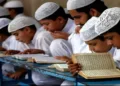
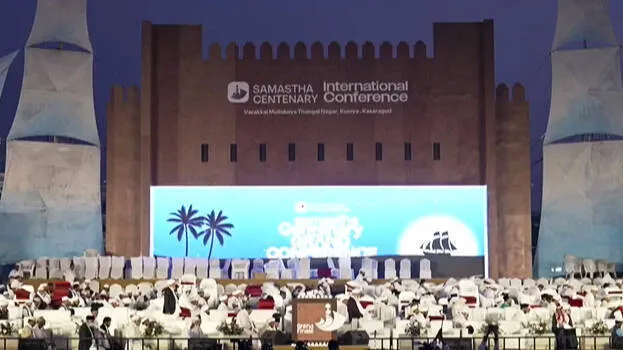
Samastha Kerala Jamiyathul Ulama, a Muslim organisation, has demanded three-day holidays for Muslim festivals. The resolution was passed on February 8 at its annual conference held in Kasargod, in connection with the centenary celebrations of the organisation.
The conference also asked the authorities to ensure that classes are not conducted during Juma hours. Juma hours are the religious term for the Friday afternoon hours; Calling it as injustice to run classes and examinations during the Juma hours. Timings of the examinations should be arranged, making sure that the Juma niskar (Friday prayers) is not disturbed. Samastha asked the government to do the needful in this respect. It also asked the government to fulfil the assurances given regarding madrasa timing.
The conference assessed that the existing one- or two-day holiday is not sufficient for the celebrations and religious rituals connected with the festivals. The holiday systems in Kerala are not enough for those who live abroad for jobs or education to spend time with their family members. It prevents them from refreshing their family links. Kerala should implement the ‘global pattern’ and the system followed by the Gulf countries, where lengthy holidays are provided during festivals. Three-day holidays should be declared for both Eid-al-Fitr and Eid-al-Adha. Classes during the Juma hours are injustice.
Significantly, the demand was reportedly aired in the presence of the CPM Chief Minister Pinarayi Vijayan and the Leader of the Opposition, a prominent Congress leader.
Recently, Samastha had passed a resolution demanding the reorganisation of the Muslim-majority district of Malappuram. The resolution stated that district organisation based on scientific studies is inevitable. It is necessary in view of the increasing population and challenges in administration. It is not an easy task to run the administration in Malappuram, a district with a population of 45 lakhs. And a declaration for a new district is essential for the smooth running of the administration and the equal distribution of resources; hence, the formation of new districts is essential.
Then Samastha ‘discovers’ that there are similar issues in Idukki, Ernakulam and Palakkad in view of the landscape and travel hardships. Samastha cited the example of Tamil Nadu, where 38 districts and 39 Parliament constituencies exist.
Even though the district reorganisation is presented in a sugar-coated manner, at the end of the day it is echoing the demands of other Muslim organisations. Some of them had even demanded the bifurcation of the state. The idea is to create Muslim-majority pockets here and there.
It should be remembered that the Muslim organisations have not opposed or denounced the demand of the outlawed Popular Front of India (PFI) to make Bharat an Islamic state by 2047.
The latest Samastha demand is presented as a classical example of Islamic forces’ pressure on the Communist regime. When Muslims reach a majority in number, they dictate the terms to the elected government, a notion that always proves to be correct, with new demands from Muslims in Malappuram district seeking no education classes and exams during the Islamic religious festival, and demanding a Middle Eastern Gulf countries pattern for Kerala Muslims.
It underlines that the religion is above education. The demand is projected as being of utmost importance as the Assembly election is imminent.