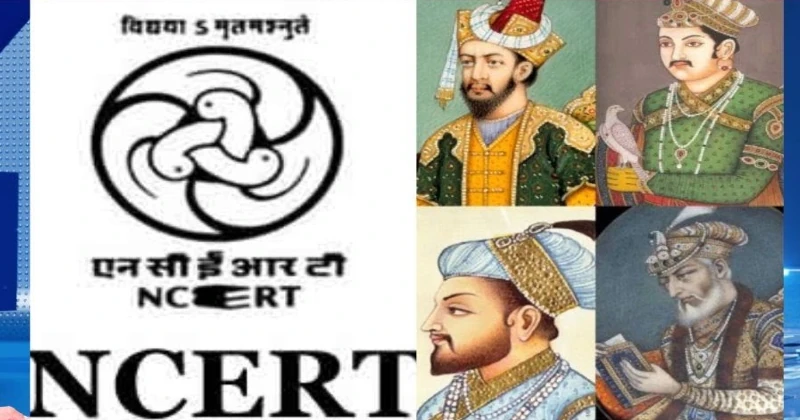
When the National Council of Educational Research and Training (NCERT) recently unveiled its newly revised Class 8 history textbook Exploring Society: India and Beyond, it triggered intense debate across the intellectual and political spectrum. At the heart of the revision lies a fundamental shift: the portrayal of Mughal rulers, once glorified as symbols of India’s “composite culture” is now more critical, based on primary sources and real historical accounts. While critics accuse the NCERT of pushing a ‘saffronised’ agenda, a closer examination reveals something else: a long-awaited correction of a selectively romanticised past. It is not about vilifying a dynasty or glorifying another. Rather, it is about removing filters that have hidden truths from generations of Indian students.
For decades, Indian history textbooks have been curated with a soft touch, particularly when dealing with the medieval Islamic rulers of Bharat. The Mughal Empire, in particular, was often presented as a progressive, tolerant, and artistically refined phase in Indian history. While these traits certainly existed, especially under emperors like Akbar they were never the whole truth.
The updated NCERT textbook is perhaps the first state-endorsed curriculum to acknowledge this. Babur is now introduced as a ‘brutal and ruthless conqueror’ who built towers of skulls after military victories and enslaved innocent civilians, a fact derived directly from his own memoir, the Baburnama. Akbar’s image is more nuanced. While his administrative reforms and relative religious tolerance are recognised, so are his military atrocities, such as the mass massacre at Chittorgarh in 1568 and the destruction of temples. Contrary to the oft-glorified narrative of Akbar as a tolerant and secular monarch, historical evidence presents a far more complex and at times, unsettling picture. A telling example lies in a Farman issued by Akbar in 1598, which explicitly lists 35 Hindu temples in Mathura and its surrounding regions. This document, now preserved in the National Archives of India, serves as a chilling reminder of the state’s watchful interference in Hindu religious life during the Mughal era.
[Source: Imperial Farmans (A.D. 1577 to A.D. 1085) granted to the Ancestors of His the Tikayat Mahara], Bombay, 1928]
Though not all temple records could be photographed by the research team of the International Association of the VRI, they did manage to capture an early copy of this Farman, along with a related version. The very existence of such an order raises serious questions about Akbar’s real intent—why would the emperor officially catalogue Hindu temples unless it was part of a broader imperial strategy? Many scholars argue that such listings often preceded either the imposition of restrictions, confiscations of temple lands, or outright destruction under the guise of imperial authority.
Aurangzeb, who in earlier textbooks was treated as just another ruler, is finally shown in the light of historical reality: an orthodox monarch who reimposed jizya tax on non-Muslims, banned Hindu festivals, and sanctioned the destruction of temples, including the iconic Kashi Vishwanath in Varanasi and the temple at Mathura. These are not ideological reinterpretations, they are historical facts. The silence around them for decades did more harm than good.
The problem with the older textbooks was not just omission but distortion. The romanticisation of the Mughal period helped create a fictional version of India’s past, one where bloodshed, religious persecution, and imperial authoritarianism were downplayed in favour of ornate architecture and court poetry. But history must be about truth, not convenience.
The new NCERT textbook doesn’t stop at laying out facts. It also includes a disclaimer: “No one should be held responsible today for events of the past.” This is not a call for communal resentment but for critical reflection. Students are encouraged to understand the motives, context, and consequences of decisions taken by rulers, without burdening present communities with ancestral guilt. This approach encourages a deeper understanding of history; one that is analytical, not emotional. British colonial historians often exaggerated Mughal tyranny to justify their own occupation. Ironically, post-independence historians, eager to construct a secular national narrative, overcorrected by whitewashing Mughal misdeeds and positioning them as symbols of Indo-Islamic harmony. The truth lies somewhere in between and it’s this balanced truth that students must learn.
The new curriculum under NCF-SE 2023 focuses on developing historical reasoning rather than memorisation. Students are encouraged to examine primary sources, assess evidence, and consider multiple perspectives. Rewriting the Mughal narrative to include both their achievements and atrocities is a part of this academic evolution. For centuries, the victims of imperial brutality the civilians massacred, the temples demolished, the communities taxed and marginalised have had no voice in official narratives. This revision brings their stories into classrooms, giving students a more complete picture of the past. Indian history as taught in schools has been disproportionately focused on dynasties particularly the Delhi Sultanate and the Mughals. The contributions of indigenous rulers like the Ahoms, Cholas, Vijayanagara kings, Rajputs, Marathas, and tribal leaders have often been overshadowed. Revising the Mughal narrative is also a way to restore balance and broaden the scope of historical inquiry. Unsurprisingly, the textbook revision has faced backlash. Critics argue that this is part of a ‘Hindu nationalist’ project aimed at demonising Muslim rulers. However, this criticism misses the larger academic point: history should not be written to comfort sensibilities. The same critics who once celebrated the “decolonising” of syllabi are now upset that their own biases are being corrected.
We must ask: Is it communal to tell students that Babur built towers of skulls, as he himself claimed? Is it ideological to mention that Akbar’s army slaughtered thousands at Chittorgarh? Is it revisionism to show Aurangzeb’s anti-Hindu policies? Or is it simply honesty? If facts disturb our sense of identity, then perhaps we have built our identity on myths.
This new approach signals that Indian education is finally ready to graduate from the politics of narrative control to the ethics of truth-telling. The NCERT has not merely “rewritten history” it has recalibrated it. Moreover, the revised textbook does not promote hate or division. On the contrary, it provides an opportunity for students to reflect on how ambition, ideology, and power have always shaped rulers’ decisions, whether Hindu, Muslim, or British. It teaches young minds to recognise that history is not about binaries, but about understanding.
The real measure of a nation’s maturity is not in how it glorifies its past, but in how truthfully it confronts it. NCERT’s textbook revision, especially in the context of the Mughal Empire, marks a turning point in Indian historiography. It doesn’t seek to erase the past, but to unmask it. For the first time in a long time, students will not just read about what emperors built, but also what they broke. They will not only know how Bharat was ruled but at what cost. This is not about Hindu or Muslim, left or right, rather this is about truth. And the classroom is where that truth must begin.
In the years following Independence, a distorted narrative took root in the collective consciousness, one that suggested Bharat could not have progressed without the intervention of foreign powers. This misleading perspective led many to admire those very forces that had once inflicted immense suffering upon our ancestors, including acts of violence and exploitation. It is now imperative that we confront and reassess these inherited narratives. The time has come to understand the true legacy of the Mughals; not through romanticised accounts, but through a lens grounded in historical truth and national dignity.