India fight against red terror: Transforming conflict zones
July 7, 2026
  • Read Ecopy
  • Circulation
  • Advertise
  • Careers
  • About Us
  • Contact Us
Android AppiPhone AppArattai
Organiser
  • ‌
  • Bharat
    • Assam
    • Bihar
    • Chhattisgarh
    • Jharkhand
    • Maharashtra
    • View All States
  • World
    • Asia
    • Europe
    • North America
    • South America
    • Africa
    • Australia
  • Editorial
  • International
  • Opinion
  • RSS @ 100
  • More
    • Op Sindoor
    • Analysis
    • Sports
    • Defence
    • Politics
    • Business
    • Economy
    • Culture
    • Special Report
    • Sci & Tech
    • Entertainment
    • G20
    • Azadi Ka Amrit Mahotsav
    • Vocal4Local
    • Web Stories
    • Education
    • Employment
    • Books
    • Interviews
    • Travel
    • Law
    • Health
    • Obituary
  • Subscribe
    • Subscribe Print Edition
    • Subscribe Ecopy
    • Read Ecopy
  • ‌
  • Bharat
    • Assam
    • Bihar
    • Chhattisgarh
    • Jharkhand
    • Maharashtra
    • View All States
  • World
    • Asia
    • Europe
    • North America
    • South America
    • Africa
    • Australia
  • Editorial
  • International
  • Opinion
  • RSS @ 100
  • More
    • Op Sindoor
    • Analysis
    • Sports
    • Defence
    • Politics
    • Business
    • Economy
    • Culture
    • Special Report
    • Sci & Tech
    • Entertainment
    • G20
    • Azadi Ka Amrit Mahotsav
    • Vocal4Local
    • Web Stories
    • Education
    • Employment
    • Books
    • Interviews
    • Travel
    • Law
    • Health
    • Obituary
  • Subscribe
    • Subscribe Print Edition
    • Subscribe Ecopy
    • Read Ecopy
Organiser
  • Home
  • Bharat
  • World
  • Operation Sindoor
  • Editorial
  • Analysis
  • Opinion
  • Culture
  • Defence
  • International Edition
  • RSS @ 100
  • Magazine
  • Read Ecopy
Home Bharat

India takes final steps to end Maoist insurgency

India’s battle against red terror has entered its most decisive and transformative phase. With coordinated operations, socio-political outreach, and robust infrastructure, the government is turning conflict zones into corridors of governance

Bagmita Borthakur and Bishaldeep KakatiBagmita Borthakur and Bishaldeep Kakati
Jul 13, 2025, 06:00 pm IST
in Bharat, Opinion
Follow on Google News
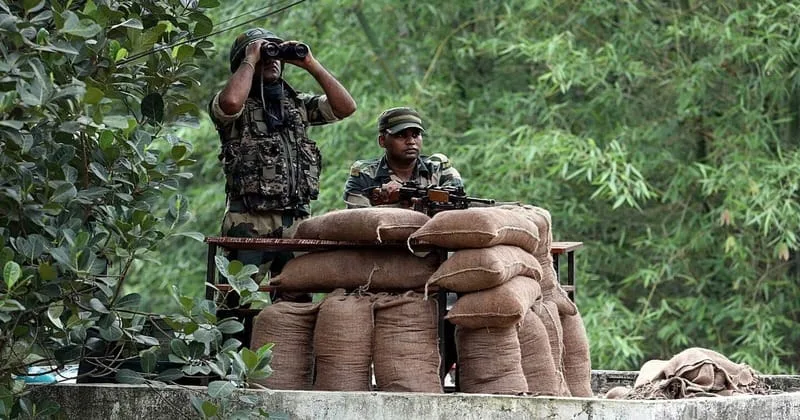
Representative image

Representative image

FacebookTwitterWhatsAppTelegramEmail

India’s fight against red terror is no longer a slow-burning internal conflict; it has become a mission of national reclamation. What was once a protracted security dilemma rooted in socio-economic neglect has now entered its final, most decisive phase. The Modi government formulated a blend of strategic precision with grassroots socio-political outreach to dismantle decades-old insurgent networks.

The transformation is unprecedented; strongholds of Maoist influence are collapsing under the weight of coordinated security operations, intelligence-driven strategy and strong political will. What used to be the Red Corridor of rebellion is now being systematically reclaimed, district by district, hill by hill, and mind by mind.

Also Read: From Palm Leaves to Pixels: Gyan Bharatam Mission set to digitise 50 crore pages of Indian manuscript treasure

The anti-maoist mission of the government is no longer about containment but more about closure. In 2014, India had 126 Maoist-affected districts, with 35 severely impacted. As of 2025, that number has dropped to 18, with only 6 districts classified as critically affected. This sharp territorial contraction reflects the success of the government’s integrated approach.

The reduction is credited to a multi-pronged doctrine executed by the Union Home Ministry that prioritises continuous operations, intelligence sharing, and developmental engagement. In terms of human cost, civilian casualties have dropped from 71 in 2024 to 20 in 2025, showing how the anti-maoist mission is becoming not only more effective but also more precise. The turning point in India’s fight against red terror came in 2025, with a series of anti-maoist operations. Among them, Operation Kagar was the most strategic. Conducted over just 50 hours in May 2025, the operation neutralised 27 Maoists, including Basavaraju, the General Secretary of CPI (Maoist), carrying a bounty of Rs 1.5 crore. Basavaraju’s elimination was hailed as a “landmark achievement,” given his role in orchestrating over 170 attacks and receiving training from international insurgent groups.

Equally decisive and precise was Operation Sankalp, launched in Chhattisgarh in April 2025. It involved over 24,000 security personnel and resulted in the killing of 26 Maoists and the destruction of hundreds of bunkers. More than 400 IEDs and two tonnes of explosives were seized, crippling the Maoist logistical backbone in the region.

At the Karreguttalu Hills, situated on the Chhattisgarh–Telangana border, 31 Maoists, including 16 women, were eliminated in the largest coordinated assault on a Maoist command hub in history. The operation lasted 21 days, culminating in the seizure of over 800 explosive devices and the symbolic raising of the national flag where red terror once ruled. Apart from these, in 2025 alone, 584 Naxals were arrested or surrendered, while 192 were killed, and 606 weapons and 916 IEDs were seized.

The government’s steady, consistent approach has been key to this success. It enhanced security infrastructure, expanded rural connectivity and linked welfare initiatives with ground-level law enforcement to address root causes and restore civilian trust. In multiple public addresses, Union Home Minister Amit Shah reaffirmed, “The country will be free from Maoism by March 31, 2026.” The mission has been built not merely on counterinsurgency but on consolidation in terms of reclaiming territory, embedding governance, and replacing fear with functionality. The fundamentals of the current anti-red terror operation are not just about combative efficiency but also about comprehensive scope. The government aimed at security reinforcement, intelligence modernisation, and social reintegration.

While these operations delivered tactical victories, the long-term breakthrough stems from parallel institutional reforms. Security infrastructure has seen a quantum leap, as the number of fortified police stations has jumped from 66 in 2014 to 612 in 2025. Additionally, 320 forward camps and 68 night-landing helipads have been established in remote, high-risk zones, enabling rapid deployment and 24/7 mobility. These enhancements have significantly reduced casualties among security personnel, reflecting improved preparedness and operational resilience.

Simultaneously, intelligence coordination has improved dramatically. A specialised multi-agency task force now deploys real-time analysis from drone surveillance, satellite imaging, and ground informants to pre-empt insurgent activity. This technological edge has helped dismantle Maoist stockpiles, bypass IED traps, and eliminate key commanders with minimal loss. Moreover, the government is equally committed to integration-based operations like Operation Cheyutha, a welfare-led surrender initiative in Telangana. By offering economic incentives and community rehabilitation, the government is on its mission of shrinking the recruitment base of the insurgent groups.

The surrender initiative reflects a shift towards disarmament with a human-centric approach. It targets the top Maoist leaders, with the aim to strike at the core of the issue, and emphasises grassroots rehabilitation. Therefore, by combining boots on the ground with bridges to society, the government is ensuring that red terror is not just defeated by force but dismantled both socially and psychologically.

India’s final battle against Maoism is not just unfolding in remote jungles but is being etched into the country’s evolving internal security legacy. With the data on hand, it is clear that India’s fight against red terror is no longer a defensive war but is the final offensive one. With major operations completed, infrastructure in place, and a clear political mandate, the nation is poised to close a long chapter of internal strife. However, the road ahead still calls for vigilance, especially in transitioning insurgent regions into stable spaces. For a generation scarred by insurgency, the establishment of good governance is the ultimate victory, and in that journey, the Union Home Ministry under the leadership of Shah remains both the architect and anchor.




Topics: internal securityOperation SankalpOperation KagarRed CorridorMaoism
ShareTweetSendShareSend
✮ Subscribe Organiser YouTube Channel. ✮
✮ Join Organiser's WhatsApp channel for Nationalist views beyond the news. ✮
Previous News

India faces new security threats from Bangladesh under Yunus regime

Next News

“No controversy in voter revision drive, ECI running campaign with good intentions”: BJP leader Shahnawaj Hussain

Related News

President Droupadi Murmu confers the Padma Shri on former civil servant R.V.S. Mani on June 23, 2026.

Former MHA official RVS Mani honoured with Padma Shri for contributions to internal security

Prime Minister Narendra Modi

‘Maoism is breathing its last’: PM Modi highlights crackdown on red terror in last 12 years and growth in tribal areas

Shri J. Shri Nandakumar,
Dr Rahul Shastri, Shri SM Rama Mohan (Left to Right)

Cultural Marxism, Maoist networks, narco menace pose emerging threats: Speakers at Samvit Kendra seminar in Hyderabad

Odisha Police Director General of Police Y.B. Khurania addressing media persons

Odisha: The state gains maoist-free tag; Vigilance intensified along Jharkhand border to thwart resurgence

After the fall of Maoism, India faces a new security challenge in tackling illegal immigration across its borders

From Maoism to Migration: India’s next big internal security challenge lies in illegal immigration

Representative Image

From Insurgency to Elimination: India’s strategy against Maoist violence

Load More

Latest News

Shri Ram Janmabhoomi Teerth Kshetra Trust accepts resignation on moral grounds; SIT submits interim report

Ayodhya Ram Mandir Donation Row: Trust accepts resignations, promises greater transparency; SIT submits interim report

Nida Khan one of the accused in Nashik TCS Corporate Jihad Case gets bail

Nashik TCS Corporate Jihad Case: Court grants bail to Nida Khan in conversion and sexual harassment case

Karnataka State BJP files complaint with Election Commission over irregularities in voter verification

Karnataka SIR Row: NDA submits documentary evidence to Election Commission, alleges irregularities in voter revision

Hindenburg report was a conspiracy to tarnish the image of India’s industrial sector using the Adani Group as a pretext

Battlefield to Top of the World: Indian Paralympian Hokato Hotozhe Sema becomes No.1 in shot put F57 category

Editor of Organiser Weekly Prafulla Ketkar and West Bengal Governor R N Ravi at the Narad Jayanti Udjapan & Narad Samman 2026

Whether my reporting is in the interest of nation or not is a litmus test for journalist: West Bengal Governor R N Ravi

POJK Protests: A reality check on atrocities committed by Pakistan

117 pseudo-intellectuals write to PM Modi to extend diplomacy with Pakistan at the cost of national security

80 years of Organiser: Enduring voice

PM Modi and Australian PM Anthony Albanese

Powering India’s Nuclear Future: PM Modi’s Australia visit brings the landmark Uranium deal into focus

Load More
  • Privacy
  • Terms
  • Cookie Policy
  • Refund and Cancellation
  • Delivery and Shipping

© Bharat Prakashan (Delhi) Limited.
Tech-enabled by Ananthapuri Technologies

  • Home
  • Search Organiser
  • Bharat
    • Assam
    • Bihar
    • Chhattisgarh
    • Jharkhand
    • Maharashtra
    • View All States
  • World
    • Asia
    • Africa
    • North America
    • South America
    • Europe
    • Australia
  • Editorial
  • Operation Sindoor
  • Opinion
  • Analysis
  • Defence
  • Culture
  • Sports
  • Business
  • RSS @ 100
  • Entertainment
  • More ..
    • Sci & Tech
    • Vocal4Local
    • Special Report
    • Education
    • Employment
    • Books
    • Interviews
    • Travel
    • Health
    • Politics
    • Law
    • Economy
    • Obituary
  • Subscribe Magazine
  • Read Ecopy
  • Advertise
  • Circulation
  • Careers
  • About Us
  • Contact Us
  • Policies & Terms
    • Privacy Policy
    • Cookie Policy
    • Refund and Cancellation
    • Terms of Use

© Bharat Prakashan (Delhi) Limited.
Tech-enabled by Ananthapuri Technologies