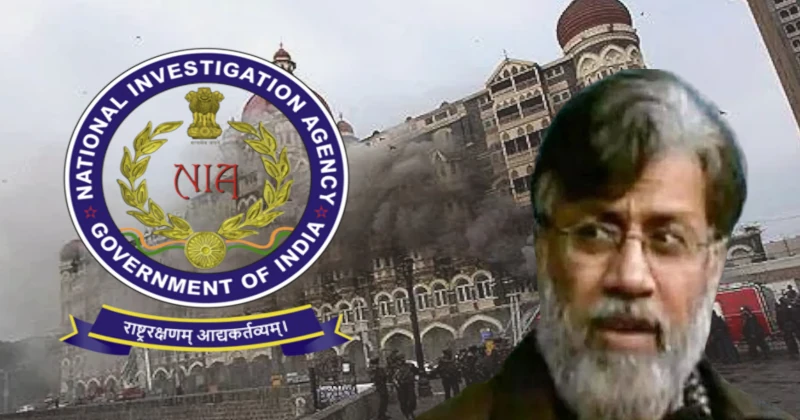
Tahawwur Hussain Rana, a key conspirator behind the 26/11 Mumbai terror attacks, has confessed to Indian authorities that he was physically present in Mumbai during the 2008 carnage. In his damning admission, Rana also declared himself to be a trusted agent of the Pakistani Army and confirmed that the attack was executed with full knowledge and involvement of Pakistan’s Inter-Services Intelligence (ISI) and the Lashkar-e-Taiba (LeT).
The confessions, sourced from top Mumbai Crime Branch and National Investigation Agency (NIA) officials, were made during Rana’s interrogation while in custody at Tihar Jail, Delhi. Rana had been extradited from the United States in April 2025, following the dismissal of his review petition by the U.S. Supreme Court. He is currently under judicial custody and is being grilled in connection with NIA case RC-04/2009/NIA/DLI, related to conspiracy, terrorism, murder, and forgery.
Sources told media, that Rana made chilling admissions to Mumbai police officials. He stated unequivocally that he worked closely with the Pakistani Army and was instrumental in setting up espionage and terror logistics for the 26/11 plot.
According to Rana’s confession, he had visited Chhatrapati Shivaji Maharaj Terminus (CSMT) and other potential targets ahead of the attacks, posing as part of his immigration business operations. He revealed that opening a branch of his U.S.-based immigration firm in Mumbai was a tactical decision meant to provide cover for reconnaissance. These activities were funded through business expense claims, thus camouflaging terror-linked logistics under the pretext of legitimate corporate operations.
Rana, a Pakistani-origin Canadian national, has admitted to multiple training sessions conducted by Lashkar-e-Taiba (LeT) inside Pakistan, along with his close friend and fellow conspirator David Coleman Headley. He confessed that LeT functioned not just as a terrorist organisation but also as a sophisticated spy network, gathering strategic intelligence across South Asia and beyond, often in concert with the ISI.
Rana’s testimony confirms that he and Headley coordinated extensively with LeT handlers, providing them with reconnaissance data, maps, and communication infrastructure. He also acknowledged his presence in India at the time of the 26/11 attacks and admitted that this was part of the LeT’s plan to have handlers and informants on the ground to assist the attackers.
In another significant disclosure, Rana claimed that he was earlier deployed by the Pakistani Army to Saudi Arabia during the Khaleej War, indicating that his association with the Pakistan Army’s deep state machinery goes back decades. This adds another layer to the complex nexus of jihadist networks, state-sponsored terrorism, and intelligence warfare spanning continents.
Rana’s extradition was a diplomatic victory for India. After sustained pressure from the Indian government, including a strong plea from Prime Minister Narendra Modi during his U.S. visit earlier this year, the Biden administration approved Rana’s extradition.
Following his arrival in India, Solicitor General Tushar Mehta led a high-powered legal team formed by the Centre to prosecute Rana. The team includes Additional Solicitor General SV Raju, senior advocate Dayan Krishnan, and lawyer Narendra Mann. They are building the case on solid intelligence, confessional evidence, and documentary trails connecting Rana to RC-04/2009/NIA/DLI, one of India’s most critical anti-terror cases.
On November 26, 2008, ten LeT terrorists landed on Mumbai’s shores via the sea route from Karachi, unleashing a 60-hour siege on India’s financial capital. The attacks claimed 166 lives and injured more than 300, leaving behind a scar that continues to haunt the nation.
From the Taj Mahal Palace Hotel and Oberoi Trident, to the bustling Leopold Café, CSMT, and the Jewish Chabad House at Nariman Point, the city of dreams was transformed into a warzone. Among the martyrs and victims were security personnel, foreign tourists, and ordinary Mumbaikars. The only terrorist captured alive, Ajmal Amir Kasab, later confirmed that the plan was hatched in Pakistan and executed with military precision, trained by LeT and supported by ISI handlers.
Now, nearly 17 years later, the circle is closing in. Rana’s confession corroborates earlier intelligence inputs from Kasab and Headley and further substantiates India’s long-standing allegation of state-sponsored terrorism emanating from Pakistan.
With this confession, the Mumbai Police are preparing to formally arrest Tahawwur Rana. A detailed interrogation log, along with Rana’s testimony, is expected to form the backbone of a fresh chargesheet. This could potentially open the door to renewed international diplomatic pressure on Pakistan to account for its role in exporting terror.
India has also escalated efforts to revive pending dossiers with global bodies like the UN Security Council, Financial Action Task Force (FATF), and Interpol, to ensure Pakistan is held accountable for enabling terror on foreign soil.