K-6 Hypersonic Missile of India nears launch; 8000 KM strike range
July 9, 2026
  • Read Ecopy
  • Circulation
  • Advertise
  • Careers
  • About Us
  • Contact Us
Android AppiPhone AppArattai
Organiser
  • ‌
  • Bharat
    • Assam
    • Bihar
    • Chhattisgarh
    • Jharkhand
    • Maharashtra
    • View All States
  • World
    • Asia
    • Europe
    • North America
    • South America
    • Africa
    • Australia
  • Editorial
  • International
  • Opinion
  • RSS @ 100
  • More
    • Op Sindoor
    • Analysis
    • Sports
    • Defence
    • Politics
    • Business
    • Economy
    • Culture
    • Special Report
    • Sci & Tech
    • Entertainment
    • G20
    • Azadi Ka Amrit Mahotsav
    • Vocal4Local
    • Web Stories
    • Education
    • Employment
    • Books
    • Interviews
    • Travel
    • Law
    • Health
    • Obituary
  • Subscribe
    • Subscribe Print Edition
    • Subscribe Ecopy
    • Read Ecopy
  • ‌
  • Bharat
    • Assam
    • Bihar
    • Chhattisgarh
    • Jharkhand
    • Maharashtra
    • View All States
  • World
    • Asia
    • Europe
    • North America
    • South America
    • Africa
    • Australia
  • Editorial
  • International
  • Opinion
  • RSS @ 100
  • More
    • Op Sindoor
    • Analysis
    • Sports
    • Defence
    • Politics
    • Business
    • Economy
    • Culture
    • Special Report
    • Sci & Tech
    • Entertainment
    • G20
    • Azadi Ka Amrit Mahotsav
    • Vocal4Local
    • Web Stories
    • Education
    • Employment
    • Books
    • Interviews
    • Travel
    • Law
    • Health
    • Obituary
  • Subscribe
    • Subscribe Print Edition
    • Subscribe Ecopy
    • Read Ecopy
Organiser
  • Home
  • Bharat
  • World
  • Operation Sindoor
  • Editorial
  • Analysis
  • Opinion
  • Culture
  • Defence
  • International Edition
  • RSS @ 100
  • Magazine
  • Read Ecopy
Home International Edition News

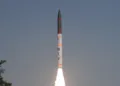
K-6 missile nears completion: India prepares 8000 km hypersonic ballistic missile to precisely strike multiple targets

India is on the brink of completing its most advanced submarine-launched ballistic missile, the K-6, capable of hypersonic speeds and intercontinental range. Designed to bolster the country’s naval nuclear deterrent, the missile marks a major leap in indigenous defence technology

Dr Vishnu AravindDr Vishnu Aravind
Jun 28, 2025, 09:30 am IST
in News, Bharat, World, Defence, International Edition
Follow on Google News
K-6 Missile Breakthrough: India Readies 8000 km Hypersonic Strike Arsenal

K-6 Missile Breakthrough: India Readies 8000 km Hypersonic Strike Arsenal

FacebookTwitterWhatsAppTelegramEmail

India is nearing the final stages of developing its indigenously built submarine-launched hypersonic ballistic missile, the K-6 (Kalam-6). The missile, which can travel at 7.5 times the speed of sound, approximately 9,261 kilometres per hour, is being developed under the aegis of the Defence Research and Development Organisation (DRDO). Unlike its predecessors, the K-4 and K-5, the K-6 is an intercontinental ballistic missile (ICBM) and is expected to be tested by 2030.

The K-6 has an estimated strike range of up to 8,000 km and is capable of carrying both conventional and nuclear warheads. It is set to become a state-of-the-art asset and the backbone of India’s naval nuclear deterrent. Designed as a submarine-launched ballistic missile (SLBM), the project is being spearheaded by the Advanced Naval Systems Laboratory (ASL) in Hyderabad, which operates under the DRDO.

Read More: DRDO Unveils Next-Gen Weapons: What new systems India will deploy from next year to boost army power amid Sino-Pak ties

The missile project began in 2017 and has achieved significant progress in just eight years, reflecting India’s rapid technological advancement, especially in the context of China’s growing presence in the Indian Ocean. China’s JL-3 SLBM, with a range of 9,000 km, has pushed India to enhance its defensive and offensive capabilities.

Given its hypersonic velocity, the K-6 can penetrate most existing missile defence systems. Like the Agni-5 missile, it features Multiple Independently Targetable Re-entry Vehicle (MIRV) technology, which allows it to strike multiple targets in a single launch. This MIRV capability, developed indigenously by India, significantly increases the missile’s lethality and reduces the need for multiple launches. India now joins an elite group of countries, namely the US, Russia, China, France and the UK, that possess MIRV technology.

A key advantage of the K-6 is its ability to strike from underwater at a safe standoff distance. It is a three-stage, solid-fuel missile measuring 12 metres in length and two metres in diameter, with a payload capacity of up to 3,000 kg.

However, India’s current fleet of nuclear submarines cannot accommodate the larger K-6 missile. As a result, India is simultaneously developing a new class of indigenous nuclear-powered submarines, codenamed the S-5. These submarines will be capable of carrying 16 K-6 missiles simultaneously and will be significantly heavier than the existing Arihant-class submarines, with an estimated displacement of 13,000 tons.

The S-5 class submarines will be powered by a 190 MW reactor designed by the Bhabha Atomic Research Centre, more than double the 83 MW reactors currently used in the Arihant class. Design and planning for the new submarines are nearly complete, with construction expected to begin by 2027. These vessels are projected to join the Indian Navy by 2030. The steel for the submarines will be supplied by the Steel Authority of India, and the submarines will feature advanced stealth capabilities.

With the K-6, India strengthens its nuclear triad, the ability to launch nuclear weapons from land, air, and sea. The K-6 is the fastest SLBM currently under development anywhere in the world. The K-series missiles represent an advanced evolution of India’s Agni missile programme. Compared to the Agni series, K-series missiles are faster, lighter, and possess superior radar-evading capabilities. All systems, including navigation, have been developed indigenously.

The K-6 has an accuracy range of within 90 to 100 metres of its target, making it one of the most precise strategic weapons in India’s arsenal.

India currently possesses the following missiles in the K-series, K-4, with a range of 3,500 km and K-5, with a range of 5,000 to 6,000 km. The K-6, once inducted, will mark a quantum leap in India’s strategic deterrent capabilities and cement its position as a formidable naval nuclear power.

Topics: Kalam-6DRDODefence Research and Development OrganisationK-6 missileHypersonic ballistic missile
ShareTweetSendShareSend
✮ Subscribe Organiser YouTube Channel. ✮
✮ Join Organiser's WhatsApp channel for Nationalist views beyond the news. ✮
Previous News

CBSE to hold two board exams a year for class 10 from 2026; main exam in Feb, optional in May

Next News

Changes in ICC Cricket Rules: Stop clock to use of saliva to ball changes, game changer across all formats

Related News

DRDO successfully tests Pinaka long-range guided rocket

What Is Pinaka LRGR? DRDO successfully tests long range guided rocket

DRDO successfully tests Long-Range Precision Missile

India’s ‘Tomahawk’ Takes Flight: DRDO successfully tests long-range precision cruise missile

DRDO, IAF successfully flight-test indigenous RudraM-II air-to-surface missile

DRDO, IAF conduct successful RudraM-II Missile trials under extreme conditions, boosting India’s defence self-reliance

Bangladesh’s reported JF-17 push has triggered fresh scrutiny after India’s Ops Sindoor exposed the vulnerabilities of Pakistani-Chinese defence systems and precision strike capabilities

Shadows of Operation Sindoor: Questions loom over Bangladesh’s JF-17 ambitions amid Sino-Pakistani tech vulnerabilities

National Executive Council Meeting of the ABVP in Bhubaneswar

ABVP National Executive Council Meeting: ABVP calls for industry-academia partnership to boost research ecosystem

DRDO Virupaksha Radar is stealth-hunting eye in the Indian sky

Virupaksha AESA Radar: DRDO’s high-power GaN system to replace legacy bars Radar on Su-30MKI fleet

Load More

Latest News

Seva Bharati Purvanchal, Barpeta District Committee has launched the district's first completely free coaching programme for the National Eligibility-cum-Entrance Test (NEET)

Barpeta witnesses’ landmark in educational inclusion: Seva Bharati launches 1st completely free NEET coaching programme

Representatives of the civil society members addressing the media

14 Manipur civil society groups demand NRC update before 2027 Census; Meet top MHA officials in Delhi

Dignitaries on the stage on the occasion of 90 years of Rashtra Sevika Samiti and celebration of birth anniversary of its founder Lakshmibai Kelkar

Lakshmibai Kelkar Birth Anniversary | The need is not to give strength to women but to awaken it: Alka Inamdar

UP transformed from an electricity-deficient state to a model of household electrification and power reforms over the past decade

Ten Years of Power Reforms in UP: How electricity schemes transformed the state’s energy landscape

A representative image

Poshan Tracker: How India’s real-time nutrition monitoring platform is transforming nutrition governance

Melbourne [Australia], Jul 09 (ANI): Prime Minister Narendra Modi and Australian Prime Minister Anthony Albanese exchange a handshake, in Melbourne on Thursday. (@narendramodi X/ANI Photo)

India, Australia launch new era of strategic cooperation with uranium pact

ABVP's National General Secretary Dr Virendra Singh Solanki hoisted the flag at ABVP Lucknow Office on occasion of National Students' Day

ABVP’s 78th Foundation Day: World’s largest student organisation reaffirms its commitment to service & nation-building

T. Satisan speaks. L/R: E.N. Nandakumar, K.G. Venugopal, Adv. K. Ramkumar, Kummanam Rajasekharan and Sunil Vadayar

Keralam: RSS karyakartas in Kochi remember Emergency, honour anti-Emergency struggle veterans

Hindu Munnani protesting against the temple demolition move

Tamil Nadu: Hindu Munnani protests Rajakaali Amman Temple demolition in Ramanathapuram, alleges TVK is targeting Hindus

A representative image

How India turned a toy import crisis into a 152 Million US dollar trade surplus: Inside the Toy Story

Load More
  • Privacy
  • Terms
  • Cookie Policy
  • Refund and Cancellation
  • Delivery and Shipping

© Bharat Prakashan (Delhi) Limited.
Tech-enabled by Ananthapuri Technologies

  • Home
  • Search Organiser
  • Bharat
    • Assam
    • Bihar
    • Chhattisgarh
    • Jharkhand
    • Maharashtra
    • View All States
  • World
    • Asia
    • Africa
    • North America
    • South America
    • Europe
    • Australia
  • Editorial
  • Operation Sindoor
  • Opinion
  • Analysis
  • Defence
  • Culture
  • Sports
  • Business
  • RSS @ 100
  • Entertainment
  • More ..
    • Sci & Tech
    • Vocal4Local
    • Special Report
    • Education
    • Employment
    • Books
    • Interviews
    • Travel
    • Health
    • Politics
    • Law
    • Economy
    • Obituary
  • Subscribe Magazine
  • Read Ecopy
  • Advertise
  • Circulation
  • Careers
  • About Us
  • Contact Us
  • Policies & Terms
    • Privacy Policy
    • Cookie Policy
    • Refund and Cancellation
    • Terms of Use

© Bharat Prakashan (Delhi) Limited.
Tech-enabled by Ananthapuri Technologies