No matter how much the Congress and the Indian alliance pretend to be the protectors of the Constitution to garner votes, the public has recognised the truth. This is the same Congress that violated the Constitution in 1975 by declaring an emergency, amended it more than 90 times, changed the Preamble of the Constitution, passed the Waqf Board Act in opposition to Dr Babasaheb Ambedkar’s vision for the Constitution, rejected the Uniform Civil Code, established the National Advisory Council, and more.
There is no other country as diverse, multilingual, and multicultural as India, yet ancient bonds of shared traditions, culture, and values bind it together. To encourage reciprocity and foster a rich value system of unity among the people of different states in a culturally diverse country like India, such bonds must be strengthened through increased and sustained mutual trust and respect among people from diverse regions and lifestyles.
However, the “Breaking India Forces”, who claim to be the true constitutional supporters, are the most vehement opponents of our great holy book. They set the narrative on a grand scale to display their ostensible love for the Constitution, but in practice, they oppose and work against the very soul and heart of our Constitution. They are working to ensure that unity and diversity are broken, for which they have set a narrative and are working against the “Making India Forces”. The hatred is so strong that they support Naxalism, terrorism, anti-social elements, caste division, religious conversions and corrupt leaders. Their anti-India actions and ideologies are either nurtured from abroad or are driven by the desire for power.
The ultimate goal of distorted history, wrong education system, and hateful narratives regularly against the basic idea of India is to break the unity, the ancient Sanskriti of India on which the soul of our Constitution is based, which believes in unity, integrity, equanimity and making Vishwaguru who teaches to take care of the entire world with a balanced and rational approach.
Although our Constitution has incorporated many provisions from various foreign documents, its essence is entirely Indian. This shows the beauty, inclusiveness and comprehensiveness of our Constitution. The Preamble clarifies the intent, which aligns with the rich Indian ancient culture.
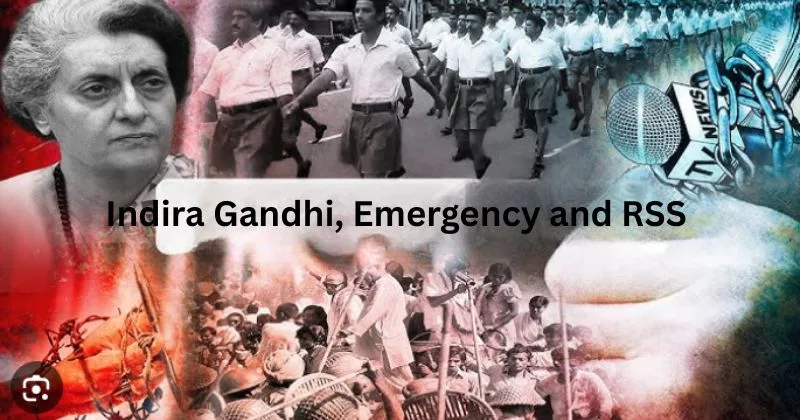
Emergency instituted against constitutional standards; an effort to save the Constitution.
On June 20, 1975, the Congress held a massive rally at which Devkant Barua declared, “Indira Teri Subah Ki Jai, Teri Sham Ki Jai, Tere Kaam Ki Jai, Tere Naam Ki Jai.” During this public meeting, Indira Gandhi stated in her speech that she would not resign as Prime Minister.
On June 25, 1975, in front of a large crowd at Ramlila Maidan, Jayaprakash Narayan stated, “All opposing sides should unite for the sake of the country, otherwise dictatorship will be established here and the people will be unhappy.” “After this, meetings will be held in villages demanding Indiraji’s resignation, and daily satyagraha will be held in front of the President’s residence from June 29,” said Nanaji Deshmukh, secretary of the Lok Sangharsh Samiti. On the same evening, as thousands of people returned from the massive public meeting at Ramlila Maidan, it seemed as if the demand from every corner was that “the Prime Minister resign and follow the tradition of a true republic.” (P.G. Sahasrabuddhe, Manikchandra Bajpai, Emergency Struggle Story (1975–1977), p. 1)
Rashtriya Swayamsevak Sangh and Emergency
On the 15th and 16th of March 1975, the Deendayal Shodh Sansthan in New Delhi hosted a discussion on the subject of Emergency and democracy in the Constitution. During this discussion, former Supreme Court Chief Justice Shri Koka Subbarao stated, “A situation may arise when the President and the Cabinet unite to destroy constitutional democracy.” (Deendayal Sansthan, Revoke Emergency, p. 17) Who could have predicted that such a situation would arise only three months later? (P.G. Sahasrabuddhe, Manikchandra Bajpai, Emergency Struggle Story (1975–1977), p 40)
On July 4, 1975, the Rashtriya Swayamsevak Sangh was banned.
The formation of the Lok Sangharsh Samiti. The committee organised an anti-emergency struggle that included Satyagraha and the imprisonment of over one lakh volunteers.
Sarsanghchalak Balasaheb Deoras was apprehended at Nagpur station on June 30. “In this extraordinary situation, it is the duty of the volunteers not to lose their balance,” he exhorted before his arrest. Continue the work of the Sangh and build the capacity of the general public to perform their national duty by engaging in public relations, awareness, and education as soon as possible, according to the orders of Sarkaryavah Madhavrao Mule and the officer appointed by him.
More than 100,000 of the total 130,000 Satyagrahis who took part in the Satyagraha during the Emergency were from the Rashtriya Swayamsevak Sangh.
More than 25,000 of the 30,000 people imprisoned under Misa were members of the Sangh.
During the Emergency, 100 Rashtriya Swayamsevak Sangh workers were sacrificed, most in captivity and some outside. Shri Pandurang Kshirsagar, the head of the Sangh’s All India Management team, was among them. (Kratiroop Sangh Darshan, p. 492)
The Sangh’s Protest Against the Emergency
All forms of communication, including newspapers and magazines, forums, the postal service, and elected legislatures, were halted. In this situation, the question was who should organise the mass movement. It could only be done by the Rashtriya Swayamsevak Sangh. The Sangh had its network of shakhas throughout the country and could only serve in this capacity. The Sangh has grown from the ground up through direct contact between people. For public relations, it was never reliant on the press or the stage. As a result, while the media’s shutdown had an impact on other parties, it did not affect the Sangh. Its central decisions at the all-India level reach the village through the provincial, departmental, district, and tehsil levels. This Sangh communication system worked flawlessly between the time the Emergency was declared and the end of the Emergency. The homes of the Sangh workers proved to be a significant boon to the underground movement, and as a result, intelligence officers were unable to track down the underground workers. (P486-87, HV Sheshadri, Kratiroop Sangh Darshan)
Before his arrest, Shri Jayaprakash Narayan had entrusted the Lok Sangharsh Samiti movement to Shri Nanaji Deshmukh, a full-time worker of the Rashtriya Swayamsevak Sangh.
When Nanaji Deshmukh was arrested, the leadership was unanimously passed to Shri Sunder Singh Bhandari.
“I am pleased to learn that the volunteers of the Rashtriya Swayamsevak Sangh, as well as any other group of political resistance, Were willing to openly collaborate and support those who opposed emergency and are able to work with enthusiasm and integrity, against the diabolical regime that resorts to blatant repression and lies,” Achyuta Patwardhan wrote. Seeing the volunteers’ bravery and valour in leading the movement in the face of police atrocities and brutality, the Marxist Member of Parliament – Shri AK Gopalan – became emotional as well. “There must be some high ideal giving them indomitable courage for such a heroic act and sacrifice,” he had said. (June 9, 1979, Indian Express)
“The Rashtriya Swayamsevak Sangh is particularly noteworthy among the sections that have done this work with fearless dedication,” MC Subramaniam wrote. They organised Satyagraha. Maintained the entire Indian communication system. Funds for the movement were quietly collected. Arrangements have been made for the free distribution of literature. Helped fellow prisoners from other parties and even those with different ideologies in the prison. In this way, they demonstrated that it is the closest character to Swami Vivekananda’s call for a sannyasi army for social and political work in the country. They are revolutionary traditionalist. (April 1977, Indian Review – Madras)
Emergency and Communist
The CPI saw the Emergency as an opportunity and welcomed it. The leaders of the CPI believed they could turn the Emergency into a communist revolution. The CPI supported Indira Gandhi’s Emergency during the 11th Bathinda Congress. (Coalition Strategies and Indian Communism Tactics, p. 224)
RSS has proven itself time and again in protecting the four pillars of democracy, assisting each one during natural disasters, and developing each one’s personal and national character with a “Nation First” attitude.