The world is witnessing a dangerous surge in extremism that is unsettling nations across continents. Over the past two decades, developments in Central Asia have forced the West to acknowledge the true menace of Islamic terrorism. While India battles the external threat of Pakistan-sponsored jihad, it also suffers an internal haemorrhage—Maoism, rooted in Karl Marx’s dogma and Mao Zedong’s brutal blueprint.
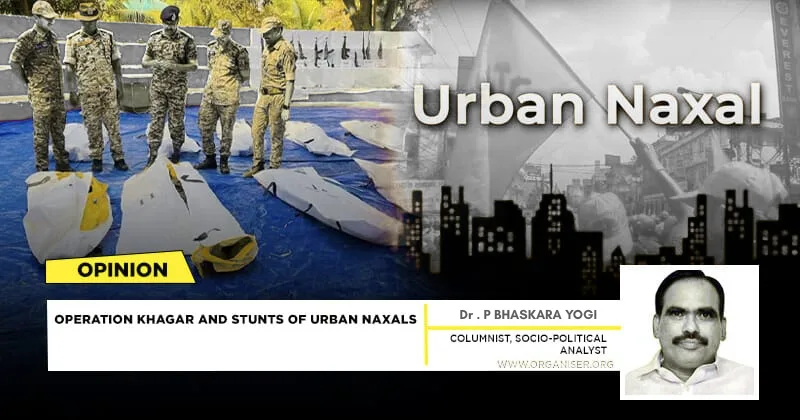
In a major victory for our security forces and democratic institutions, Nambala Keshav Rao—the General Secretary of the CPI (Maoist)—was neutralised in Chhattisgarh. An engineer by education, Keshav Rao chose a path of destruction, spearheading insurgency tactics and IED warfare. The government had placed a bounty of Rs 1.5 crore on him, a reflection of the threat he posed to the nation.
As Dandakaranya’s forests are being reclaimed for development and peace, the so-called “intellectuals,” “poets,” and “artists” who have long cheered from the comfort of urban apartments are losing ground. With slogans like “Another World – Another Path,” they lured tribal youth into jungles and sacrificed generations on the altar of a failed revolution. Indeed, the post-1960 socio-economic distress in India created fertile ground for such insurrections, a weakness that foreign interests eagerly exploited to inject communist radicalism—rebranded as Naxalism and later as Maoism.
These Maoists did not just operate underground; they built a parallel ecosystem in cities, now infamously known as Urban Naxals. These are the people who provide legal cover, media justification, and social legitimacy to insurgents. While democratic forces toiled to uplift the masses through policy and reform, these subversives attempted to infiltrate public institutions, poison academia, and hijack social movements. But Bharat’s civilisational strength and democratic system stood firm.
Thanks to improved standards of living, widespread education, and global integration, the youth are no longer seduced by jungle warfare or utopian delusions. Forests are turning into eco-tourism hubs, not guerrilla battlegrounds. The ideological fire that once lured rebels has been reduced to embers.
Now, Maoists are confined to a few pockets near the Karregutta region bordering Telangana and Chhattisgarh. With the death or surrender of key leaders, their ranks are thinning. Welfare programmes launched by successive governments have offered tangible alternatives, leading many to abandon the path of violence. But the real threat now comes not from the jungles—but from the corridors of academia and activism.
Urban Naxals have repeatedly attempted to derail democratic governance. Be it the abrogation of Article 370, Shaheen Bagh protests, the Waqf Act controversies, or the Bhima Koregaon incident—these groups have left fingerprints everywhere. Intelligence agencies have revealed their links to plots as grave as the assassination attempt on the Prime Minister.
Recognising the scale of the threat, the Centre launched “Operation Kagar” to dismantle Maoist strongholds. Union Home Minister Amit Shah has openly declared a timeline for wiping out Maoist violence. Yet, recent murmurs from Telangana signal an uneasy alliance forming in defence of these extremists.
At a public rally in Warangal on 27 April, BRS leader K. Chandrashekar Rao questioned Operation Kagar, asking, “How can we kill everyone like this?”—a reckless statement from a seasoned politician. His history of oscillating between appeasement and populism regarding Maoists is well known. This flip-flop pattern—where rebels suddenly become patriots once a leader is out of power—is not new. Even in mid 1980’s N.T. Rama Rao and others once flirted with this rhetoric. In the past, KCR lifted bans on dubious organisations masquerading as civil society to appease the same urban Naxals. His recent statements seem aimed at rekindling old sympathies for political gains.
Hyderabad’s rise as a hub for illegal Rohingya settlements and its recurring mention in terror investigations further intensify concerns. Now, parties that once crushed Maoism are signalling support. The Congress Party, which spearheaded anti-Maoist operations under Y.S. Rajasekhara Reddy after peacetalks in 2004, appears to be reversing course. Prominent Maoist sympathisers like Varavara Rao, Rona Wilson, and Sai Baba were jailed during Congress regimes under laws like UAPA. Even then, the Congress understood Maoism as a threat. Why the sudden amnesia?
CM Revanth Reddy’s political overtures raise more questions than answers. His outreach to Jana Reddy and former Congress leader Digvijaya Singh—who once handled Naxal talks—suggests backroom manoeuvring. Media reports suggest the Congress high command is orchestrating this re-alignment, perhaps hoping to weaponise Maoist narratives for electoral gains. Otherwise, what explains such urgency?
Even Gaddar, the revolutionary balladeer turned mascot of Congress events, is now immortalised through awards and ceremonies—despite his deep-rooted links to Maoist propaganda. Meanwhile, Dansari Anasuya alias Seethakka—an MLA representing a Maoist-prone region—has called for Operation Kagar’s suspension after receiving a petition from so-called civil society groups.
In contrast, Chhattisgarh Deputy CM Vijay Sharma recently visited Karregutta and raised a piercing question: “Why are Telangana leaders so eager to hold talks with those spreading terror in our state?” His concern is valid. Why would leaders from one state champion insurgents wreaking havoc in another?
Visuals of jawans marching with the tricolour through the same forests that once harboured Maoists are powerful symbols of democratic reclamation. But they seem lost on those who prefer ideological nostalgia over national interest.
Let us not forget: it was the Maoists who assassinated Congress leader Mahendra Karma. It was Maoists who recently killed a Dalit woman, branding her an informant. Villagers in tribal regions are putting up posters pleading for peace and development. Are these “intellectuals” blind to this grassroots outcry?
Today, with the Congress ruling Telangana and Maoists active along its border, the coordination between Communists, pseudo-secularists, and Urban Naxals looks less coincidental and more strategic. Just like how the Congress once held a candle march with AIMIM after the Pahalgam attack, similar optics seem to be unfolding.
A sovereign nation must stand resolute against enemies—whether foreign or domestic. India has been waging a just war against Maoist terrorism for decades. While misguided individuals have perished in the name of revolution, India’s democratic spine remains unbroken.
It is important to understand that Urban Naxals do not seek reform—they seek to replace the Indian State with a totalitarian vision. Their goal has never been genuine progress, but orchestrated chaos. What they practise is not dissent within a democratic framework, but destruction aimed at dismantling it. And now, quite ironically, these very forces speak of peace talks—conveniently ignoring the fact that for the last three decades, successive governments and civil society have repeatedly appealed to them to renounce violence and embrace mainstream politics. That window has been open for years, and it is they who chose to slam it shut. They had their chance—and lost it permanently. So the real question is this: Why Urban Naxals are in panic on Operation Kagar? And more importantly—who benefits from it?