India’s post-colonial trajectory has been shaped by traumatic partitions, repeated wars with Pakistan (1947, 1965, 1971, and 1999), and a simmering insurgency culture fostered across the borders. Pakistan’s jihadist doctrine — especially post-1979 (Afghan war) — was slowly adapted against India, with Kashmir as the epicenter. Unlike conventional armies, India was now facing an enemy hidden within proxies, terror camps, and non-state actors.
Post-Kargil, India realised it couldn’t afford long mobilizations. Pakistan had found ways to strike through irregular means while hiding behind its nuclear shield. It became clear that a short-window, high-precision response strategy was essential. Thus, the idea of the Cold Start Doctrine was born — designed for swift, limited offensives without crossing the nuclear red line.
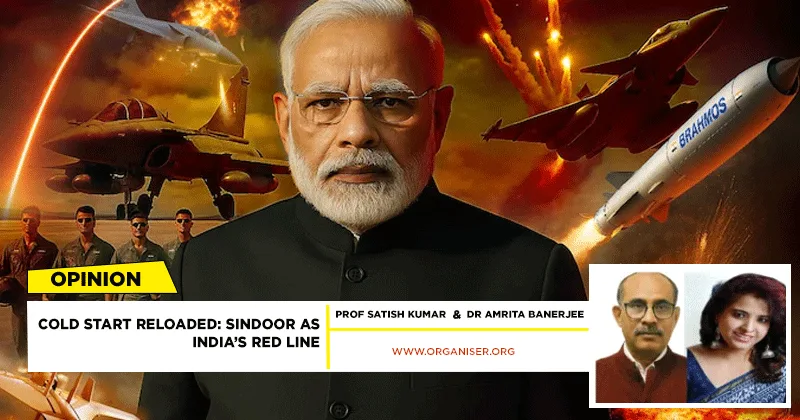
In Sanskrit and Hindu tradition, sindoor is a powerful red mark that symbolizes marital sanctity and commitment. In military parlance, naming a strategic maneuver after it suggests something deeper: an irreversible vow to protect national integrity and sovereign identity. Sindoor: The last red line. If crossed, India would not hesitate.
The timing of Sindoor is crucial. The world is distracted by elections in the West, Ukraine remains embroiled in attrition warfare, and the South China Sea is boiling with power projections. India, meanwhile, has faced an unusual escalation of joint military exercises by China and Pakistan near its vulnerable northeastern corridor. These are not routine drills. Analysts note the precision and location — near the Chumbi Valley and close to the Siliguri Corridor, the 22-kilometer-wide Chicken’s Neck connecting India to its northeast. It is the only link between mainland India and its eight northeastern states. It’s a logistical artery, and any successful strike here would sever national integration. China’s buildup near the Doklam plateau and Pakistan-backed insurgency activity in the region made this area a flashpoint. Intelligence revealed that joint China-Pak mock drills weren’t just rehearsals — they were dry runs for a coordinated two-front deception war.
Sindoor was thus born as an offensive-defensive strategy — to reinforce, deter, and if needed, pre-emptively strike. Rapid troop mobilizations were ordered, ISR (Intelligence, Surveillance, Reconnaissance) missions launched, and psychological operations activated to signal India’s readiness.
In the shadow of these drills, India activated its forward deployment readiness under the Cold Start umbrella. However, instead of announcing anything formally, the Modi administration let one word slip through closed doors: Sindoor. This was not meant for the public. It was meant for those who would listen — adversaries, intelligence communities, and strategic watchers. A leak calculated to seed uncertainty.
The Cold Start Doctrine, long denied officially, is built on the logic of speed and surprise — allowing India to respond swiftly to Pakistani aggression without breaching the nuclear threshold. But Sindoor indicates an evolved version of Cold Start, one that fuses hard military posture with political narrative warfare. It isn’t about just retaliation. It’s about controlling the sequence of escalation. Sindoor as a doctrine tests red lines, creates counter-narratives, and exposes enemy vulnerabilities by forcing them to overcommit their resources in response to feints and whispers.
India’s Panchamrit foreign policy doctrine also ties into Sindoor’s strategic logic. The five pillars — Samman (dignity), Samvad (dialogue), Samriddhi (prosperity), and Suraksha (security), and Sanskriti (culture)— frame a comprehensive world view. Under Sindoor, this doctrine transforms into realpolitik. When adversaries try to exploit India’s soft spots — ethnic identities, border disputes, minority tensions — the government doesn’t just respond with tanks. It responds with cultural confidence, economic resilience, diplomatic precision, and calculated military posture.
The Siliguri Corridor, or Chicken’s Neck, is the geostrategic jugular of India. Lose this, and the northeast is severed. China’s infrastructure buildup in the Chumbi Valley and Pakistan’s renewed emphasis on insurgent corridors in Arunachal Pradesh are not coincidental. Intelligence inputs suggest that “mock drills” by enemy forces near this corridor include real-time logistics testing, including drone-based surveillance, field communication jamming, and multi-division mobility rehearsals.
Sindoor was born in response to this pattern. It is not merely a symbol; it is a response matrix. Under Sindoor, Indian forces conducted counter-maneuvers in Sikkim, ramped up surveillance in Bhutanese buffer zones, and deployed rapid-response units that simulate Cold Start offensives. But crucially, this was done without making headlines.
When PM Modi invoked “Sindoor,” he wasn’t addressing opposition parties or appeasing domestic politics. He was speaking directly to the ecosystem of radical jihadists who thrive on symbolic defiance. By choosing a term like Sindoor — deeply embedded in Indian identity — he flipped their narrative. His message: “Your jihad will be met not just with guns, but with a civilization unwilling to kneel.” This was India’s cultural deterrence fused with strategic doctrine.
Sindoor wasn’t just a symbolic response. It was India’s most mature attempt to integrate military readiness, political narrative, and cultural identity into one unified strategic doctrine. It showed that India is no longer reactive. It has evolved.
But it also revealed the limits of strategic boldness in a system where political will alone cannot override institutional inertia, diplomatic caution, and nuclear calculus. The machinery is in place. The enemy is known. The doctrine is refined. And yet — the moment passed.
Sindoor has not failed as a strategy. It failed as a timed execution. The window was open, but the hand hesitated. And perhaps that’s the lesson for the next flashpoint. India has the doctrine. What it needs is the nerve — not just at the top, but across every node of national power. That is why India is trying to flash its doctrine through proper channels of democracy to the world. If the texts and contexts are still not understood by Pakistan, then , Sindoor remains a red line.