

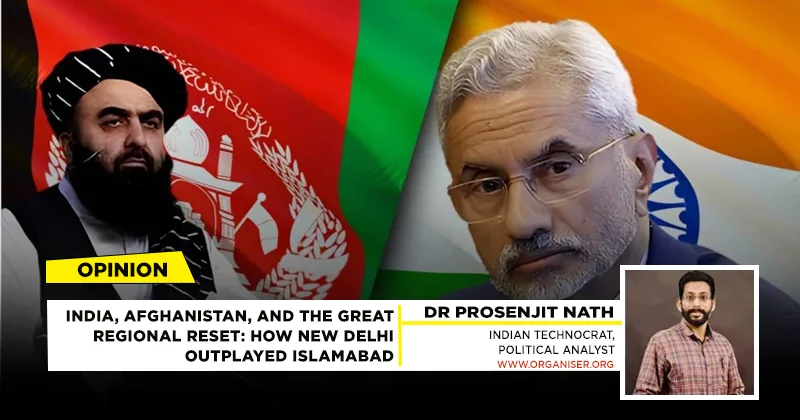
India, Afghanistan, and the Great Regional Reset: How New Delhi outplayed Islamabad
June 9, 2026
  • Read Ecopy
  • Circulation
  • Advertise
  • Careers
  • About Us
  • Contact Us
Android AppiPhone AppArattai
Organiser
  • ‌
  • Bharat
    • Assam
    • Bihar
    • Chhattisgarh
    • Jharkhand
    • Maharashtra
    • View All States
  • World
    • Asia
    • Europe
    • North America
    • South America
    • Africa
    • Australia
  • Editorial
  • International
  • Opinion
  • RSS @ 100
  • More
    • Op Sindoor
    • Analysis
    • Sports
    • Defence
    • Politics
    • Business
    • Economy
    • Culture
    • Special Report
    • Sci & Tech
    • Entertainment
    • G20
    • Azadi Ka Amrit Mahotsav
    • Vocal4Local
    • Web Stories
    • Education
    • Employment
    • Books
    • Interviews
    • Travel
    • Law
    • Health
    • Obituary
  • Subscribe
    • Subscribe Print Edition
    • Subscribe Ecopy
    • Read Ecopy
  • ‌
  • Bharat
    • Assam
    • Bihar
    • Chhattisgarh
    • Jharkhand
    • Maharashtra
    • View All States
  • World
    • Asia
    • Europe
    • North America
    • South America
    • Africa
    • Australia
  • Editorial
  • International
  • Opinion
  • RSS @ 100
  • More
    • Op Sindoor
    • Analysis
    • Sports
    • Defence
    • Politics
    • Business
    • Economy
    • Culture
    • Special Report
    • Sci & Tech
    • Entertainment
    • G20
    • Azadi Ka Amrit Mahotsav
    • Vocal4Local
    • Web Stories
    • Education
    • Employment
    • Books
    • Interviews
    • Travel
    • Law
    • Health
    • Obituary
  • Subscribe
    • Subscribe Print Edition
    • Subscribe Ecopy
    • Read Ecopy
Organiser
  • Home
  • Bharat
  • World
  • Operation Sindoor
  • Editorial
  • Analysis
  • Opinion
  • Culture
  • Defence
  • International Edition
  • RSS @ 100
  • Magazine
  • Read Ecopy
Home Bharat

India, Afghanistan, and the Great Regional Reset: How New Delhi outplayed Islamabad

A single phone call between Jaishankar and Muttaqi has unravelled Pakistan’s strategic illusions and signalled a seismic shift in South Asia’s geopolitical landscape

Dr Prosenjit NathDr Prosenjit Nath
May 21, 2025, 09:00 pm IST
in Bharat, World, South Asia, Opinion, Asia
Follow on Google News
FacebookTwitterWhatsAppTelegramEmail

For most, May 15 was just another unremarkable Thursday. However, within the hallowed halls of South Block, a phone call rang out that may very well reshape the strategic architecture of South Asia. On one end was India’s External Affairs Minister, Dr S Jaishankar. On the other, Afghanistan’s acting Foreign Minister, Amir Khan Muttaqi. What followed was far more than a diplomatic exchange; it was a confirmation of India’s deepening engagement with the Taliban and an unmistakable signal that the geopolitical sands are shifting.

The immediate context of the conversation was Pakistan’s increasingly frantic disinformation campaign. Islamabad had accused New Delhi of staging a fake military operation in Pahalgam with Taliban collusion and launching airstrikes on Afghan territory during “Operation Sindoor.” But in a rare and strategic alignment, the Taliban dismissed these claims outright. India, in turn, praised this move. That a regime as ideologically distant from India as the Taliban would publicly side with New Delhi over Pakistan is no minor development; it marks the end of a decades-old relationship that had, until recently, seen the Taliban as Islamabad’s protégé.

Taliban’s Breakup with Pakistan

To understand the significance of this shift, one must revisit the historical context. Pakistan has long treated Afghanistan as a client state, a strategic backyard to buffer itself against India. It nurtured the Taliban in the 1990s and saw their resurgence in 2021 as a victory for its so-called “strategic depth” policy. However, post-2021, the Taliban seems to have sobered up to the reality that Pakistan is a volatile, unreliable neighbour, one that lacks both internal stability and international credibility.

From expelling Afghan refugees en masse to launching military strikes that allegedly kill civilians, Pakistan has managed to alienate even its former allies. Meanwhile, Pakistan accuses the Taliban of harbouring the Tehreek-e-Taliban Pakistan (TTP), a group responsible for repeated terror strikes inside Pakistani territory. The tensions have escalated to the point of confrontation, including military clashes along the contentious Durand Line.

Read More: ‘Right to free speech fine; where is the duty?’ Supreme Court to Ashoka Professor, while granting interim bail

This collapse in Taliban-Pakistan relations has presented India with a rare strategic opportunity, one it has seized with the precision of a chess grandmaster.

India’s Multi-Front Diplomacy

India has steadily built a reputation for pursuing nuanced and patient diplomacy. Its outreach to the Taliban is not an endorsement of the regime’s ideology but a recognition of geopolitical necessities. The Modi government is clear-eyed about the Taliban’s track record on women’s rights, minority safety, and democratic norms. But India also understands that to protect its investments in Afghanistan, curb terror threats, and prevent China from filling the power vacuum, engagement is essential.

By establishing lines of communication with Kabul, India has flipped Pakistan’s assumptions about its western front being secure. Islamabad now finds itself trapped in a classic two-front dilemma. To the east lies a confident, assertive India. To the west, a disgruntled and less cooperative Taliban regime. Internally, Pakistan is battling separatist movements in Balochistan and Sindh, as well as renewed TTP offensives. Its military and political establishment is spread dangerously thin.

This multi-front pressure is precisely what Islamabad and Beijing envisioned for India through the “String of Pearls” strategy a series of Chinese-funded bases and alliances to encircle India. Ironically, it is India that now appears to be implementing a mirror version of that policy, boxing in Pakistan with deft diplomacy and layered strategic engagements.

Strategic Realism, Not Sentiment

India’s approach reflects a careful calibration of interests over emotions. There is no illusion in New Delhi about who the Taliban are or what they represent. However, in the cold calculus of international relations, morality often takes a back seat to national interest. For India, maintaining a functional working relationship with the Taliban ensures the safety of its development projects, secures humanitarian access, and, most importantly, denies Pakistan its cherished influence in Kabul.

Moreover, this diplomatic line strengthens India’s position vis-à-vis China. Beijing, sensing opportunity, has already sent ambassadors to Kabul and accepted Taliban envoys in return. India cannot afford to lose ground in a region it has long considered vital to its strategic depth and historical ties. Indian officials highlighted the Jaishankar-Muttaqi call precisely because it came just before Muttaqi visited China and Iran, two countries whose stakes in Afghanistan are growing. The message was clear: India remains a player and one that Afghanistan will listen to.

Humanitarian Leverage and Soft Power

While military and strategic elements dominate the headlines, India’s use of soft power in Afghanistan should not be underestimated. New Delhi has consistently provided humanitarian aid, built infrastructure, and supported Afghan civil society even during difficult times. Its current pledge to assist Afghan refugees expelled by Pakistan is not just a moral stance; it is a tactical manoeuvre to win hearts and minds. Humanitarian diplomacy, in this context, becomes a tool of realpolitik.

By doubling down on development aid and social projects, India solidifies its image as a responsible, benevolent power in a region awash with instability. This soft power approach contrasts sharply with Pakistan’s coercive tactics and bolsters India’s credibility as a partner of choice.

A Sticky But Strategic Partnership

India’s ongoing engagement with the Taliban is not without its risks. The ideological chasm remains vast, and the volatility in Afghan internal politics could shift the sands again. Yet, for now, New Delhi has embraced what could only be described as its “Afghan jalebi” moment sticky, complex, and impossible to untangle, but too significant to ignore.

By reorienting its Afghan policy with realism and strategic clarity, India has taken a significant step toward reshaping South Asia’s balance of power. The Taliban may be a problematic partner, but in geopolitics, adversaries can often become instruments of strategic advantage.

For Pakistan, this moment is a diplomatic nightmare. Its worst fear, an Afghanistan that not only resists Pakistani influence but also aligns with India, has arrived. And the message is clear: New Delhi is playing the long game with a steady hand, a sharp mind, and a clear vision of regional supremacy.

What began as a phone call may well go down in history as the beginning of a new strategic chapter in South Asia, one where Pakistan finds itself isolated, India ascendant, and Afghanistan at the centre of a complex but redefining regional pivot.

 

Topics: Pakistan Diplomatic CrisisTaliban India EngagementOperation SindoorIndia Afghanistan RelationsJaishankar Muttaqi Call
Dr Prosenjit Nath
Dr Prosenjit Nath
The writer is a technocrat, political analyst, and author. [Read more]
ShareTweetSendShareSend
✮ Subscribe Organiser YouTube Channel. ✮
✮ Join Organiser's WhatsApp channel for Nationalist views beyond the news. ✮
Previous News

India calls out Pakistan’s obsession with blaming others for internal failures: MEA

Next News

Telangana: KCR served notice over irregularities in Kaleshwaram Irrigation Project, Congress tightens noose

Related News

Saurav Das, Chief Spokesperson of CJP

Exposing CJP’s Saurav Das: Inside his controversial commentary on Article 370, Umar Khalid & nationalism

As Khalistani networks seek new platforms beyond the West, Azerbaijan has emerged as a key venue for conferences, campaigns and narratives aligned with the Pakistan-Turkey axis against India.

Khalistan’s New Grazing Ground: Azerbaijan emerges as new hub for Turkey-Pakistan backed anti-India networks

Bangladesh’s reported JF-17 push has triggered fresh scrutiny after India’s Ops Sindoor exposed the vulnerabilities of Pakistani-Chinese defence systems and precision strike capabilities

Shadows of Operation Sindoor: Questions loom over Bangladesh’s JF-17 ambitions amid Sino-Pakistani tech vulnerabilities

Rajnath Singh releases book on Operation Sindoor; The publication chronicles unparalleled valour of the Indian soldiers

Operation Safed Sagar; a turning point in the history of military aviation

Operation Safed Sagar: How Kargil war shaped India’s precision strike doctrine

1 Year of Operation Sindoor | India’s Strategic Shift: A step in the right direction

Load More

Latest News

Banda Singh Bahadur

Banda Singh Bahadur Martyrdom Day: Betrayal of Guru Gobind Singh Ji by Mughals and the rise of Madho Das

12 years of Modi Govt: Meaningful philosophy or manufactured phenomenon; Bharat’s tryst with democracy

Prime Minister Narendra Modi during an overseas visit, greeting members of the Indian diplomatic and community delegation upon arrival. (File Photo)

Trade, Defence and Diaspora: PM Modi eyes Indo-Pacific reset with three-nation tour

Accused Nida Khan reportedly admits taking victim for religious instruction, teaching Islamic rituals

Nashik TCS Corporate Jihad: ‘I taught her how to do namaz,’ says Nida Khan; victim pressured to observe 30 ramzan roza

Germany: Sri Ganesha temple opens in Berlin: Europe’s largest Hindu Mandir reflects India’s cultural & dharmic spirit

Rajasthn | RSS centenary journey embodies dedication to nation-building: Dr Ramesh Agrawal

Decades of illegal infiltration from Bangladesh have driven profound demographic shifts in Assam, fundamentally altering its religious, linguistic, and political landscape

Unnatural demographic change: The termite threat

The Rs 200-crore MAHA Water Mission seeks to boost water security and democratise research funding in India

From Rigveda to Research Labs: How ANRF’s Rs 200 crore water mission is securing India’s future

(Right) Prakhar Shrivastava, Senior Consulting Editor and Anchor at Delhi Doordarshan Kendra at a Narada Jayanti programme in Guwahati (Left) Prakahar Srivastava addressing the gathering

Narada Jayanti by VSK Assam: “Half-truths more dangerous than lies,” says senior journalist Prakhar Shrivastava

Everest Survivor being taken to the hospital on a stretcher

Everest Survivor ICU Interview: BBC under fire for interviewing Sherpa without family’s consent

Load More
  • Privacy
  • Terms
  • Cookie Policy
  • Refund and Cancellation
  • Delivery and Shipping

© Bharat Prakashan (Delhi) Limited.
Tech-enabled by Ananthapuri Technologies

  • Home
  • Search Organiser
  • Bharat
    • Assam
    • Bihar
    • Chhattisgarh
    • Jharkhand
    • Maharashtra
    • View All States
  • World
    • Asia
    • Africa
    • North America
    • South America
    • Europe
    • Australia
  • Editorial
  • Operation Sindoor
  • Opinion
  • Analysis
  • Defence
  • Culture
  • Sports
  • Business
  • RSS @ 100
  • Entertainment
  • More ..
    • Sci & Tech
    • Vocal4Local
    • Special Report
    • Education
    • Employment
    • Books
    • Interviews
    • Travel
    • Health
    • Politics
    • Law
    • Economy
    • Obituary
  • Subscribe Magazine
  • Read Ecopy
  • Advertise
  • Circulation
  • Careers
  • About Us
  • Contact Us
  • Policies & Terms
    • Privacy Policy
    • Cookie Policy
    • Refund and Cancellation
    • Terms of Use

© Bharat Prakashan (Delhi) Limited.
Tech-enabled by Ananthapuri Technologies