
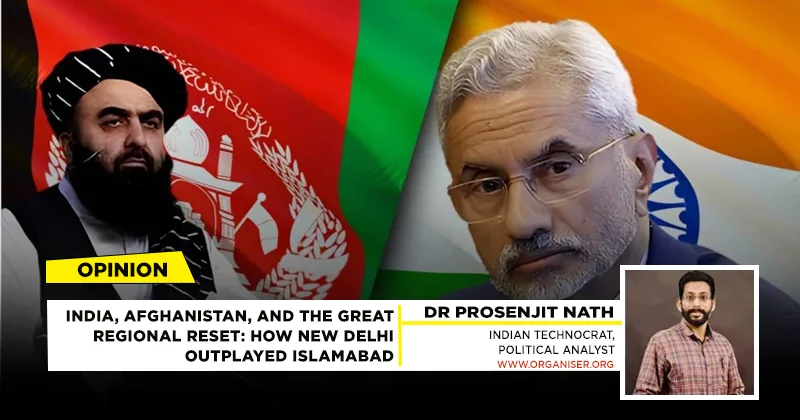
For most, May 15 was just another unremarkable Thursday. However, within the hallowed halls of South Block, a phone call rang out that may very well reshape the strategic architecture of South Asia. On one end was India’s External Affairs Minister, Dr S Jaishankar. On the other, Afghanistan’s acting Foreign Minister, Amir Khan Muttaqi. What followed was far more than a diplomatic exchange; it was a confirmation of India’s deepening engagement with the Taliban and an unmistakable signal that the geopolitical sands are shifting.
The immediate context of the conversation was Pakistan’s increasingly frantic disinformation campaign. Islamabad had accused New Delhi of staging a fake military operation in Pahalgam with Taliban collusion and launching airstrikes on Afghan territory during “Operation Sindoor.” But in a rare and strategic alignment, the Taliban dismissed these claims outright. India, in turn, praised this move. That a regime as ideologically distant from India as the Taliban would publicly side with New Delhi over Pakistan is no minor development; it marks the end of a decades-old relationship that had, until recently, seen the Taliban as Islamabad’s protégé.
Taliban’s Breakup with Pakistan
To understand the significance of this shift, one must revisit the historical context. Pakistan has long treated Afghanistan as a client state, a strategic backyard to buffer itself against India. It nurtured the Taliban in the 1990s and saw their resurgence in 2021 as a victory for its so-called “strategic depth” policy. However, post-2021, the Taliban seems to have sobered up to the reality that Pakistan is a volatile, unreliable neighbour, one that lacks both internal stability and international credibility.
From expelling Afghan refugees en masse to launching military strikes that allegedly kill civilians, Pakistan has managed to alienate even its former allies. Meanwhile, Pakistan accuses the Taliban of harbouring the Tehreek-e-Taliban Pakistan (TTP), a group responsible for repeated terror strikes inside Pakistani territory. The tensions have escalated to the point of confrontation, including military clashes along the contentious Durand Line.
This collapse in Taliban-Pakistan relations has presented India with a rare strategic opportunity, one it has seized with the precision of a chess grandmaster.
India’s Multi-Front Diplomacy
India has steadily built a reputation for pursuing nuanced and patient diplomacy. Its outreach to the Taliban is not an endorsement of the regime’s ideology but a recognition of geopolitical necessities. The Modi government is clear-eyed about the Taliban’s track record on women’s rights, minority safety, and democratic norms. But India also understands that to protect its investments in Afghanistan, curb terror threats, and prevent China from filling the power vacuum, engagement is essential.
By establishing lines of communication with Kabul, India has flipped Pakistan’s assumptions about its western front being secure. Islamabad now finds itself trapped in a classic two-front dilemma. To the east lies a confident, assertive India. To the west, a disgruntled and less cooperative Taliban regime. Internally, Pakistan is battling separatist movements in Balochistan and Sindh, as well as renewed TTP offensives. Its military and political establishment is spread dangerously thin.
This multi-front pressure is precisely what Islamabad and Beijing envisioned for India through the “String of Pearls” strategy a series of Chinese-funded bases and alliances to encircle India. Ironically, it is India that now appears to be implementing a mirror version of that policy, boxing in Pakistan with deft diplomacy and layered strategic engagements.
Strategic Realism, Not Sentiment
India’s approach reflects a careful calibration of interests over emotions. There is no illusion in New Delhi about who the Taliban are or what they represent. However, in the cold calculus of international relations, morality often takes a back seat to national interest. For India, maintaining a functional working relationship with the Taliban ensures the safety of its development projects, secures humanitarian access, and, most importantly, denies Pakistan its cherished influence in Kabul.
Moreover, this diplomatic line strengthens India’s position vis-à-vis China. Beijing, sensing opportunity, has already sent ambassadors to Kabul and accepted Taliban envoys in return. India cannot afford to lose ground in a region it has long considered vital to its strategic depth and historical ties. Indian officials highlighted the Jaishankar-Muttaqi call precisely because it came just before Muttaqi visited China and Iran, two countries whose stakes in Afghanistan are growing. The message was clear: India remains a player and one that Afghanistan will listen to.
Humanitarian Leverage and Soft Power
While military and strategic elements dominate the headlines, India’s use of soft power in Afghanistan should not be underestimated. New Delhi has consistently provided humanitarian aid, built infrastructure, and supported Afghan civil society even during difficult times. Its current pledge to assist Afghan refugees expelled by Pakistan is not just a moral stance; it is a tactical manoeuvre to win hearts and minds. Humanitarian diplomacy, in this context, becomes a tool of realpolitik.
By doubling down on development aid and social projects, India solidifies its image as a responsible, benevolent power in a region awash with instability. This soft power approach contrasts sharply with Pakistan’s coercive tactics and bolsters India’s credibility as a partner of choice.
A Sticky But Strategic Partnership
India’s ongoing engagement with the Taliban is not without its risks. The ideological chasm remains vast, and the volatility in Afghan internal politics could shift the sands again. Yet, for now, New Delhi has embraced what could only be described as its “Afghan jalebi” moment sticky, complex, and impossible to untangle, but too significant to ignore.
By reorienting its Afghan policy with realism and strategic clarity, India has taken a significant step toward reshaping South Asia’s balance of power. The Taliban may be a problematic partner, but in geopolitics, adversaries can often become instruments of strategic advantage.
For Pakistan, this moment is a diplomatic nightmare. Its worst fear, an Afghanistan that not only resists Pakistani influence but also aligns with India, has arrived. And the message is clear: New Delhi is playing the long game with a steady hand, a sharp mind, and a clear vision of regional supremacy.
What began as a phone call may well go down in history as the beginning of a new strategic chapter in South Asia, one where Pakistan finds itself isolated, India ascendant, and Afghanistan at the centre of a complex but redefining regional pivot.