Media Bias and the Pahalgam Attack: A tale of selective outrage
September 14, 2026
  • Read Ecopy
  • Circulation
  • Advertise
  • Careers
  • About Us
  • Contact Us
Android AppiPhone AppArattai
Organiser
  • ‌
  • Bharat
    • Assam
    • Bihar
    • Chhattisgarh
    • Jharkhand
    • Maharashtra
    • View All States
  • World
    • Asia
    • Europe
    • North America
    • South America
    • Africa
    • Australia
  • Editorial
  • International
  • Opinion
  • RSS @ 100
  • More
    • World Hindu Congress 2026
    • Op Sindoor
    • Analysis
    • Sports
    • Defence
    • Politics
    • Business
    • Economy
    • Culture
    • Special Report
    • Sci & Tech
    • Entertainment
    • G20
    • Azadi Ka Amrit Mahotsav
    • Vocal4Local
    • Web Stories
    • Education
    • Employment
    • Books
    • Interviews
    • Travel
    • Law
    • Health
    • Obituary
  • Subscribe
    • Subscribe Print Edition
    • Subscribe Ecopy
    • Read Ecopy
  • ‌
  • Bharat
    • Assam
    • Bihar
    • Chhattisgarh
    • Jharkhand
    • Maharashtra
    • View All States
  • World
    • Asia
    • Europe
    • North America
    • South America
    • Africa
    • Australia
  • Editorial
  • International
  • Opinion
  • RSS @ 100
  • More
    • World Hindu Congress 2026
    • Op Sindoor
    • Analysis
    • Sports
    • Defence
    • Politics
    • Business
    • Economy
    • Culture
    • Special Report
    • Sci & Tech
    • Entertainment
    • G20
    • Azadi Ka Amrit Mahotsav
    • Vocal4Local
    • Web Stories
    • Education
    • Employment
    • Books
    • Interviews
    • Travel
    • Law
    • Health
    • Obituary
  • Subscribe
    • Subscribe Print Edition
    • Subscribe Ecopy
    • Read Ecopy
Organiser
  • Home
  • Bharat
  • World
  • Operation Sindoor
  • Editorial
  • Analysis
  • Opinion
  • Culture
  • Defence
  • International Edition
  • RSS @ 100
  • Magazine
  • Read Ecopy
Home Bharat

Media Bias and the Pahalgam Attack: A tale of selective outrage

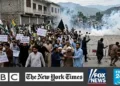
On April 22, 2025, a brutal terrorist attack in Pahalgam, Kashmir, claimed the lives of at least 26 Hindu tourists, highlighting a disturbing disparity in how such tragedies are reported by both national and international media

Shuvabrata GaraiShuvabrata Garai
May 21, 2025, 07:30 pm IST
inBharat, World, Opinion
Follow on Google News
Facebook
Twitter
WhatsAppTelegramEmail

On April 22, 2025, the serene valley of Pahalgam in Kashmir was shattered by the sound of gunfire. Four armed terrorists opened fire on a group of tourists and selectively identified and killed Hindu tourists that were men, leaving at least 26 dead and dozens more injured. What should have been a moment of national mourning and international outrage shed light on a grave problem: the selective coverage and silence from key sections of the media, both at the national and international levels.

Despite the gravity of the attack, much of the global media showed apathy and an ideological slant, covering the story with little urgency and an anti-reality, anti-humanitarian bias. The difference in how this was reported compared to similar attacks in Western countries was glaring writing on the wall and it was impossible to ignore.

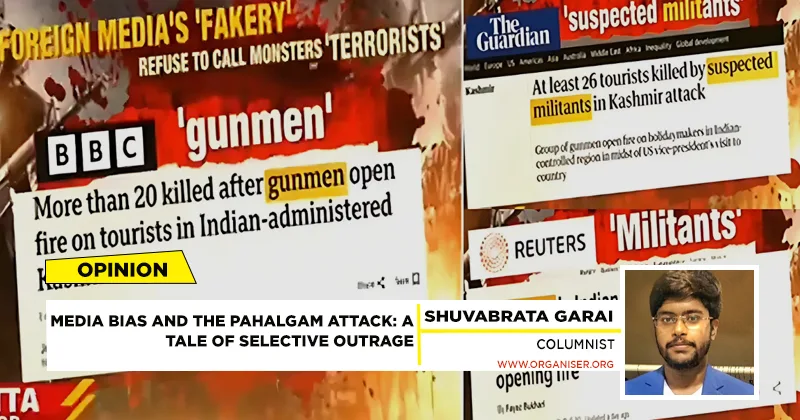
A striking example of such a response came from The New York Times (NYT). In its coverage titled “India Takes Aim at Pakistan After Slaughter of Civilians in Kashmir,” rather than clearly calling the attackers “terrorists,” the publication chose slanted terms like “militants” and “gunmen.”. This lessened the acute and grave violence of terrorism into something more palatable- a deeply regrettable choice of wording.

Read More: “Cops inactive, TMC leaders involved”: Major findings of High Court-appointed panel on Murshidabad Violence

Similarly, the BBC’s coverage did little to centre the grief of the victims. One headline read, “Pakistan suspends visas for Indians after deadly Kashmir attack on tourists,” removing all context and giving the impression that Pakistan was acting in justified response. This also shifted the focus from the human tragedy to geopolitical fallout. This sparked criticism from various quarters, including a diplomatic protest from the Indian government accusing the BBC of whitewashing terror.

The Indian government has long pointed out these outlets for their non-neutral and misleading writing. The misplaced emphasis, mitigating the crime and using slanted words dilutes the motives behind such heinous acts and contributes to a global narrative that often downplays violence in South Asia unless it fits a particular lens.

Indian media, however, was expected to rise above such neglect, and yet they also stumble. Many right-leaning channels focused heavily on the attackers’ identity, sometimes veering into communal narratives. On the other hand, several left-leaning platforms were equally egregious, offering limited attention to the victims and instead shifting the spotlight to political context or state failures.

Take The Wire, for example. Its article in the aftermath of the attack was more concerned with critiquing the government’s security lapses and recounting historical grievances than accurately identifying the real perpetrator of the crime- Pakistan and its state sponsored proxies of terrorism.

The Frontline headline “Is anger our mourning now?” takes an intellectual approach to public reactions to the Pahalgam attack. It questions whether anger has replaced mourning, suggesting that grief is being overshadowed by commodified outrage. While this perspective is thought-provoking, it risks distancing the public from the actual pain of the victims. In this case, the focus should be on the immediate human tragedy, rather than getting lost in abstract reflections. The victims’ suffering demands clear attention, not intellectual debates about the expression of grief.

By focusing more on politics than on people, Frontline’s coverage came across as cold and distant, leaving some to wonder: Where was the outrage for the innocent lives taken?

When attacks occur in Paris, London, or New York, they rightly draw widespread condemnation and blanket media coverage. Victims are named, mourned, and remembered. Hashtag trends, vigils are held, and world leaders react with urgency. Why, then, does a mass killing terror attack in Pahalgam specifically targeted Hindus by identity, not evoke the same level of national and international moral clarity and forceful response?

The uncomfortable truth is that selective outrage shows that some tragedies are seen as more important than others. In this hierarchy, some lives are mourned, while others are overlooked.

The global media, especially, has struggled to treat Hindu victims of terrorism with the same empathy and clarity it gives to victims in other parts of the world. The media is not just a recorder of events; it shapes and reflects public opinion. When it opts for silence, vague language, or political bias instead of honest reporting, it neglects its most important responsibility.

The Pahalgam attack should have been covered for what it was: a terrorist strike targeting innocent civilians with a religious intent aimed to strike fear and paralysis into Indian society. And yet, between muted headlines, ideological filters, and deflections, the story of 26 lost lives risks being forgotten. As citizens, readers, and storytellers, we owe it to the victims to demand better from our media, our institutions, and ourselves.

Topics: BBCGlobal MediaPahalgam Terrorist attack
Share
Tweet
SendShareSend
✮ Subscribe Organiser YouTube Channel. ✮
✮ Join Organiser's WhatsApp channel for Nationalist views beyond the news. ✮
Previous News

Swadeshi Strength: Securing India’s future through self-reliance

Next News

Operation Sindoor: India’s iron resolve crushes terror infrastructure

Related News

PoJK bloodshed raises questions over Western media's selective coverage; India seeks global scrutiny

PoJK bloodshed exposes questions over Western media’s selective coverage of human rights crisis

(Left) Sanket Upadhyay (Right) Veteran BBC journalist Rehan Fazal

Veteran Journalist Rehan Fazal claims BBC India blocked RSS coverage, raising questions over editorial neutrality

Everest Survivor being taken to the hospital on a stretcher

Everest Survivor ICU Interview: BBC under fire for interviewing Sherpa without family’s consent

One Year of Operation Sindoor: The military campaign that reshaped India’s security outlook

Flags of India and Singapore

India and Singapore condemn Pahalgam attack, Red Fort blast; Reaffirm zero tolerance against terrorism at JWG meet

Hidayat Bhutto, UK and Europe Organiser of the World Sindhi Congress, issued a strongly worded statement condemning the violence and criticising Pakistan's alleged role in fostering cross-border terrorism

Pahalgam Terrorist Attack Anniversary: UK-based Sindhi leader blames Pakistan for fostering cross-border terror

Load More

Latest News

RSS Akhil Bharatiya Sah-Bauddhik Shikshan Pramukh Deepak Vispute addressing the gathering

‘Nation First’ should be the guiding principle for every individual, regardless of their Field: Deepak Vispute

‘India was not poor; it was made poor’: The truth re-emerges through Jema Ferrer’s perspective

Six years after talent manager Disha Salian was found dead, her father Satish Salian on September 11 recorded a detailed statement with the Central Bureau of Investigation (CBI), naming Shiv Sena (UBT) leader Aaditya Thackeray, actors Dino Morea and Sooraj Pancholi, and others.

Disha Salian Murder Case: Father names Aaditya Thackeray in CBI statement; Lawyer claims gang rape, murder cover-up

Release of a book at Vishwa Bandhutva Diwas programme that was organised in Ujjain

Bharat’s youth rooted in sacrifice, service & discipline can give new direction to World: Parag Abhyankar

AI Generated Representative Image

“Let Go” — But only when it suits you? Exposing the double standards of Kashmir’s political leadership

Bharatiya Kisan Sangh distributed free school uniforms, notebooks, pen bundles, bags to 7,000 students in flood-affected areas of Assam

Assam: Bharatiya Kisan Sangh distributes free school uniforms, notebooks & bags to 7,000 flood-affected students

Chinmoy Prabhu

When a Bengali Hindu suffers in Bangladesh, where does ‘Bangali-Prem’ go?

AI Generated Representative Image

BRICS Summit: Not de-dollarisation, but derisking from dollar; India scripts pragmatic shield against external shocks

RSS Sarsanghchalak Dr Mohan Bhagwat, attended the 37th annual prize distribution ceremony ‘Swaraj’ at L.K. Singhania Education Centre

Education must go beyond livelihood and focus on holistic human development: Dr Mohan Bhagwat

(Left) Prime Minister Narendra Modi and Russian President Vladimir Putin (Right) Prime Minister Narendra Modi and Chinese President Xi Jinping in the backdrop of the Rameshwaram temple corridor in the backdrop of the BRICS 2026 summit

Bharat’s civilisational pride at BRICS 2026: Rameswaram temple corridor frames world leaders

Load More
  • Privacy
  • Terms
  • Cookie Policy
  • Refund and Cancellation
  • Delivery and Shipping

© Bharat Prakashan (Delhi) Limited.
Tech-enabled by Ananthapuri Technologies

  • Home
  • Search Organiser
  • Bharat
    • Assam
    • Bihar
    • Chhattisgarh
    • Jharkhand
    • Maharashtra
    • View All States
  • World
    • Asia
    • Africa
    • North America
    • South America
    • Europe
    • Australia
  • Editorial
  • Operation Sindoor
  • Opinion
  • Analysis
  • Defence
  • Culture
  • Sports
  • Business
  • RSS @ 100
  • Entertainment
  • More ..
    • Sci & Tech
    • Vocal4Local
    • Special Report
    • Education
    • Employment
    • Books
    • Interviews
    • Travel
    • Health
    • Politics
    • Law
    • Economy
    • Obituary
  • Subscribe Magazine
  • Read Ecopy
  • Advertise
  • Circulation
  • Careers
  • About Us
  • Contact Us
  • Policies & Terms
    • Privacy Policy
    • Cookie Policy
    • Refund and Cancellation
    • Terms of Use

© Bharat Prakashan (Delhi) Limited.
Tech-enabled by Ananthapuri Technologies