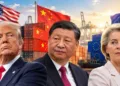

On April 2, 2025, the newly elected President of the United States, Donald Trump announced imposition of high tariffs on goods coming from different countries, which he calls reciprocal tariffs. Since different countries impose different tariffs on goods coming from the US, President Trump announced imposition of different tariffs on different countries. In this context, President Trump had earlier announced a 26 percent tariff on Bharat, which means that goods exported from Bharat to the US will face a 26 per cent tariff. It is important that Trump has imposed reciprocal tariff of 54 per cent, Vietnam 46 percent, Sri Lanka 44 per cent, Thailand 36 per cent, Taiwan 32 per cent, South Africa 30 per cent and Japan 24 per cent. According to the office of United States Trade Representative (USTR), a formula has been used for deciding this reciprocal tariff. Further, US administration has threatened to raise these tariffs, if other countries retaliate and raise their tariffs on imports from US. In this context, after China’s retaliation, and decision to raise tariffs on imports from US, Trump administration has decided to impose tariff of 104 per cent on imports from China. Though, in less than a week, on February 9, itself President Trump retracted, and paused the reciprocal tariff for 90 days, and said that only 10 per cent tariff would be effected on 75 countries for 90 days. Due to the fact that China has retaliated, Trump imposed a reciprocal tariff of 104 percent at first instance and then at 125 per cent.
Reciprocal Tariffs are Against WTO Rules
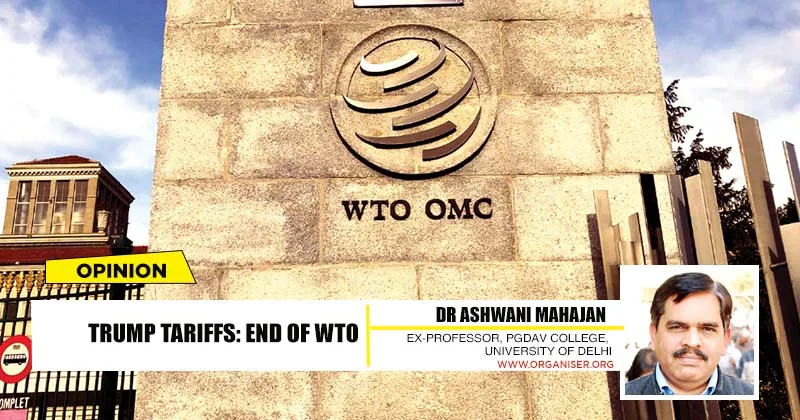
The unilateral announcement of tariffs by the US administration is in complete violation of WTO rules. It is also true that the US has violated WTO rules earlier too. But this time the scale of violation is much bigger, as Trump has imposed high reciprocal tariffs on one and all. It has to be understood that till now various countries have been imposing import duties based on their commitments in the WTO. With the birth of WTO, the import duties that could be imposed by every country, known as ‘Bound Tariffs’, were determined by way of agreement. In this case, the Bound Tariff that can be imposed by Bharat is on an average 50.8 per cent.
Reason For High Bound Tariffs
When President Trump complains about his trade partners, that they impose high duties on goods coming from the US, whereas it imposes much less duty on goods coming from these countries, it’s not a legitimate complaint. It has to be understood that those countries impose import duty within the limits of their Bound Tariff as per WTO rules, which are in accordance with the agreements made earlier. Here it is important to understand that why did America accept the imposition of high import duty by other countries in the earlier General Agreement on Tariffs andTrade (GATT) agreements?
Before the birth of WTO, various countries used to impose quantitative restrictions (QRs) in addition to very high import duties to protect their industries in their respective countries. Along with this, various countries used to impose multiple types of restrictions on the entry of foreign capital to protect their industries. The US and other developed countries wanted Bharat and other developing countries to reduce their import duties and stop imposing QRs, so that their goods can be exported to these destinations, unhindered. Along with this, they also wanted that developing countries should change their intellectual property laws, allow the capital of developed countries to enter their countries, agree to agreement on agriculture, and allow services to be a part of GATT agreements. These conditions were not acceptable to developing countries. In such a situation, developed countries allowed developing countries to impose higher import duties so that developing countries would agree to their conditions. That is, developing countries had to give a lot of benefits to developed countries, in lieu of the permission to charge higher tariffs on goods imported from the rest of the world. That is, permission to impose higher import duties by developing countries was not given by developed countries as a matter charity, but as a bargain. In such a situation, if the US administration now says that Bharat is imposing higher duties than USA then there is no justification in the same.
The WTO system greatly benefited the US and other developed countries, as it paved the way for a strong patent and other IPRs (Intellectual Property Rights) regime, which benefited their pharmaceutical and other companies, by way of royalties for their IPR, opened the doors of developing countries for investment by multinational companies of developed countries; and opened markets for US agricultural products in developing countries including Bharat.
Trump is Now Denying the Existence of WTO
We can say that imposition of unilateral tariffs by the US is against both the rules and the spirit of the WTO. It must be understood that although the WTO’s predecessor ‘GATT’ i.e. General Agreement on Tariffs and Trade, operated on the principle of free trade, ‘GATT’ had no authority to stop various countries from imposing high import duties or quantitative restrictions. But the World Trade Organisation i.e. WTO has been a powerful organisation and the agreements made in it are legally binding. In such a situation, the announcement of unilateral tariffs by the US implies complete disregard of WTO rules.
Bharat: A Victim of WTO
Due to the WTO and its so-called rule-based international trade system, Bharat has been a victim of unfair trade practices such as dumping by China and unfair subsidies by the Chinese Government; and the obligation to grant Most Favoured Nation (MFN) status even to a non-market economy like China; unfair competition from subsidised agricultural products from developed countries like the US, heavy royalty expenditure by developing countries including Bharat, are just a few examples of how developing countries, including Bharat have been suffering under the WTO.
Since the adoption of free trade policies has led to a decline in manufacturing in Bharat and other countries, leading to loss of jobs, and increased dependence on foreign countries, there is an urgent need to bring appropriate changes in the policy. In the last five years, Bharat has decided to promote manufacturing of all those goods in the country, in which it was dependent on other countries including China, through the policy of Aatamanirbhar Bharat. This policy has also started giving dividend. The biggest obstacle to the success of this policy is that our import duties are very low even now. If the Aatamanirbhar Bharat policy is to succeed, imports from China will have to be curbed. Even today, there is no dearth of people who say that even if USA increases the import duty, Bharat should reduce its import duties further. This advice can’t be called economically prudent. We need to understand that the biggest advocates of free trade in the past, say USA, are now turning protectionists in the interest of their respective countries. Therefore, after USA’s reciprocal tariffs, free trade policies will no longer be relevant. Today, when the existence of the World Trade Organisation, the biggest instrument of free trade, itself is under threat, there is no justification for advocating free trade. Though, looking at mutual interest, Bharat can have trade deals with other countries, including the US, but in Trump’s era there can’t be any dogmatic approach to free trade, if others are becoming protectionist. Bharat will have to take advantage of this opportunity and prepare its industries for global competition in a protective environment.
Imperative for Bilateral Agreements
Under the new scenario, Bharat should enhance its foreign trade with bilateral trade agreements, rather than multilateral trade agreements. However, while entering into bilateral trade agreements with the US and other countries, national interests should be protected, especially our farmers and small entrepreneurs. We have observed that in the last 10 years, Government has been protecting the interests of farmers and their livelihood, while negotiating trade agreements, whether it was exclusion of agriculture from Free Trade Agreement (FTA) with Australia, or withdrawal from Regional Comprehensive Economic Partnership (RCEP), due to concerns of its adverse impact on dairy and agriculture. This policy needs to continue, so far as agriculture and small industry is concerned, especially where livelihood of farmers and workers is involved.